
A Hung Jury or a Final Verdict? Inside the Legal Battle Over Aaron Fisher’s Murder Charge
While Aaron C. Fisher was sentenced earlier today to 90 months in prison for the manslaughter of 70-year-old Richard Madeo, the most consequential battle in the courtroom wasn’t about the length of his sentence—it was about a scribbled word on a jury verdict form, and a judge with a history of getting reversed on jury instructions.
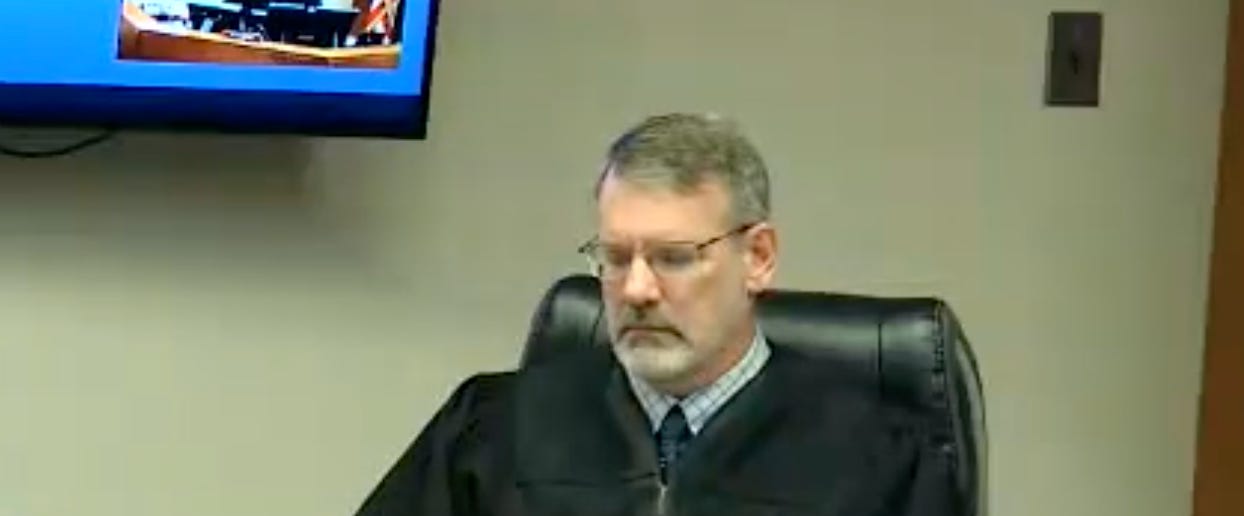
During Fisher’s sentencing hearing on Tuesday, March 31, 2026, Clallam County Superior Court Judge Brent Basden formally denied the State’s motion for a mistrial on Count 1 (Murder in the Second Degree).
The denial effectively blocked the prosecution’s attempt to dismiss the murder charge without prejudice, a move that would have left the door open to retry Fisher for the more serious offense.
The Crossed-Out Verdict
The dispute stems from highly unusual markings left by the jury following Fisher’s trial in February.
According to a Memorandum Opinion authored by Judge Basden, the jury was instructed on how to properly fill out Verdict Form A, which corresponded to the second-degree murder charge. They were told to write “not guilty” or “guilty”—and specifically instructed to simply leave the form blank if they could not agree on a verdict.
Instead, the jury wrote the words “Not Guilty” on the blank line, then crossed those words out and had the presiding juror initial the strike-through. Slightly off to the side, the jury explicitly wrote the word “hung.”
Chief Criminal Deputy Prosecuting Attorney Michele Devlin discovered the irregularity while preparing the final Judgment and Sentence paperwork. Noting that the jury explicitly wrote they were “hung,” Devlin filed a motion for a mistrial as to Count 1.
The State argued that by writing the word “hung,” the jury triggered a legal obligation for the court to engage in a formal colloquy with them to clarify their stance before discharging them.
Judge Basden’s Rationale for Denial
Judge Basden firmly rejected the State’s arguments, laying out a multi-point defense of his decision to accept the scribbled form as a finalized outcome and essentially letting Fisher off the hook for the murder charge.
In his written opinion, Basden stated that the jury was not legally required to agree on Count 1, and that “inherently” they were communicating their failure to reach a consensus. He argued that writing the word “hung” was functionally identical to leaving the form blank.
Furthermore, Basden argued that sending the jury back for further instruction after they had already communicated their status would have been a “perilous path.” Citing court rule CrR 6.15, he noted that judges cannot instruct a deliberating jury in a way that suggests a “need for agreement.”
Because the court had not received a formal question from the jury asking what to do in the event of a deadlock, Basden concluded that sending them back “would have required them to consider further a decision that they had reached and communicated to the court,” risking “inappropriate influence.”
He also emphasized that he had polled the jurors individually in the courtroom, and everyone affirmed the outcomes were their collective verdicts.
A Track Record of Costly Procedural Errors
Judge Basden’s reluctance to instruct the jury—citing the “perilous path” of intervening—is particularly striking given his documented history of mismanaging jury instructions, a track record that has already cost Clallam County taxpayers dearly.
As we reported in January, Basden’s rulings are frequently overturned by the Washington State Court of Appeals.
Notably, in the case of State v. McGee, Basden committed a “glaring procedural oversight” regarding jury instructions.
In that case, Basden seated an alternate juror after deliberations had already begun, but entirely failed to explicitly instruct the newly reconstituted jury to restart their deliberations from the beginning.
That failure to properly instruct the jury resulted in a mistrial, forcing the Court of Appeals to overturn the conviction.
Now, in the Fisher case, Basden’s handling of jury procedures is once again the focal point of a major legal dispute. While Basden argued that further instructing the Fisher jury might inappropriately influence them, the State contends his failure to conduct a proper colloquy denied them a lawful mistrial on the Murder 2 charge.
The Final Sentence
With the mistrial debate settled for the moment at the trial court level, Judge Basden moved forward with sentencing Fisher solely on the lesser charge of Manslaughter in the First Degree. He imposed a sentence of 90 months in prison, along with 36 months of community custody.
Fisher’s defense attorney—Lane Wolfley, who was controversially appointed to the case at public expense by his longtime friend, Judge Basden—had argued for a lower sentence of 78 months, but the State successfully secured the 90-month term.
As for the Murder 2 charge and the “hung” verdict form, the State is expected to appeal the court’s decision, setting the stage for higher courts to once again review Judge Basden’s grasp of courtroom procedure.
The joke of justice in the Clown County courts is pathetic...who in their right mind would bother to show up and waste their time with a jury summons.
Wonder how much pepper paid.