
Amended Lawsuit Alleges LDS Church Orchestrated Interstate Child Sex Abuse Cover-Up

Last month, we reported on a lawsuit against The Church of Jesus Christ of Latter-Day Saints, for allegedly covering up severe sexual abuse of a child in Ridgefield, Washington and Albany, Oregon.
Newly filed court documents claim that the Church’s alleged failure to protect the plaintiff, identified as “Julie Doe,” was not a localized oversight, but a coordinated silence that crossed state lines and reached the highest levels of Church administration in Salt Lake City.
On March 13, 2026, attorneys for the plaintiff filed a Motion for Leave to File First Amended Complaint, citing explosive new evidence uncovered during recent discovery.
According to the motion, internal church records—produced to the plaintiff on December 23, 2025, and January 30, 2026—indicate that multiple LDS Church agents, including headquarters personnel and an Oregon bishop, received actual notice that the teenager was living alone with her abuser. Despite strict mandatory reporting laws in Oregon, none of these church officials contacted civil authorities.
The Initial Report and Relocation to Oregon
The original complaint alleged that Jennifer Ford, the adoptive mother of the victim, discovered evidence of the abuse in the spring of 2016 and brought it to Ridgefield LDS Stake President Wade Pickett, who failed to report the abuse to authorities.
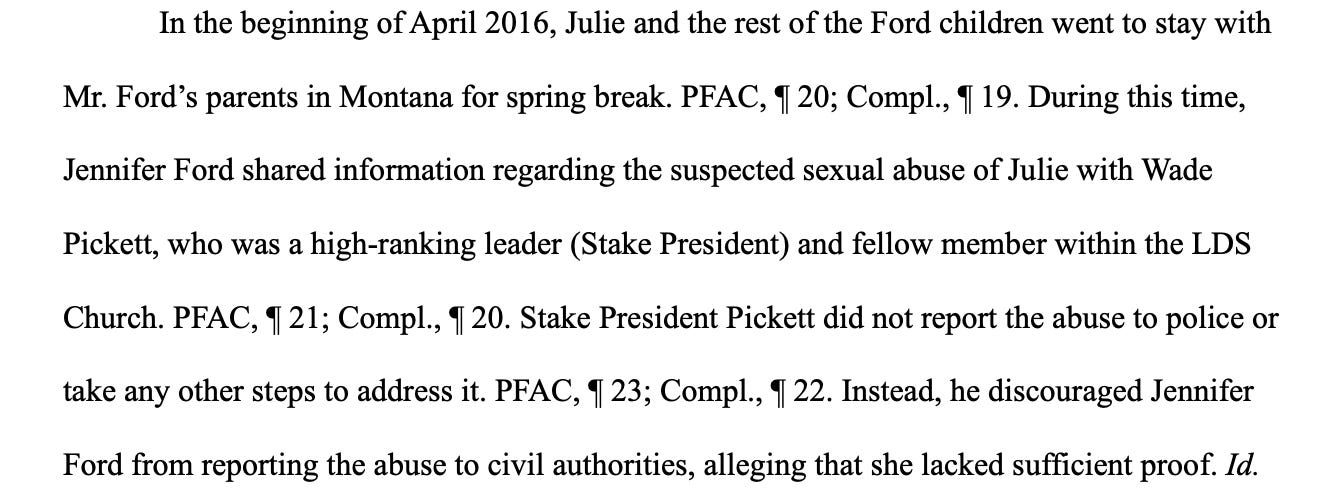
This failure allowed Craig Ford to move Julie Doe to an apartment in Albany, Oregon, where the near-daily sexual abuse continued.
In November 2016, the abuse was finally reported to the Vancouver Police Department—not by the Church, but after Craig Ford’s youngest daughter passed a note to a classmate.
This triggered an investigation by the Washington Department of Social and Health Services, during which Stake President Pickett explicitly acknowledged that Jennifer Ford had previously notified him of the abuse.
Salt Lake City Headquarters and “Consensual Relations”
The amended complaint sheds new light on what the Church knew, revealing that the alleged cover-up went far higher than Pickett.
According to the amended complaint, by December 2016, the LDS Church’s “Confidential Records Department” at its headquarters in Salt Lake City received direct notice from local Washington leaders, including Bishop Nathan Hess and Stake President Joseph Vance, that Craig Ford was living with and sexually abusing the plaintiff.
Headquarters responded by placing an “annotation” on Craig Ford’s church membership record for “Child Abuse or Incest.”
However, the amended complaint alleges that the Church’s internal documents shockingly referred to the statutory rape of the minor as allegedly “consensual relations.”
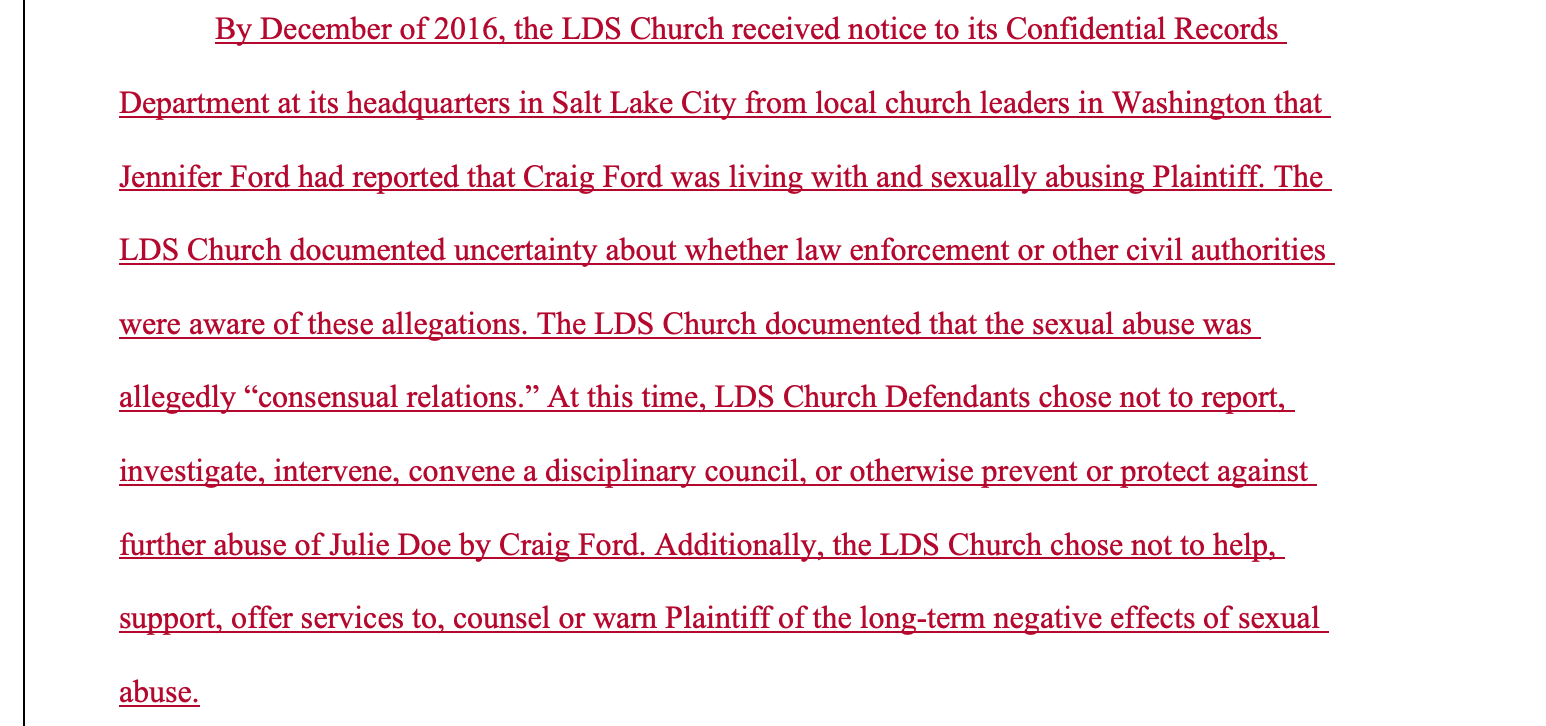
Furthermore, the records show that Church headquarters documented “uncertainty about whether law enforcement or other civil authorities were aware of these allegations,” yet still chose not to report the abuse, investigate, or intervene to protect the child.
Oregon Clergy Ignore Mandatory Reporting Laws
The most legally perilous revelation for the LDS Church involves its agents in Oregon. Unlike Washington, where clergy were exempt from mandatory reporting during the relevant timeframe, Oregon law strictly classifies clergy as mandatory reporters of child abuse.
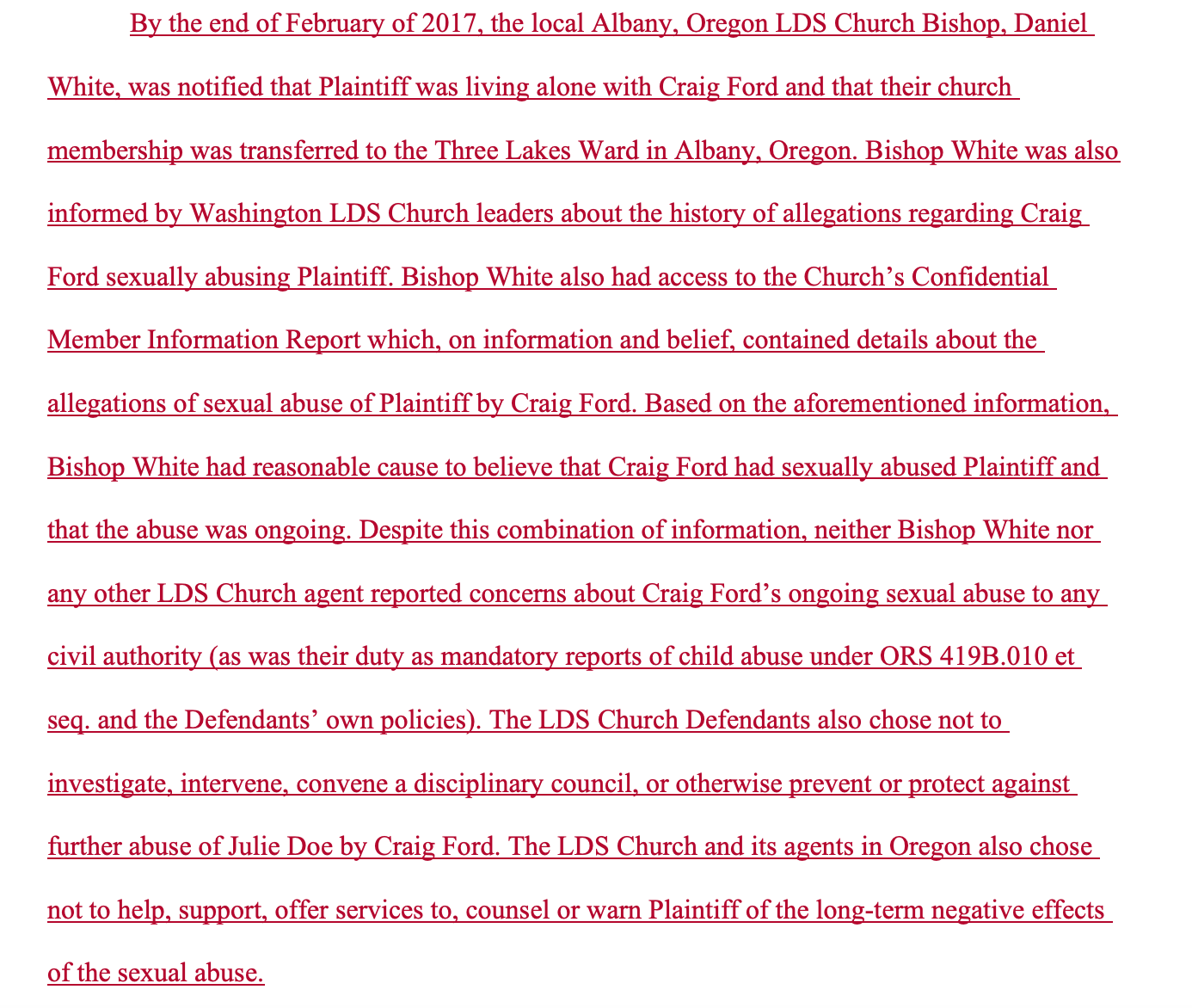
According to the new filings, Washington-based Bishop Hess delayed locating the Fords for several months, but by the end of February 2017, Daniel White, the local LDS Bishop for the Three Lakes Ward in Albany, Oregon, was officially notified through internal communications that Craig Ford was living alone with Julie Doe within his ward’s boundaries.
Bishop White was informed of the history of sexual abuse allegations and had access to the Church’s Confidential Member Information Report detailing the abuse. Despite having reasonable cause to believe the abuse was ongoing, neither Bishop White nor any other Oregon LDS agent picked up the phone to call the police, in direct violation of Oregon’s mandatory reporting statutes.
A Severe Psychological Toll
The amended complaint paints a disturbing picture of Julie Doe’s life in Albany. While Craig Ford was actively abusing her, the two continued to participate in local LDS services.
The filings allege that local Oregon church leaders frequently interacted with the victim. These leaders visited the apartment where Ford was keeping her, supervised her in youth groups without her guardians present, and even drove her to and from her job at a local restaurant.
During this time, church agents observed Craig Ford displaying risqué images of himself and noted that something was “amiss” and “weird” in the household. Yet, instead of rescuing her, they kept the church’s dark secret intact.
The Church’s handling of the abuse allegations had catastrophic psychological consequences for the victim. The amended complaint details severe mental cruelty inflicted by Jennifer Ford, who allegedly blamed the teenage victim for the sexual abuse.
According to the amended complaint, Jennifer Ford repeatedly verbally harassed the plaintiff, threatened to expose the abuse to the plaintiff’s biological mother, and actively encouraged the teenager to commit suicide.
Legal Battle Over the “Duty to Rescue”
The Motion to Amend seeks to directly counter the LDS Church’s recent legal maneuvers. On February 20, 2026, the Church filed a Motion for Judgment on the Pleadings, arguing they cannot be sued because Washington and Oregon adhere to a “no-duty-to-rescue” rule.
The Church’s attorneys argued that to rule in favor of the plaintiff, the Court would have to recognize that a volunteer clergyman had a duty to rescue her from her father’s abuse.
In response, the plaintiff’s attorneys are utilizing the newly published December 2025 Oregon Supreme Court decision, Stone v. Witt, to argue that the Church did owe a duty to Julie Doe. The plaintiff alleges that by bringing her into the fold, supervising her, transporting her, and maintaining internal policies that explicitly promise to protect victims of abuse, the LDS Church created a special relationship and a voluntary undertaking to keep her safe.
The plaintiff’s attorneys also took aim at the Church’s attempt to dismiss the claim for punitive damages. They pointed out in their response brief that the Church’s attorneys selectively omitted a crucial clause from a cited precedent, Jane Doe 130 v. Archdiocese of Portland in Oregon, 717 F. Supp. 2d 1120 (D. Or. 2010), cutting off the sentence with a period to hide the court’s conclusion that punitive damages can lie in connection with a negligence claim if the evidentiary record supports findings of aggravated misconduct.
The court will now decide whether to allow this Amended Complaint to proceed, setting the stage for what could be a landmark trial regarding institutional accountability, mandatory reporting, and the limits of clergy-penitent privilege.
Horrifying. Thank you for bringing this to light.
Thank you Anthony Tomashefsky for writing such a difficult yet important article~!
This is the first that I have heard of this specific case, however as an analyst who has been working on this subject over the past 6 years or so, I have been absolutely shocked by the many recent reports of human trafficking incidents and unbelievable numbers of children who are reportedly enslaved for the worst imaginable reasons~! As difficult as this case is, especially for the young girl that is involved, I am afraid that the general public is soon going to learn of a terrible number of atrocities that occur every year that involves men, women, and child victims, if the information that I have been tracking turns out to be true. One of the best things that we (America) can do is to standardize the age of consent all across the country~! As I understand it, many states have different "age of consent" laws and that kind of systemic confusion is insane for a country that needs to protect ALL of its population regardless of age. What one Individual may be mature enough to handle, is not necessarily the same as what others may be able to deal with, regarding sex, alcohol, drugs, and everything else, so no laws will fit all Individuals because we are all very different. That said, we (America) need to have a standardized uniform set of laws regarding all serious issues, especially to help our children mature into hopefully good well-adjusted young adults ready to deal with their future~! God willing this specific young Lady in this case will be able to get the help that she may need and live a good, happy, and prosperous life going forward~!
Thank you again for having the courage to bring up this difficult subject~!
Sincerely, Mike