
Another Legal Victory: Judge Barnhart Orders Reversal of Court Admin Halberg's Blanket Denial on Basden-Watts Emails
A Clallam County judge has overturned the Superior Court Administration’s categorical denial of an administrative records request, affirming the public’s right to government transparency regarding communications between Judge Brent Basden and his former subordinate, Johnny Watts.
In an order issued today, Judge Simon Barnhart ruled that the court administration cannot utilize a blanket exemption to withhold the emails.
Instead, the court is legally required to follow established administrative procedures to determine the context of the communications and the specific capacity in which Watts was operating.
The ruling follows a formal Request for Internal Review filed by myself, which argued that the court’s initial refusal to release the records explicitly violated General Rule 31.1 and Clallam County Superior Court Policy No. 27 by failing to conduct a mandatory search, failing to produce an exemption log, and misapplying the “chambers records” exception.
The Public’s Right to Know
The legal dispute centers on the fallout of the recent scandal involving Watts. Formerly the Adult and Juvenile Drug Court Coordinator under Judge Basden, Watts was arrested earlier this month following a standoff in Agnew.
Watts was later released on bail by visiting Kitsap County Judge Cadine Ferguson-Brown.
A subsequent raid uncovered a substantial local fentanyl and methamphetamine distribution network.
Recognizing the immense public interest in how a court employee with authority over vulnerable populations was vetted and managed, I submitted an administrative records request on March 23.
The request sought any emails between Judge Basden and Watts from 2018 to 2024 to provide necessary oversight.
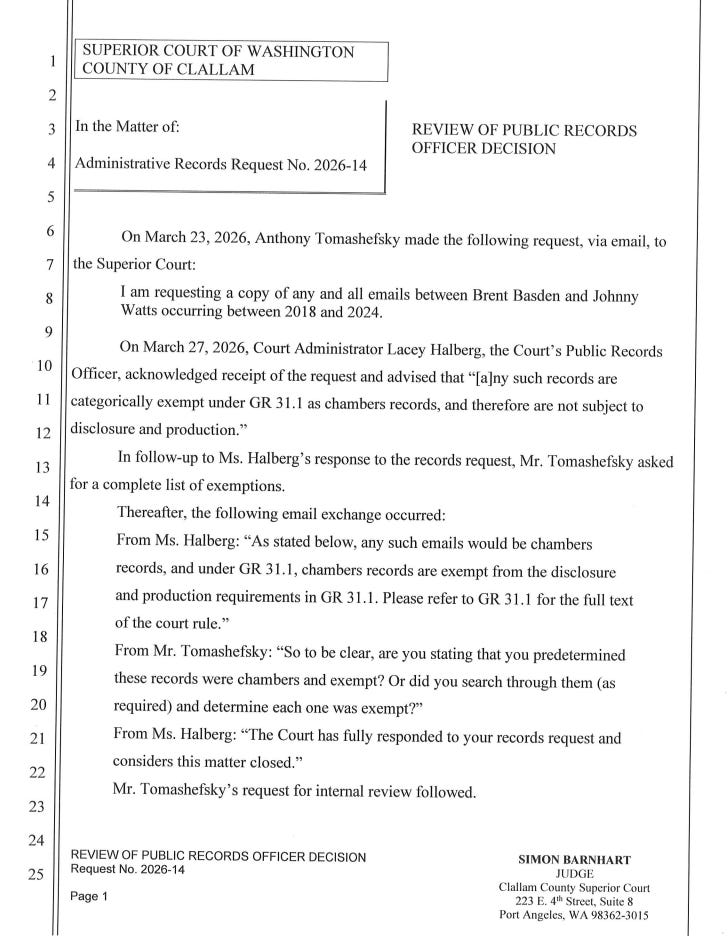
On March 27, Superior Court Administrator and Public Records Officer Lacey Halberg summarily denied the request.
Halberg stated the emails were “categorically exempt under GR 31.1 as chambers records” and declared the matter “closed.” The court administration refused to clarify whether an actual search for the records had even been conducted.
Defending Public Access
Access to public records is a cornerstone of free speech and a free press, empowering journalists and citizens to hold government institutions accountable.
On April 2, I challenged the administration’s denial. My internal review raised three central arguments based on General Rule 31.1 and Clallam County Superior Court Policy No. 27:
Procedural Requirements: Agencies are required to search for and locate documents before claiming an exemption. Categorically denying a request without a search violates these mandates.
Mandatory Exemption Logs: The court failed to provide a redaction or exemption log detailing the specific legal basis for each withheld document—a requirement meant to ensure agencies do not arbitrarily hide records.
Application of GR 31.1: State rules and internal policies explicitly note that records do not become exempt “chambers records” merely because they are in the possession of a judge. If Judge Basden communicated with a court employee acting outside of strict chambers control, the exemption does not apply.
Barnhart’s Ruling
Judge Barnhart’s review validated the necessity of these transparency procedures, reinforcing the legal standards that govern judicial administrative records.
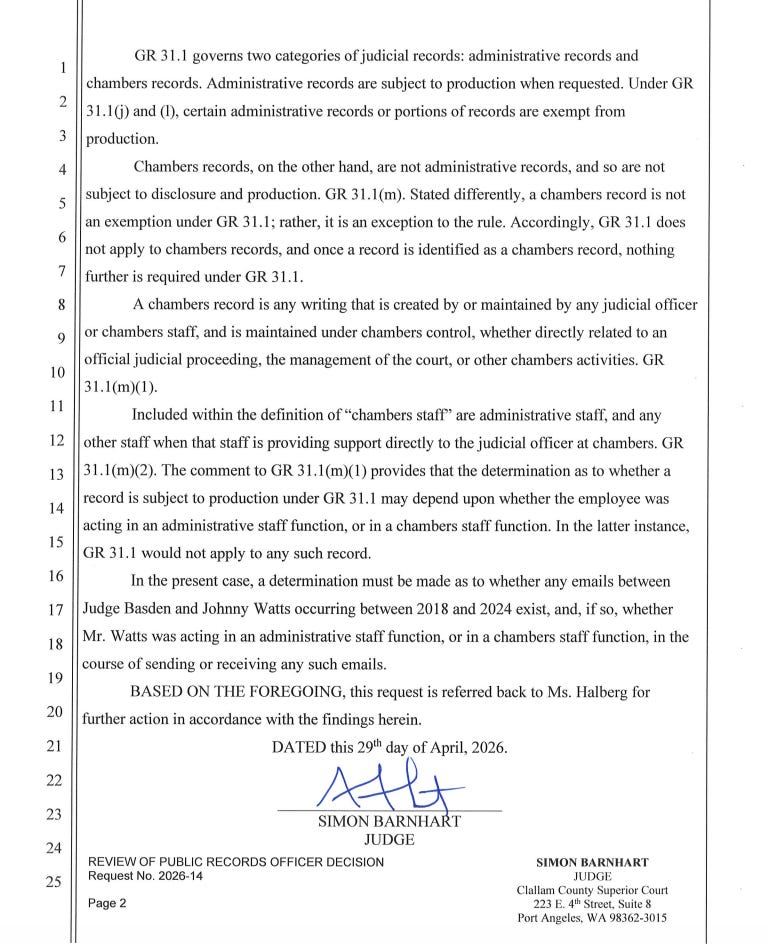
In his ruling, Judge Barnhart clarified that “chambers records” act as a specific exception rather than a blanket shield. He noted that “chambers staff” only includes administrative personnel “when that staff is providing support directly to the judicial officer at chambers.”
“In the present case, a determination must be made as to whether any emails between Judge Basden and Johnny Watts occurring between 2018 and 2024 exist,” Judge Barnhart wrote. If they do exist, the court must determine “whether Mr. Watts was acting in an administrative staff function, or in a chambers staff function.”
Judge Barnhart referred the request back to Halberg for “further action in accordance with the findings herein.”
Next Steps for Accountability
As Judge Basden faces a separate, formal investigation by the Washington State Commission on Judicial Conduct, today’s ruling stands as a critical defense of press freedom and public accountability.
The administration is now legally bound to evaluate the emails individually. The Olympic Herald will continue to monitor the court’s compliance, ensuring that the principles of transparency and the public’s right to information are upheld.
Excellent work and great news, Anthony Tomashefsky~!
Keep up the awesome effort~!
Sincerely,
Mike
Thank you!!!