
Inside the Failures of Quillayute Valley School District
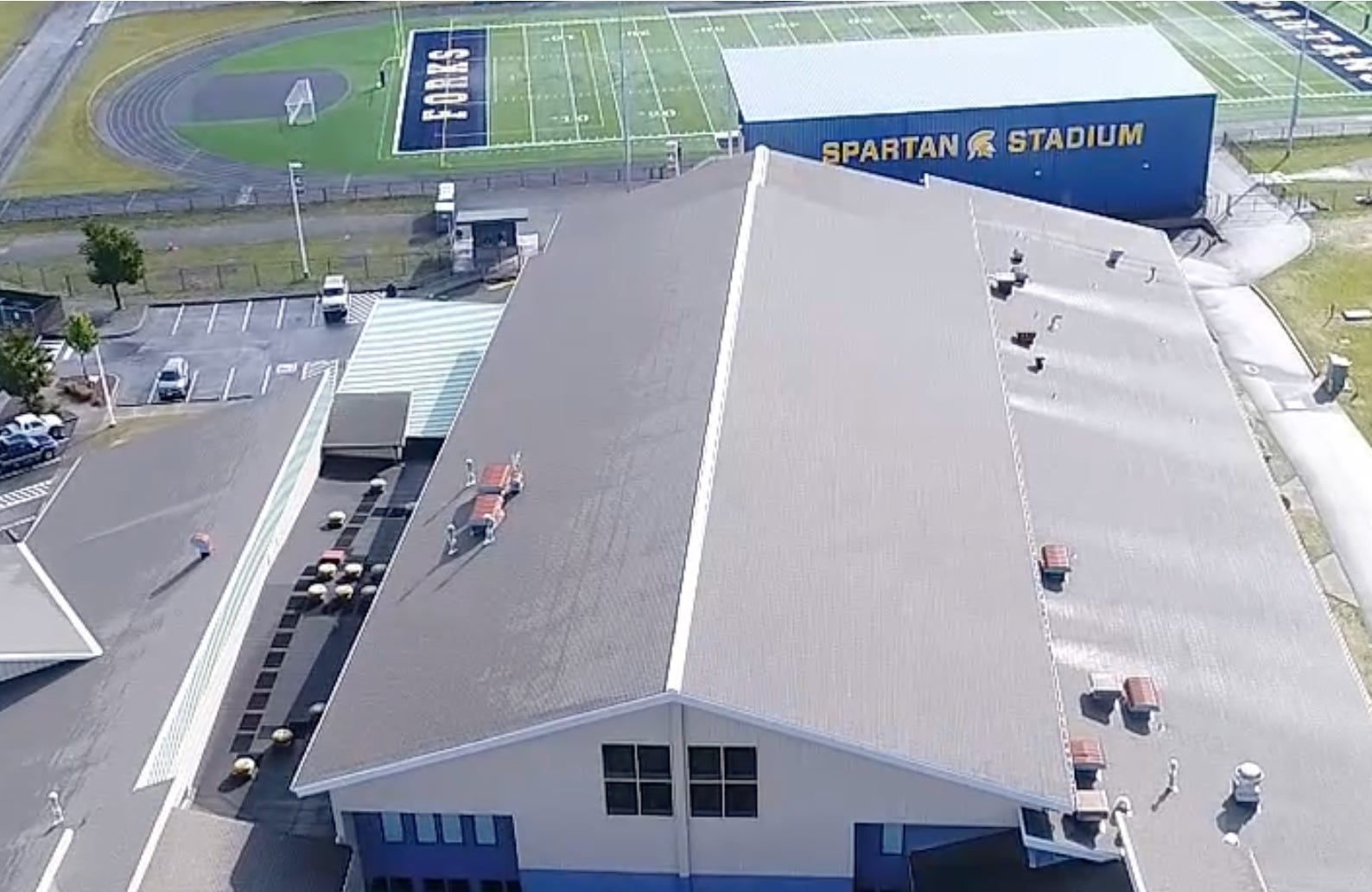
You send your children to school trusting that the adults in charge are vetted, monitored, and held to the highest professional standards. You trust that when rules are broken, there are consequences, and when a threat is identified, it is swiftly removed. But a comprehensive review of more than two decades of internal documents reveals a vastly different reality within the Quillayute Valley School District.
For over 20 years, district administration has consistently relied on a playbook that prioritizes quiet resignations, liability management, and sweeping issues under the rug over student safety and transparent accountability.
The Turn of the Century: Insubordination and Ignored Directives
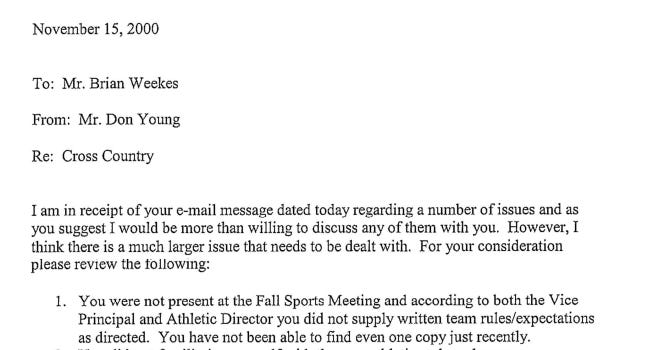
The earliest indicators of the district’s inability to manage its personnel trace back to the year 2000. It was then that the administration first documented severe compliance issues with veteran teacher and coach Brian Weekes.
Records show Weekes was cited for failing to attend mandatory meetings and neglecting basic team protocols.
More alarming was his dismissive attitude regarding student safety and conduct during overnight trips, specifically after athletes smeared feces on a motel door and damaged property.

Even worse, a primary compliance issue was Weekes’s expired First Aid/CPR card—an essential requirement for any coach—which had reportedly been invalid since late 1999.
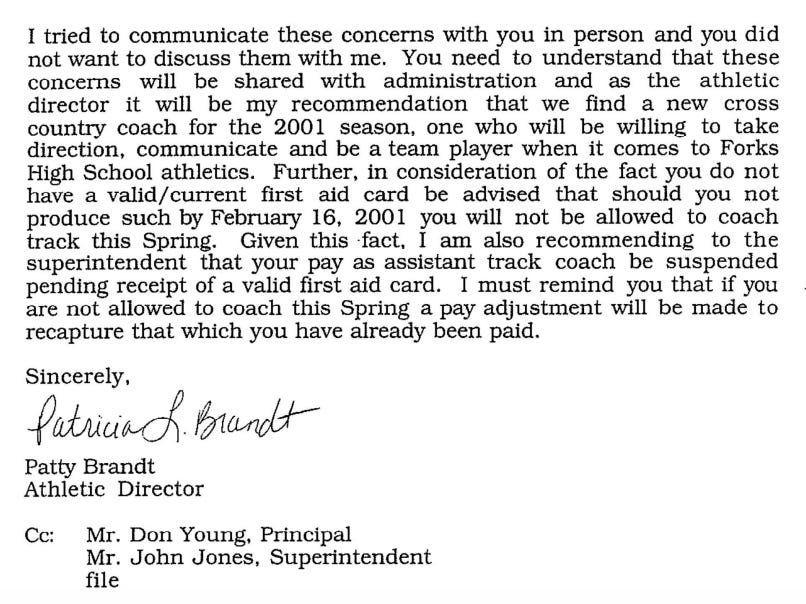
Faced with insubordination, property damage, and a coach operating without basic life-saving certifications, the administration’s response was shockingly weak. Rather than strict discipline or immediate removal, Weekes was issued a “final warning” and threatened with a pay freeze.
By 2006, the district’s loss of administrative control was undeniable. In May of that year, the Forks High School Athletic Department formally directed Weekes to “immediately cease any and all coaching related functions” for the boys’ basketball program.
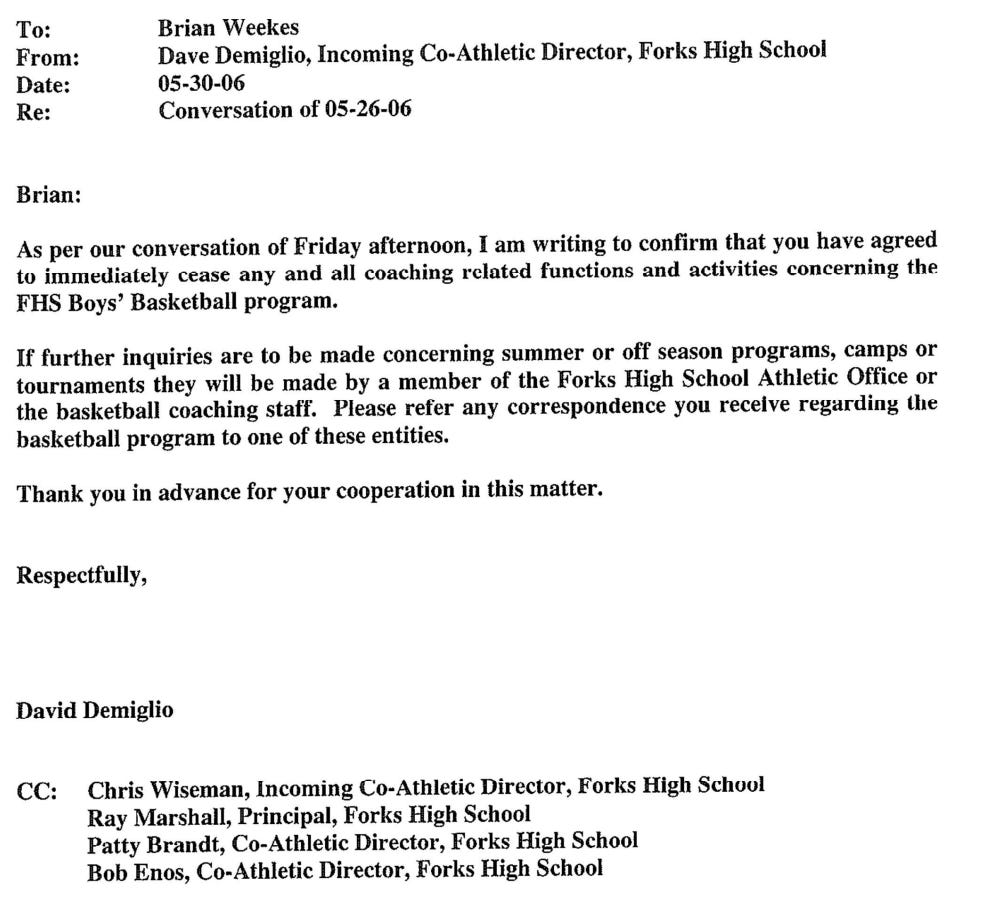
Despite a formal meeting and written confirmation of this directive, Weekes openly admitted less than a month later that he was still actively coaching the summer league team.
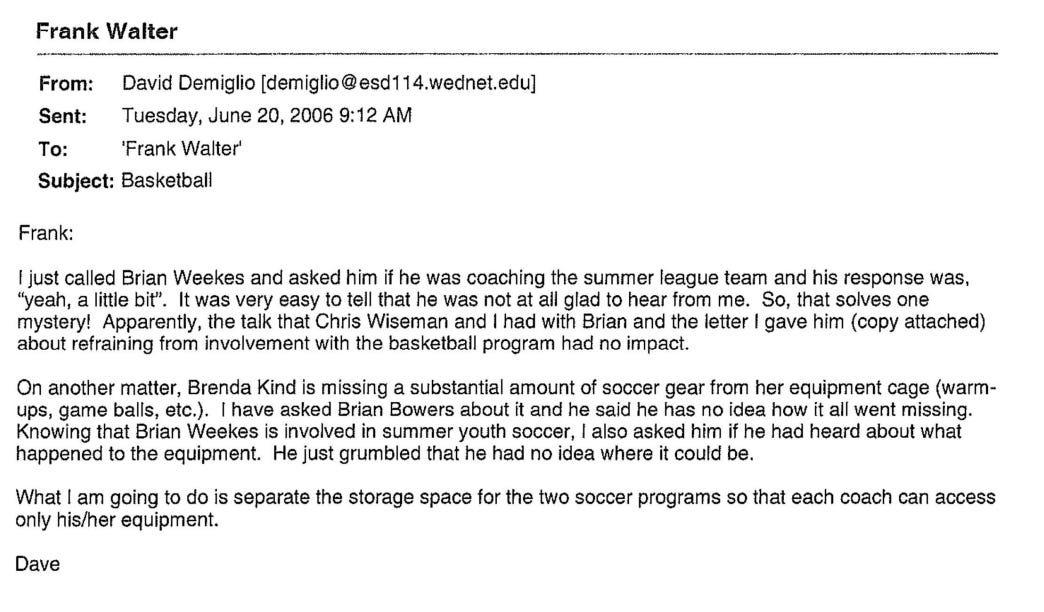
During this same period of administrative defiance, a substantial amount of school soccer equipment vanished from a secured cage.
The district’s reaction was entirely passive: focusing on physical storage separation rather than launching a rigorous investigation or terminating an employee who blatantly ignored a cease-and-desist order.
Administrative Turmoil
If the district was unable to discipline its teachers, it was equally incapable of managing its leadership. In the spring of 2005, Forks High School was thrown into severe turmoil under Principal Steve Quick.
Quick’s authoritarian disciplinary tactics alienated the community, sparking widespread protests and two student walkouts.
The boiling point occurred in March 2005, when Quick allegedly grabbed a student’s arm and ejected her from an away game over an offensive gesture.
By June, students had presented a 150-signature no-confidence petition, and staff members were publicly accusing the administration of retaliation.
The resolution to this crisis established a dangerous precedent. Although the Superintendent announced Quick would not return, the District did not formally terminate him for his actions.
Instead, in July 2005, they allowed Quick to quietly resign and immediately take a leadership position in another school district. This cemented a decades-long pattern within QVSD: when leaders become liabilities, they are not held accountable—they are simply passed along to the next community.
Failing the Most Vulnerable
This culture of prioritizing administrative convenience over student welfare inevitably bled into the classroom, specifically targeting the district’s most vulnerable populations.
In 2007, the Office for Civil Rights launched an investigation into a contract virtual program operating within QVSD. The federal findings were damning: the district was utilizing discriminatory admission criteria.
QVSD enforced written and unwritten policies specifically designed to exclude students who required modified curricula, counseling, aide support, or more than 40 minutes per week of special education services.
Furthermore, unwritten rules barred admission for any student reading below a 6th-grade level or lacking independent work skills.
The OCR ruled that these exclusionary practices violated Section 504 of the Rehabilitation Act.
It was a clear, institutional willingness to quietly exclude children who required more resources, opting for the path of least resistance rather than providing equitable educational access.
The Emergence of the Boundary Invasion Culture
When an administration repeatedly fails to enforce basic rules, allows insubordinate staff to remain, and actively discriminates against vulnerable students, the environment becomes ripe for exploitation. By the early 2010s, this systemic negligence manifested into severe, unchecked boundary invasions between staff and students.
During the first semester of the 2011–2012 school year, Forks High School teacher Crispen Willmarth engaged in a disturbing and inappropriate physical incident with a student.
While holding a pair of scissors, Willmarth took hold of an eighth-grade student’s hair and threatened to cut it, an incident that ultimately resulted in the student’s hair being cut.
When the District placed him on administrative leave on February 1, 2012, he was explicitly instructed as a condition of his leave to have no contact with Forks High School students or staff.
Demonstrating a blatant disregard for administrative authority, Willmarth violated this directive on May 3, 2012, by emailing a student to discuss the investigation and the hair-cutting incident.
Furthermore, Willmarth engaged in a pattern of deceit to secure future employment by repeatedly falsifying applications to other school districts, intentionally omitting his employment and subsequent discipline at Quillayute Valley to avoid professional accountability.
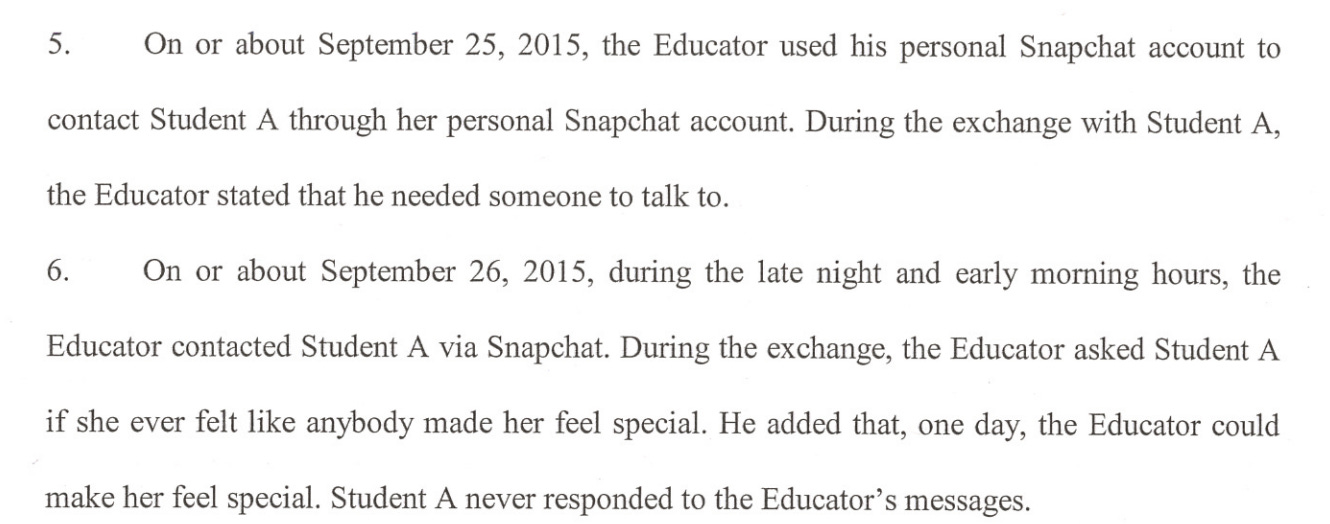
In August 2015, newly hired teacher and coach Craig Shetterly attended the district’s mandatory new employee boundary training. Just one month later, he was using personal Instagram and Snapchat accounts late at night to message a 16-year-old female student.
Shetterly told the child he “needed someone to talk to,” asked if anyone made her feel special, and stated that one day he could make her feel special.
Shetterly’s rapid descent into predatory behavior—which ultimately resulted in a state-level certificate suspension—proved that QVSD’s training protocols were entirely ineffective.
The district had cultivated a culture where adults felt emboldened to cross the line, confident that the administration would prioritize keeping things quiet over keeping students safe.
Administrative Neglect Becomes Dangerous
When a school district spends a decade failing to enforce basic professional boundaries, the consequences eventually escalate from administrative annoyances to active threats.
By the late 2010s, the Quillayute Valley School District’s historical reliance on quiet settlements and informal warnings had cultivated an environment plagued by institutional blind spots.
The negligence that once allowed a coach to bypass first-aid certification was now allowing severe predation, volatile student violence, and basic infrastructure neglect to fester in plain sight.
For parents, this era of the district’s history is perhaps the most chilling, as it demonstrates exactly what happens when leadership prioritizes keeping up appearances over maintaining a safe campus.
Unchecked Predators in Plain Sight
The inadequacy of the district’s oversight was laid bare in the catastrophic case of Avery Ironhill. For nearly five years, from 2012 to 2017, the substitute teacher and coach engaged in a severe and escalating pattern of boundary violations with high school students.
The behaviors were not subtle. Ironhill’s interactions with students included offering to provide alcohol on school grounds, sleeping in a student’s bed, showing explicit photos, discussing sexual experiences at student bonfires, and driving students at speeds of 100 mph.
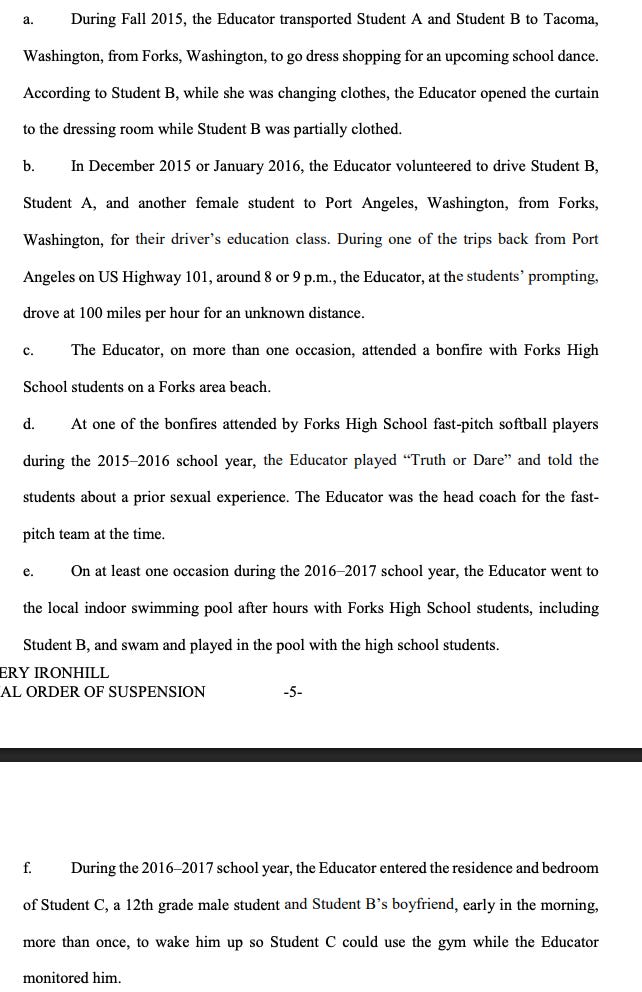
Despite these highly visible, pervasive interactions happening right under the administration’s nose, the district failed to detect or intervene in the grooming.
It did not take a rigorous internal investigation to finally stop the abuse, instead, it took a parent explicitly complaining to the principal in February 2017.
The Ironhill case highlights a profound lack of institutional oversight and a staggering failure by district staff to report glaring red flags. It also exposed the dangerous inadequacy of the district’s preventative measures.
A Culture of Harassment Turning Violent
In March 2018, the district’s lax environment regarding sexual harassment nearly resulted in an unimaginable tragedy.
A 19-year-old Forks High School student was expelled and arrested after his repeated sexual comments toward a female classmate escalated into targeted death threats.
When local law enforcement executed a search warrant at the student’s home, the reality of the threat became horrifyingly clear. Police discovered a “manifesto” detailing plans to kill someone, alongside nine firearms in the student’s bedroom—including an AR-15 semi-automatic rifle.
While a mass casualty event was ultimately thwarted by swift police intervention, the incident was the symptom of a highly volatile school environment where harassment was allowed to fester unchecked until it required an armed police response.
The Return of Old Patterns
Even as these severe crises unfolded, the district continued to handle its veteran staff with kid gloves. Brian Weekes, the coach who openly defied administrative orders a decade prior, remained a central figure in the district’s disciplinary blind spots.
Internal records from Title IX Coordinator Kyle Weakley outline two primary complaints regarding Weekes’s conduct.
In April 2019, Weekes was the subject of a report detailing inappropriate physical contact with students.
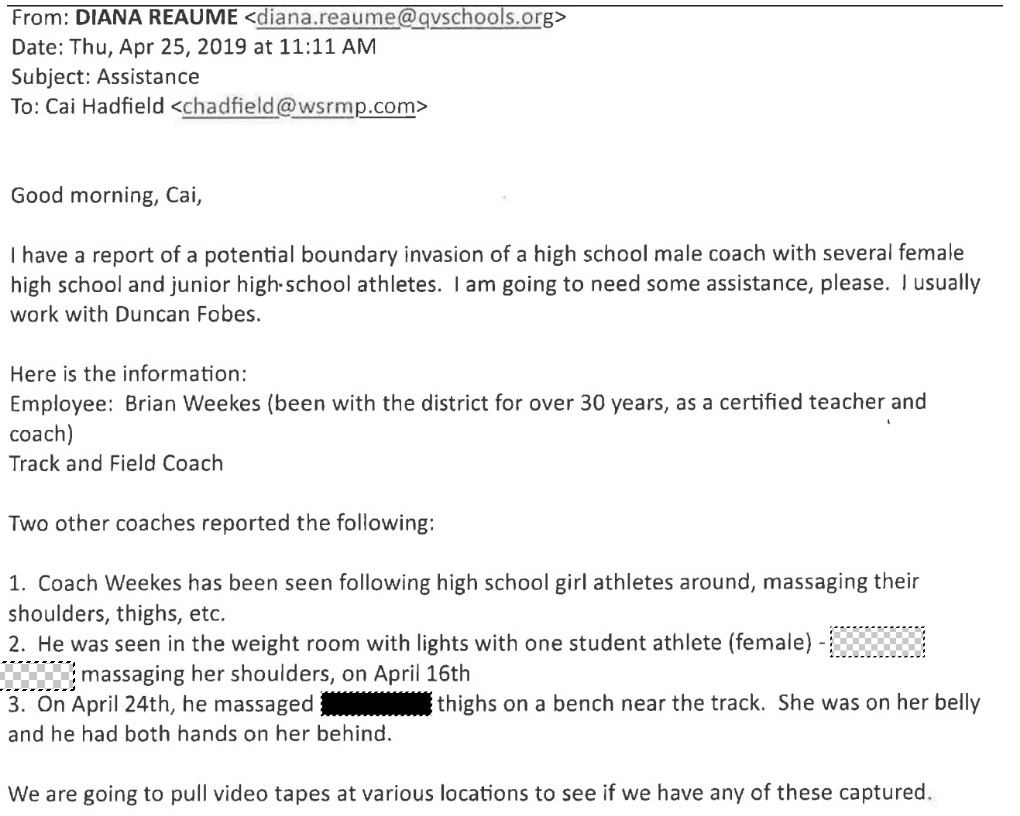
This pattern would continue into 2022, when Weekes was reported for making an inappropriate comment regarding a female athlete’s chest.
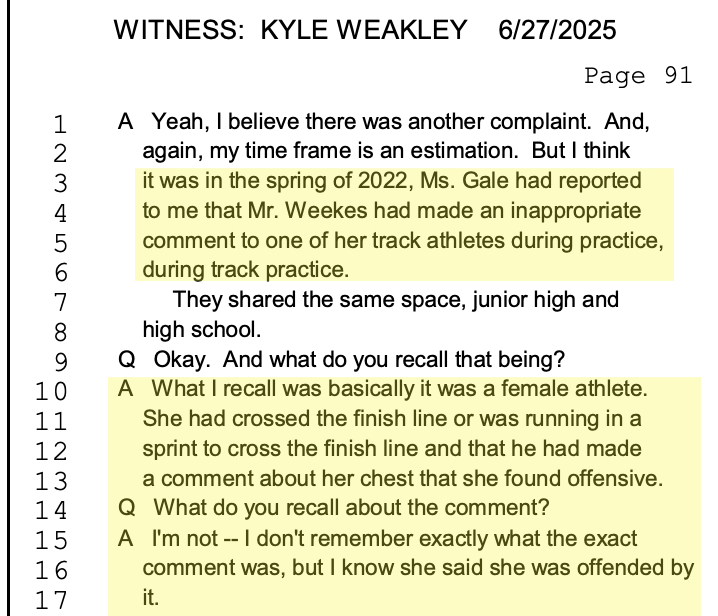
Further muddying the waters, Weakley noted administrative discrepancies regarding a student athlete’s participation in the 2019 season, citing conflicting reports from a third-party investigator and district staff.
Operational Neglect
The administration’s inability to manage its people was directly mirrored by its failure to manage its resources and facilities. The physical health of the student body and the financial integrity of the district were subjected to similar negligence.
In 2016, a regulatory loophole in the EPA’s Lead and Copper Rule exempted schools that purchased municipal water from testing their internal fixtures.
However, following high-profile water crises nationally, Washington state provided funding for voluntary lead testing. While neighboring districts utilized this funding to ensure their aging plumbing wasn’t poisoning their students, QVSD bypassed the voluntary phase entirely.
District leadership cited their “property-poor” financial status, choosing to rely on general city water reports rather than actively testing the specific fountains their students drank from daily.
This prioritization of budget optics over physical health would set the stage for a disastrous reckoning years later.
Simultaneously, the district’s financial oversight was crumbling.
A Washington State Auditor’s Office report covering the 2015–2016 school year identified a “significant deficiency” in QVSD’s internal controls regarding the management of federal Special Education grants.
District administration deviated from standard control processes, failing to maintain required monthly time and effort documentation for an employee whose salary was reclassified to federal funding.
In a move that perfectly encapsulates the district’s sloppy record-keeping, staff actually improperly discarded the required payroll documentation after the reclassification was performed.
Then in 2021, the passage of House Bill 1139 mandated comprehensive water testing for all public schools built before 2016.
When QVSD conducted this mandatory testing in November 2024, the results were catastrophic.
According to a public announcement issued by Superintendent Diana Reaume in April 2025, 148 drinking water outlets were sampled across the district’s elementary, middle, and high schools. Exactly half of them—74 outlets—failed to meet safety standards due to elevated lead levels.
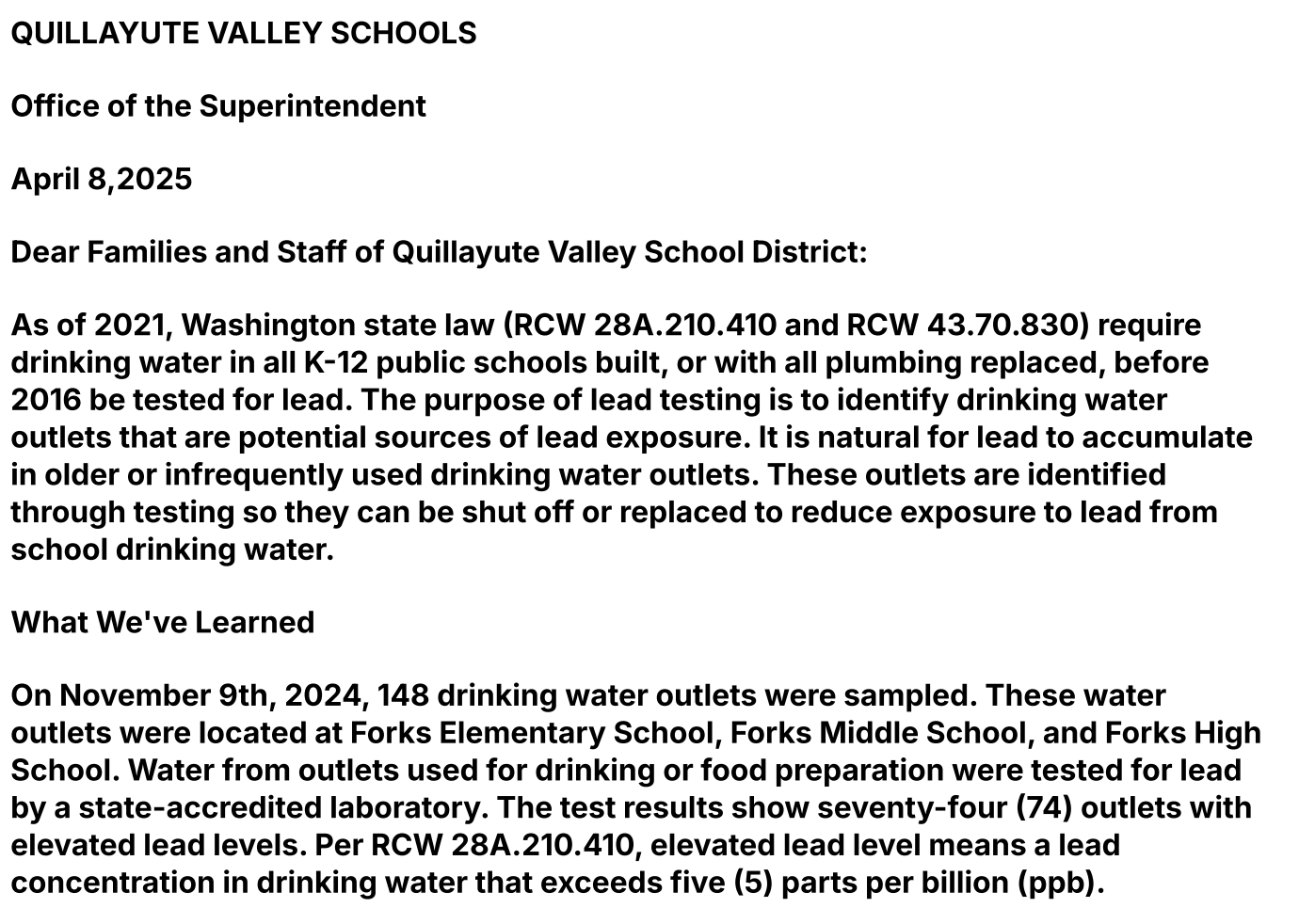
For nearly two decades, children may have been drinking from contaminated fountains while the district avoided testing.
Protecting the Institution Over the Students
By the dawn of the 2020s, the Quillayute Valley School District’s long-standing failure to enforce professional boundaries and discipline reached a tragic point.
The institutional habit of looking the other way had morphed into a system that actively enabled deeply compromised individuals to remain in contact with children.
This era of the district’s history is defined by a chilling inconsistency. The administration repeatedly demonstrated shocking leniency toward staff members who actively endangered students, yet demonstrated that they could act with immediate, ruthless speed when faced with pressure from vocal parents.
Institutional Enabling of Compromised Staff
The administration’s active choice to prioritize staff retention over student safety is perhaps best exemplified by the agonizing timeline of Elyse Wach, a 6th-grade teacher at Forks Intermediate.
Between 2016 and 2019, the district repeatedly allowed Wach to remain in the classroom despite a severe, documented pattern of drinking alcohol at school.
The red flags were glaring and continuous. After Wach admitted to drinking on campus in November 2016, the principal issued a mere warning letter.
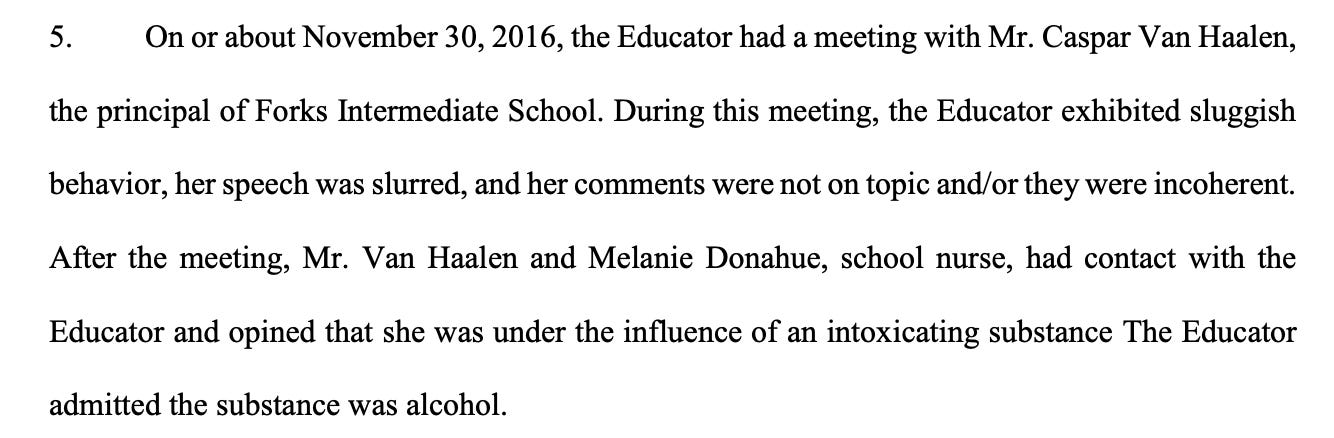
When she was caught drinking on campus again just two months later in January 2017, she was placed on paid leave, but the district inexplicably signed a Memorandum of Understanding allowing her to return to teaching by May.
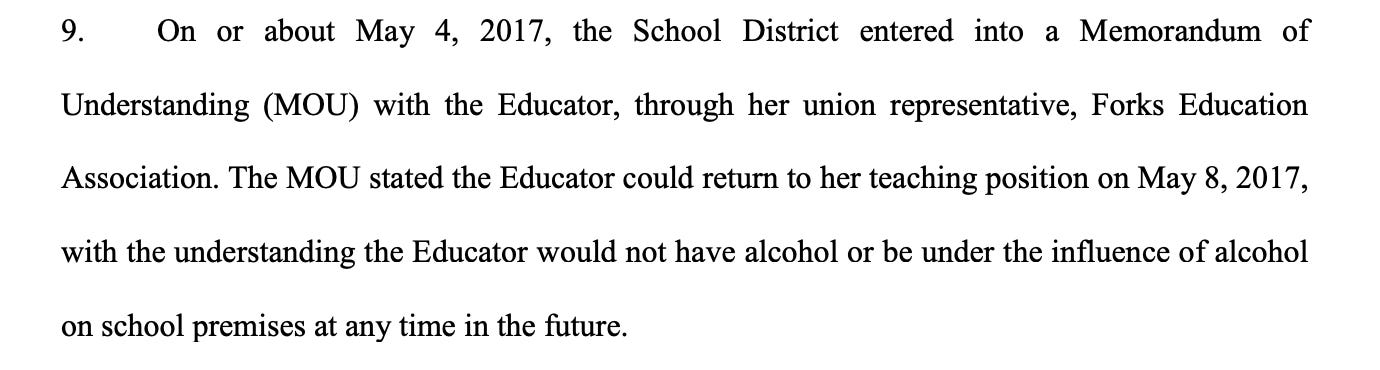
Days after that return, she received a DUI and admitted to drinking at school yet again. Even after the Office of Superintendent of Public Instruction issued a formal reprimand in 2018, QVSD kept her employed.

The district’s staggering refusal to intervene only ended when Wach was caught drinking in her classroom while with students in February 2019, finally leading to her resignation and eventual state suspension in 2020.
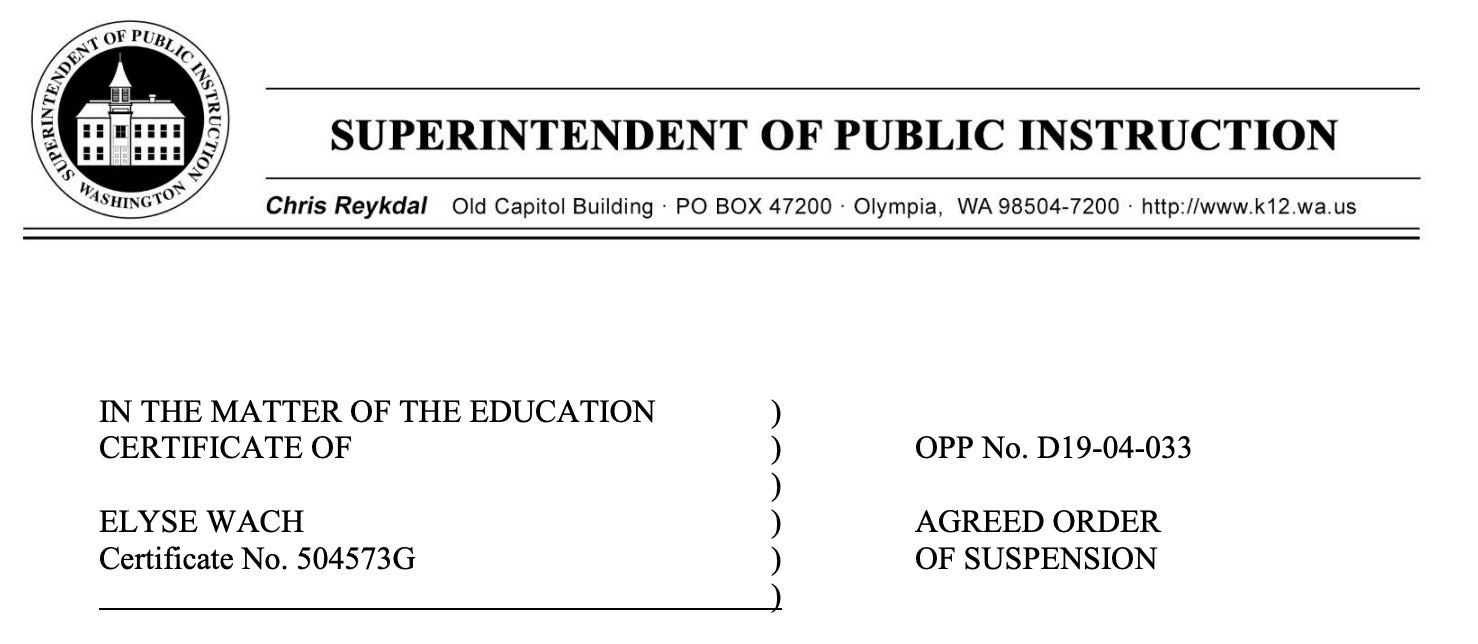
For three years, district leadership actively gambled with the daily safety of 6th graders to avoid firing a compromised teacher.
The Ultimate Betrayal on School Grounds
When early red flags are ignored and boundary violations are handled informally, predators are emboldened to act right under the administration’s nose. In 2020, this systemic negligence resulted in the darkest consequence imaginable.
Tammy Ann Leask, a para-educator for the Quillayute Valley School District, pled guilty to the rape of a 13-year-old Forks Middle School student.
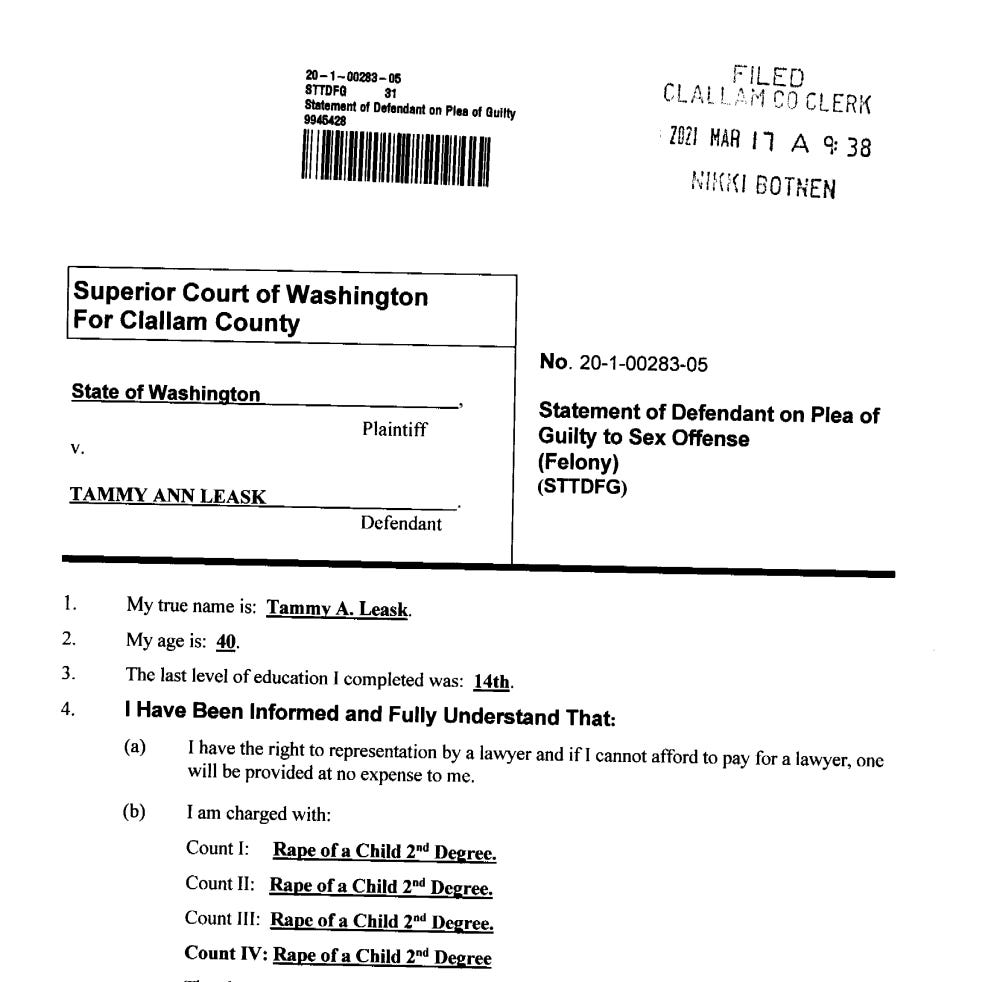
Following an investigation that began just before the 2020 school year, detectives uncovered a horrifying timeline of abuse spanning from November 2019 to January 2020.
The abuse involved extensive grooming, with Leask admitting to supplying the middle schooler with alcohol, tobacco, pornographic magazines, and condoms.
Most alarmingly for parents who trust the physical safety of the school buildings, Leask confessed to detectives that the sexual abuse occurred directly inside a classroom. This was a catastrophic breach of student safety that underscores a severe, systemic failure to monitor staff-student interactions within the district’s own facilities.
The Power of a Parent Complaint
The district’s immense patience for drunk teachers and predators stands in stark contrast to how rapidly it can move when faced with parental pressure.
In December 2019, veteran wrestling coach Robert Wheeler intervened to stop a spectator student from harassing an injured wrestler. A parent of the spectator took issue with Wheeler’s intervention and filed a formal complaint with the district.
The administration’s response was immediate. Based on that parent’s complaint, the district rapidly suspended Wheeler.
According to a federal civil rights lawsuit Wheeler filed in 2021, the district administration—including the Superintendent and the School Board—moved aggressively to permanently strip him of his coaching duties.
For the parents of QVSD, the Wheeler case reveals a vital, if frustrating, truth about the district’s operational mindset: parental pressure is the only thing that forces their hand.
The administration that took three years to remove a teacher drinking in class moved in days to permanently sideline a coach because a parent complained. It proves the district has the mechanisms to remove staff swiftly—they simply choose not to use them unless backed into a corner.
Shielding the District from Scrutiny
When Wheeler challenged his rapid removal and sued the district for denying him union representation and due process, QVSD did not reflect on its administrative inconsistencies. Instead, it utilized the legal system to bury them.
In March 2021, the district filed its formal Answer to Wheeler’s lawsuit, representing a rigid institutional defense posture designed to shield its actions from liability.
However, the district was apparently unwilling to defend its actions in the light of day. By September 2021, the federal civil rights lawsuit was voluntarily dismissed without prejudice by stipulation.
While the filing does not detail specific terms of a settlement, the quiet resolution of the lawsuit likely achieved the district’s primary goal: avoiding a public trial.
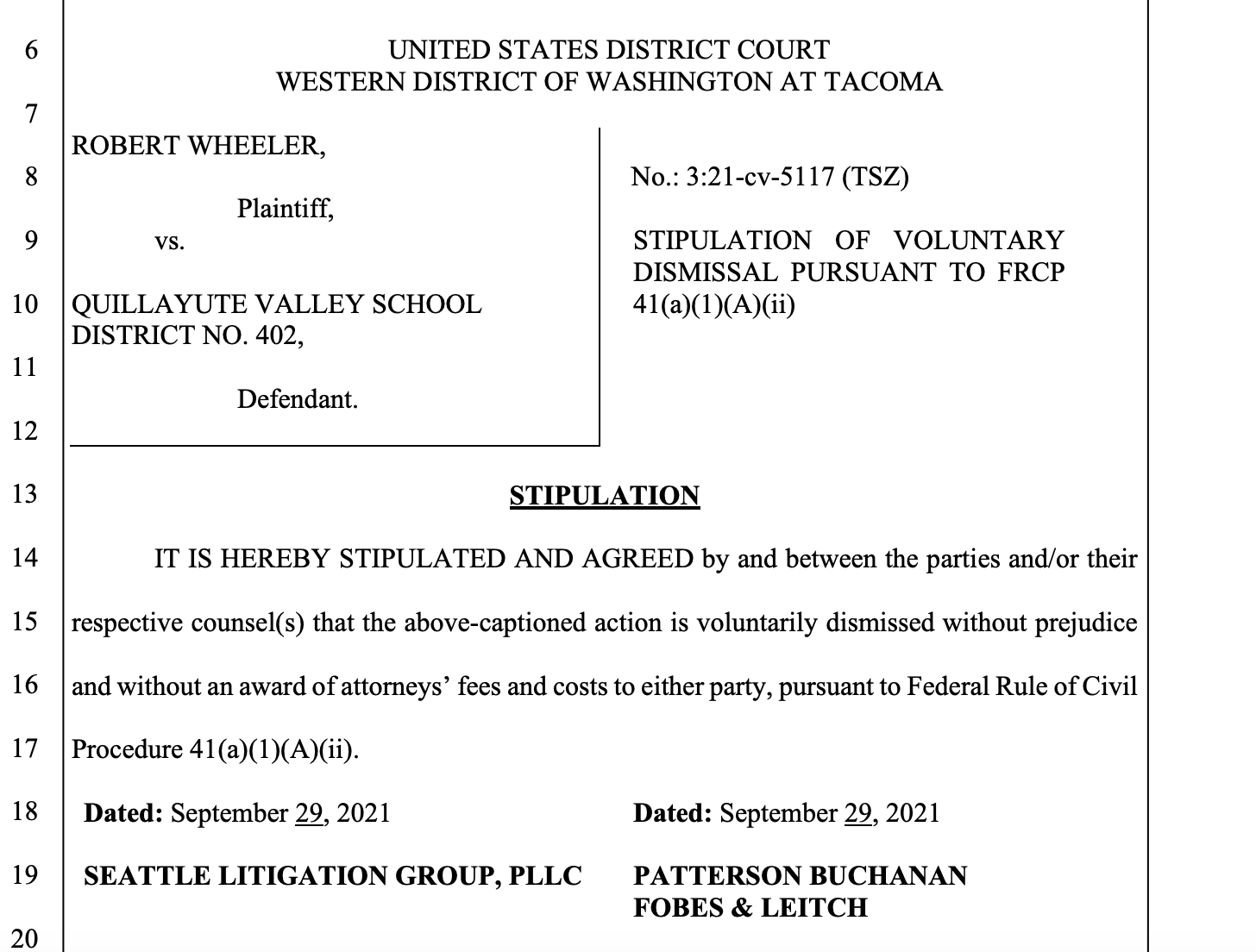
By quietly dismissing the case, QVSD successfully insulated its reactive disciplinary procedures, its double standards, and its administrative actions from any further community scrutiny.
When Severe Allegations Become an Administrative Inconvenience
For over twenty years, internal records suggest the Quillayute Valley School District relied on a system of institutional deflection—ignoring expired certifications, shuffling problematic principals out the back door, and issuing informal warnings to staff who blurred professional boundaries.
But in the late summer and fall of 2023, the district’s administrative playbook faced an unprecedented test.
According to an email submitted as an exhibit in federal court, cross-country coach Kari Larson wrote directly to district leadership, including Superintendent Diana Reaume and Title IX Coordinator Kyle Weakley. The contents were explicit: Larson notified the district that she could not continue coaching because she had allegedly been subjected to “a number of years of sexual harassment, including sexual assault by [Brian Weekes], and because of [Weekes] recent stalking…”
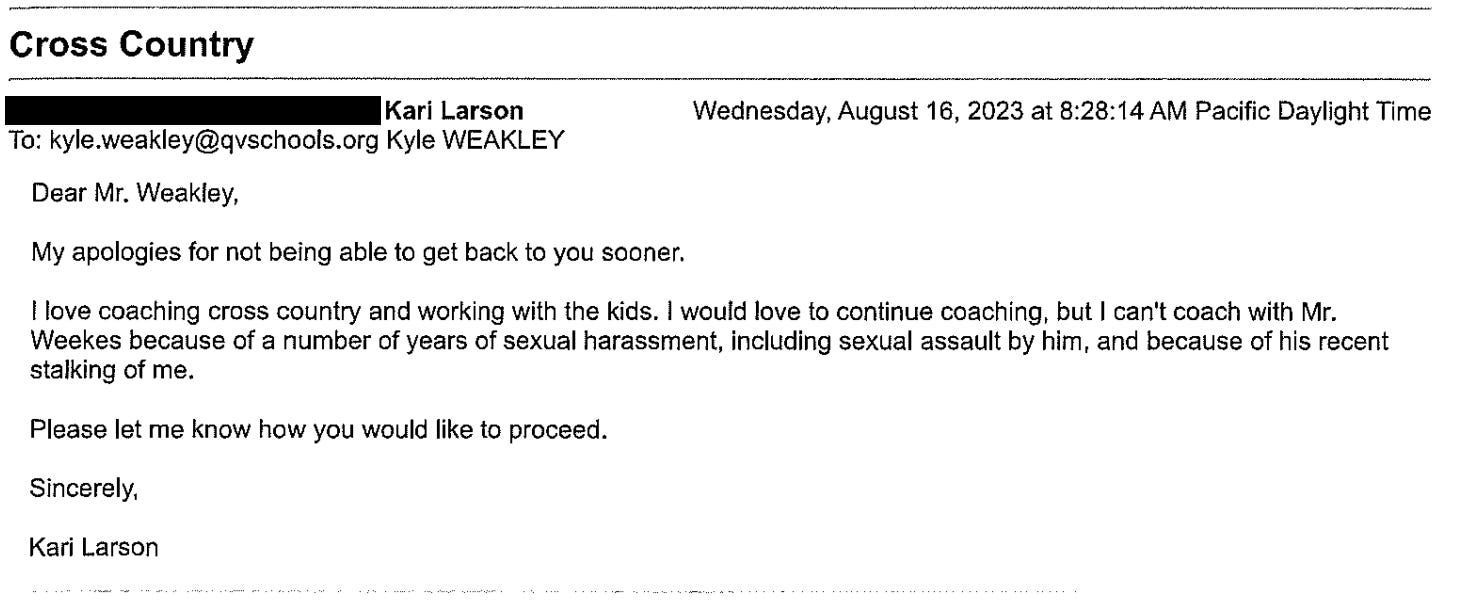
For a district prioritizing campus safety, a written report of sexual assault and stalking by a veteran educator would typically trigger an immediate, emergency intervention.
Instead, internal emails reveal a staggering administrative response. Rather than immediately confirming her physical safety or initiating a formal separation of the two employees, administrators repeatedly contacted Larson to ask if she would return to her coaching duties.
In subsequent emails, Weakley noted that having a substitute coach was “really hard on the team,” and asked if she would reconsider.
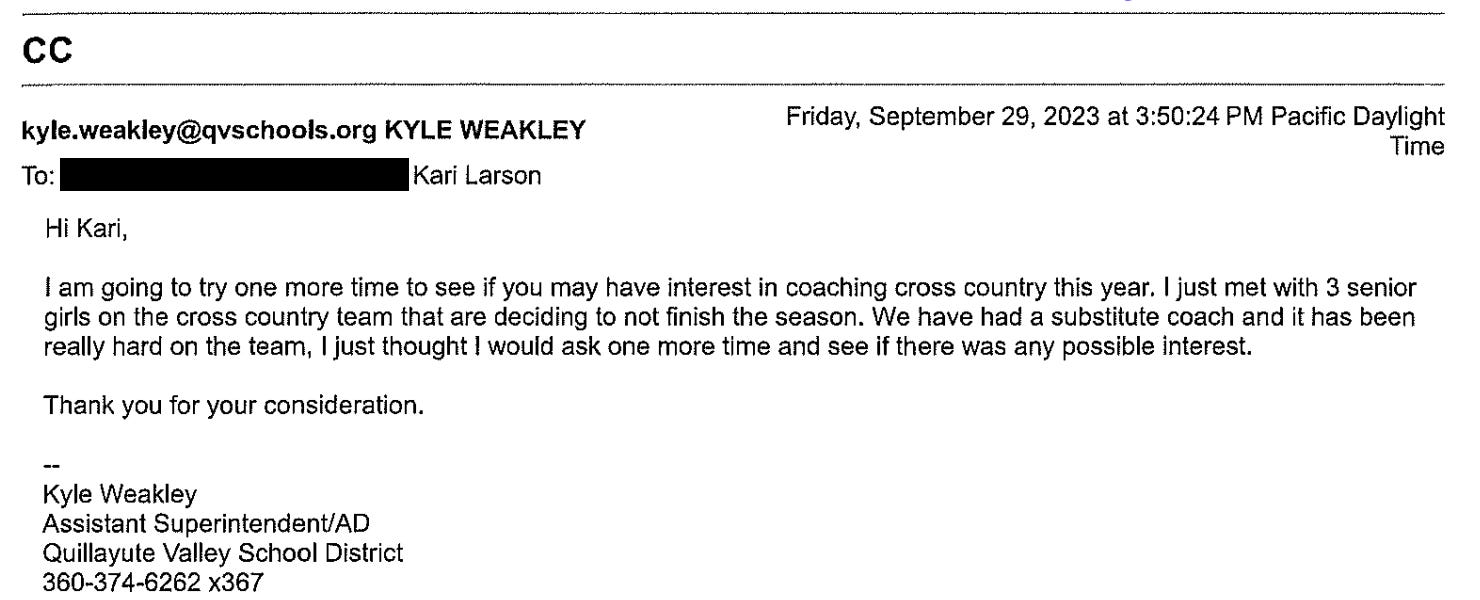
The documented communication sent a clear message: the district viewed her explosive report primarily as an administrative and staffing inconvenience.
Apparently recognizing the district’s posture, Larson formally resigned from her coaching position, stating she could no longer work alongside Weekes.
The Formal Title IX Grievance
Larson’s departure did not resolve the district’s liability. Realizing that her August emails had failed to trigger a formal reckoning, Larson escalated the issue.
In December 2023, she submitted a formal Title IX grievance directly to Superintendent Reaume. The letter outlined a deeply disturbing pattern of alleged behavior, claiming that she was the victim of pervasive sexual assault and stalking that created a hostile work environment.
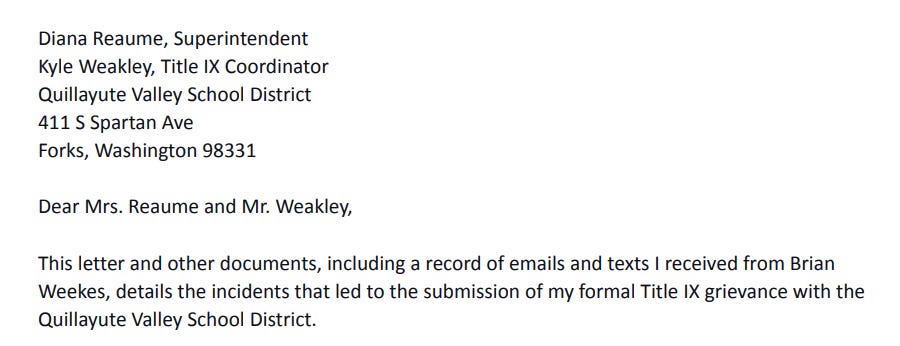
Crucially, the grievance alleges that this conduct began in the fall of 2017—meaning, if true, these actions were occurring within the QVSD athletic department for six years without administrative intervention.
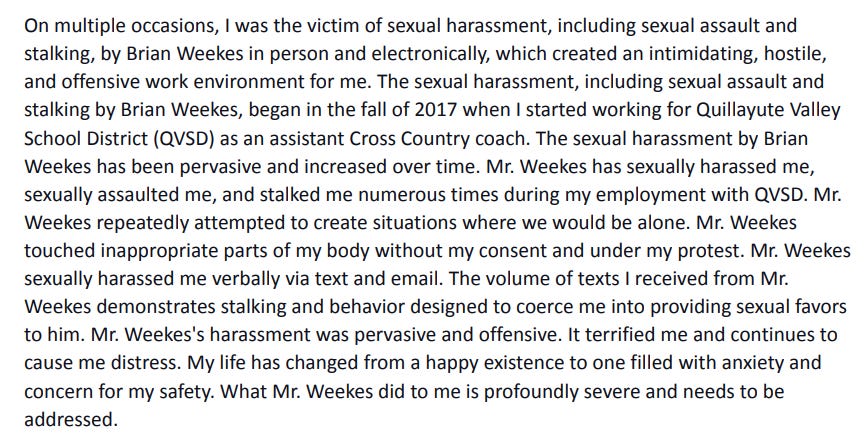
Court filings, including Larson’s amended federal complaint and deposition transcripts, detail exactly how this environment was allegedly maintained.
Larson testified under oath that Weekes manipulated standard coaching routines, using post-workout “stretching” as a guise to initiate inappropriate physical contact with female athletes and staff—a practice he allegedly did not extend to male students.
For the parents of Quillayute Valley, the grievance raises an urgent question: If a veteran teacher is formally accused of sexually assaulting and stalking an adult colleague under the guise of athletic training for six years, how vulnerable are the students running on those same teams?
The Bureaucratic Shield and Legal Posturing
Faced with a formal Title IX grievance that carried federal implications, the district finally shifted gears—moving rapidly into active liability management.
While the district did issue a formal letter placing Weekes on administrative leave on August 21, the broader administrative machinery only kicked into high gear when the threat of a lawsuit materialized.
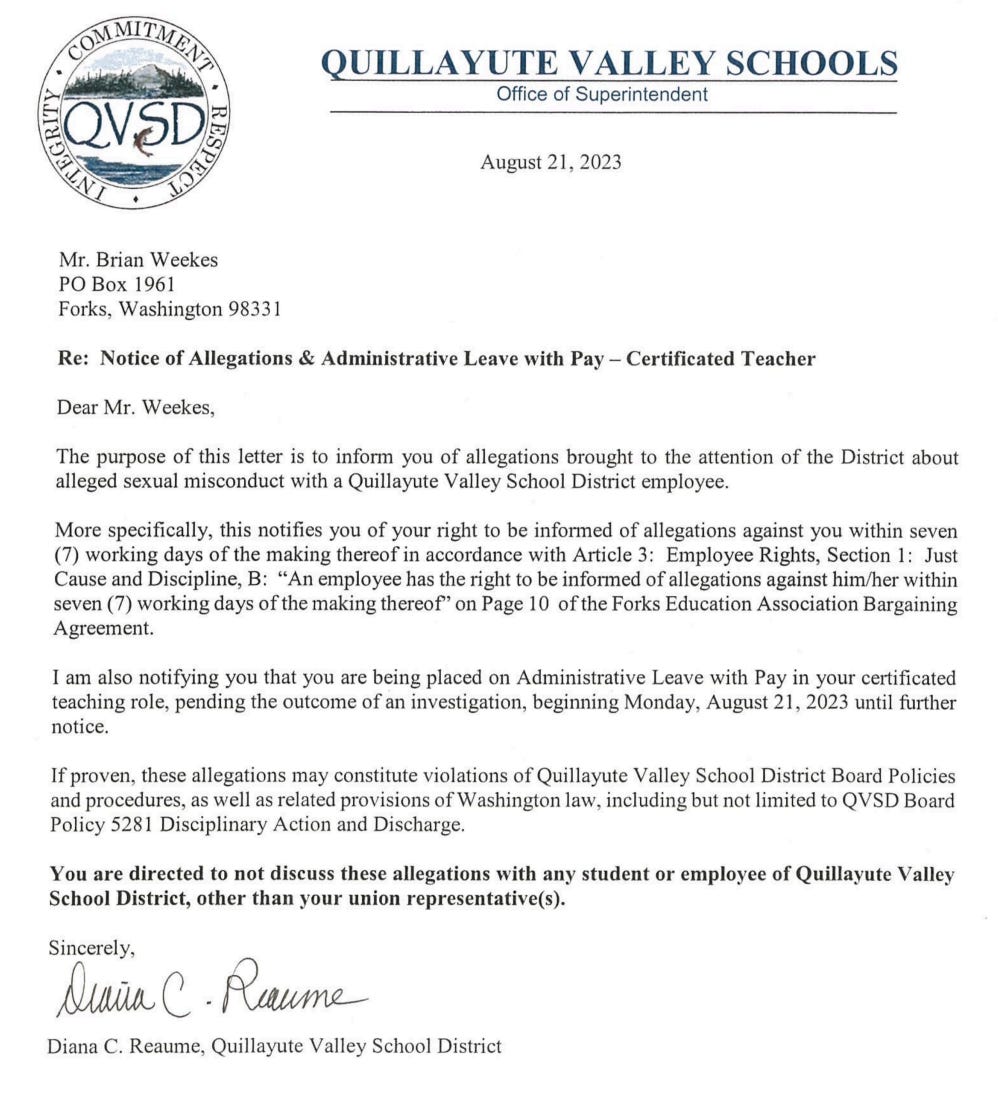
By mid-December, following the formal Title IX grievance, the district’s legal defense apparatus activated. Superintendent Reaume issued a bureaucratic “Notice of Allegations,” and internal records show administrators immediately looping in outside counsel from the Patterson Buchanan law firm to manage the fallout.
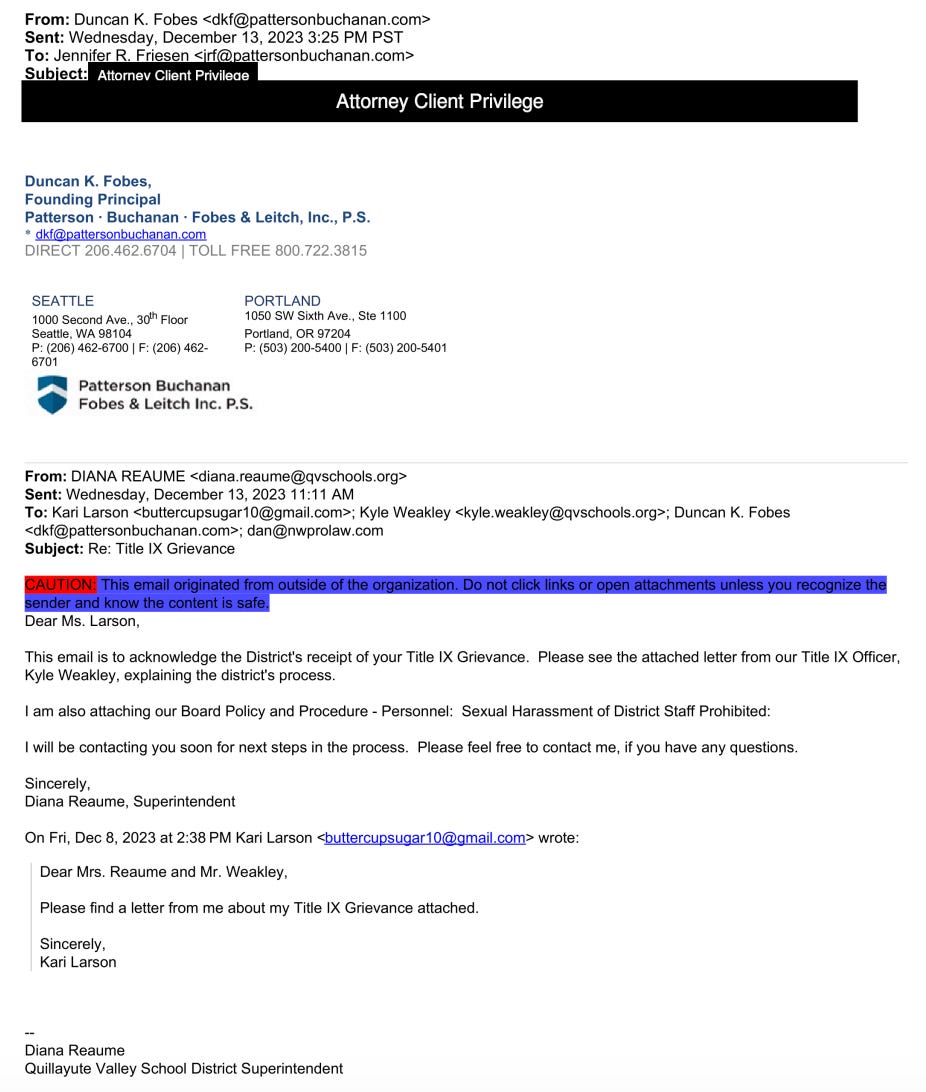
The contrast documented in the court exhibits is stark.
When Larson explicitly reported sexual assault in August, the immediate district response focused on her coaching vacancy. But the moment a formal Title IX grievance threatened the institution’s legal standing in December, the administration generated a flurry of legal paperwork.
The district quickly retreated behind the veil of “Title IX confidentiality.” While legally standard, the district utilized this bureaucratic shield to control the narrative and manage its legal exposure, keeping the community—and the parents whose children were still interacting with the athletic department—entirely in the dark about the severe allegations facing a veteran educator in their midst.
Under Oath: The Administration’s Playbook Exposed
The systemic failures documented within the Quillayute Valley School District over the last two decades are active, ongoing crises.
Recent sworn deposition transcripts appear to demonstrate that the administration’s historical playbook—prioritizing liability management and budget optics over immediate safety—continues to shape the reality for students and staff today.
Depositions and declarations filed in late 2025 regarding the federal litigation expose an administration fundamentally focused on liability over safety.
Court filings confirm that district leadership possessed deep institutional knowledge of concerning behaviors long before the explosion of the Kari Larson grievance.
In a December 2025 legal declaration, Superintendent Reaume admitted to inadvertently sending a 2019 email to a third-party investigator, a document she later tried to claw back as “privileged work product.”
The admission inadvertently confirmed that the district was discussing and investigating complaints regarding Brian Weekes as far back as April 2019.
The administrative mindset was further laid bare in the deposition of Title IX Coordinator Kyle Weakley.
When asked under oath about directing Weekes to stop the practice of “stretching” athletes—a routine that Larson alleged was used to facilitate abuse—Weakley testified about his rationale.
According to the transcript, Weakley told Weekes it was “not a good idea for a male coach... to be doing that anyway, for their own protection, so that false accusations couldn’t be made against them.”
For a community trusting the district to protect its children, the testimony is chilling. The district’s documented concern was not protecting the physical boundaries of the students, but was focused on protecting the coach from “false accusations” and shielding the district from liability.
QVSD on Trial
On March 31, 2026, a jury of eight was seated in the Tacoma courtroom of U.S. District Judge Benjamin H. Settle, marking the beginning of the federal trial Larson v. Quillayute Valley School District.
The trial represents the inevitable destination for a district that has historically shielded its actions from public view.
Plaintiff Kari Larson took the stand during the first four days of the proceeding to testify regarding the allegations of sexual assault and harassment that forced her resignation.
According to federal docket minutes, the jury has also heard from Wendy and Rod Larson, as well as community members including Kristen and Ryan Johansen, Aliya and Craig Gillett, and Shannon Gaydeski. The published depositions of former district coach Pam Gale and Robin Poole were also presented to the jury.
Administration Under Oath
On April 1 and April 2, Title IX Coordinator Kyle Weakley was called to the stand. For two days, Weakley was subjected to questioning as plaintiff’s attorneys entered dozens of internal exhibits into the court record.
For the parents of Clallam County following this case, Weakley’s time in the hot seat represents a profound shift in power dynamics.
The very same administrative tactics explored throughout this investigation—the handling of complaints, the reliance on informal warnings, and the prioritization of institutional liability—are exactly what district leadership is currently being forced to defend, under oath, in front of a jury.
For many decades now, there has been an abundant amount of information that very clearly proves that the public school system in the US is endangering the children and failing to produce truly educated young adults that are actually employable after graduation. Sure, there are always the superior students that through their own excellent efforts, hard work, and personal strength, do well early in life, however it has been well known for decades that the average high school graduate has become less and less capable of dealing with the challenge of being young adults~! History, if it is ever recorded honestly, will show that Americans have in fact been COMPLETELY underserved by one of the most expensive so-called "public educational systems" in all of recorded history~! Parents who subject their children to the public school system these days, are making a very serious mistake that they and all of America will pay dearly for in due time~! There is no excuse for parents to keep shoving their children into the public-school disaster that has become nothing more than a dangerous political indoctrination "daycare prison", especially since there are several other better options these days~!
Sincerely, Mike
I used to be a qvsd student and when I was in 7th and 8th grade I was severely bullied by the actual STAFF. The principal, disciplinary, etc. at the time. I was told by them, that I didn't have any friends because I allegedly smelled bad, they had me shower early in the morning when first classes started so I missed out on learning time. I showered everyday at HOME and wore CLEAN CLOTHES from home, but they made me shower anyways. I asked my friends time and time again if I smelled bad and to be genuine, and they always said no. And they were confused by what the staff were saying. I was threatened with cps if I didn't shower and wear the uncomfortable clothes they gave me. The abuse, now that I realize is what was happening to me, caused my mental health to plummet so much that I genuinely wanted to end myself it was that bad. Th3y gave me razors to shave with, and with how badly i was being treated by it, and threatened i used them to self harm with, on my arms. There were time where they didn't have all of my clothes ready, and I was left with wearing only a short sleeves, v-neck shirt and leggings during WINTER TIME and POURING DOWN RAINING.Told me to stop expressing myself. One time the disciplinary came into the NURSE'S OFFICE while I was recovering from a ASTHMA ATTACK just to tell me that I smelled bad, and to stop wearing my wigs. Which I wore to express myself. I was sent home on numerous occasions because I 'smelled bad' so I missed out on countless lessons and such. They withheld clothing that belonged to my brother who was away in another state who I missed dearly at the time that I broke down when they took his coat from me. At one point, they called cps on my mom because she wouldn't come pick me up because I smelled bad and it wasn'ta medical emergency. They ended up calling my adult cousin to come pick me up instead, and she was mad about it. They tried to start it again when I started high school too by making me change my clothes once again, without telling me before hand about it. They only had one outfit for me as well.