

A Washington and Utah psychologist is facing formal charges from the Washington State Department of Health regarding his handling of a child custody evaluation.
Steve R. Tutty, PhD, was named in a Statement of Charges issued by the Examining Board of Psychology on October 27, 2025.
Tutty has been credentialed to practice in Washington since 2010 and has been a licensed psychologist in Utah since 2018.
The charges allege a pattern of ethical violations, including the alteration of clinical recommendations to appease a parent, blurring professional boundaries, and failing to obtain necessary consent from minor patients.
These allegations come less than five years after Tutty settled a separate disciplinary case involving improper billing practices against Kaiser Permanente members.
Allegations of Custody Report Doctoring
The Department of Health’s investigation centers on Tutty’s role in a 2018 custody dispute. According to charging documents, Tutty was hired by “Parent A” to evaluate two children, both over the age of 13.
While Tutty was ostensibly hired for a psychological evaluation, investigators allege he failed to clarify his role, blurring the lines between a neutral parenting evaluator and a therapist advocating for the children. Parent A reportedly emailed Tutty stating he would “speak on [the children’s] behalf in the courts,” a characterization Tutty allegedly did not correct.
The most significant allegation involves the modification of clinical reports to suit a parent’s demands. On January 9, 2019, Tutty provided initial reports to Parent A. Five days later, Parent A complained that the reports did not recommend a change to the children’s residential schedule.
On January 28, 2019, Tutty issued updated reports. These new versions allegedly included the specific residential schedule changes Parent A had requested. The DOH charges state explicitly that “the recommendations were changed to match Parent A’s request,” noting that the original clinical assessments did not appear to support such a modification.
The DOH also alleges Tutty ignored clinical data, and allegedly failed to provide a diagnosis despite test results and self-reports indicating one existed.
Additionally, the DOH alleges Tutty did not obtain signed consent to treatment forms from the children, nor did he get releases of information before sharing their confidential reports with the parent.
History of Disciplinary Action
This is not Tutty’s first encounter with the Examining Board of Psychology. In 2021, the DOH brought action against him regarding “gross, wilful, or continued overcharging” and “misrepresentation” in billing.
Between 2018 and 2019, Tutty’s practice was under contract with Kaiser Permanente. When the insurer began denying claims due to administrative errors by Tutty’s office—such as incorrect tax ID numbers, missing signatures, and failure to provide treatment records—Tutty attempted to collect the funds directly from the patients.
State records detail the impact on specific patients:
- Patient A was billed approximately $2,000 and paid out-of-pocket for two visits while the billing dispute was ongoing.
- Patient B was billed approximately $800 and received three email notices demanding payment.
- Patient C was billed approximately $750 and received six email notices.
- Patient D was billed approximately $1,400.
In several instances, patients were forced to send their own medical records to Kaiser to resolve the errors Tutty’s practice had caused. In December 2021, Tutty settled the case via a Stipulation to Informal Disposition, agreeing to reimburse the Board $4,000 in costs and submit to unannounced practice audits.
Pattern of Complaints: Bait and Switch and Privacy Breaches
Beyond the DOH’s formal findings, complaints filed with the Washington State Attorney General’s Office describe a practice struggling with ethical boundaries and consumer protection.
In a 2019 complaint, a father alleged he paid Tutty’s firm, Northwest Family Psychology, $6,000 upfront for an abuse investigation involving his son. The client claimed he was promised the services of a specific doctor, but was subjected to a “bait and switch” where an associate performed the work instead. The complainant described the final report as “30 pages long” but claimed he was not allowed to submit evidence before it was finalized.
In a separate 2021 incident, a client filed a complaint alleging a severe breach of privacy. The client provided email evidence showing that a clinician at Tutty’s practice, Michael Altig, had emailed the client’s sensitive personal data, including his Social Security Number, driver’s license, and full debit card information (including the CVV code), to an unauthorized third party.
Pandemic Loans and Personal Real Estate
We obtained public records that raise questions about Tutty’s financial maneuvers involving a business entity called Big Sky Transitions, L.L.C, which is registered in Idaho, Wyoming, and possibly other states.
Records show that Tutty filed the Certificate of Organization for “Big Sky Transitions L.L.C.” in Idaho on January 17, 2021.

This filing occurred just days after the federal government reopened the Paycheck Protection Program (PPP) for new borrowers in January 2021.
The LLC lists its principal office at 3952 Ammon Circle, Island Park, ID, a location that is not a commercial office, but a private residence. Property tax records confirm this address is a home owned by Tutty, located near Yellowstone National Park.
Despite the residential nature of the address and the entity’s recent formation, “Big Sky Transitions LLC” received a $4,628 PPP loan which was subsequently fully forgiven. The loan application claimed the funds were strictly for “Payroll.”
The timing of the Idaho LLC’s formation on January 17, 2021 coincides closely with the 2021 PPP application window. This raises questions as to whether the entity was established at a vacation home specifically to qualify for federal payroll grants, or if genuine business operations requiring payroll were conducted from the remote residential home.
Tutty’s Associate, Glyn Deputy, Arrested for Domestic Battery
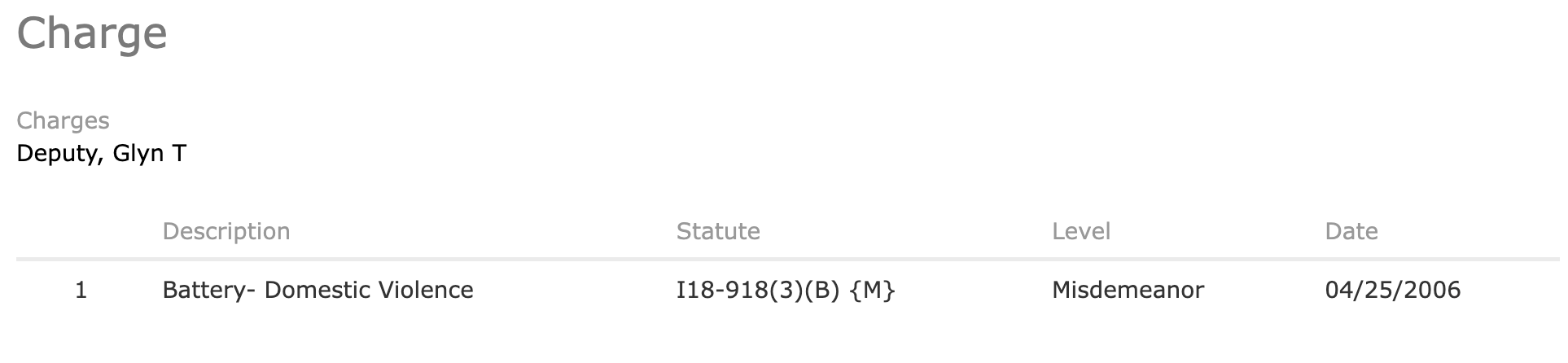
Questions regarding the vetting of staff at Tutty’s practice have also surfaced. Tutty’s associate at Northwest Family Psychology, Glyn Deputy, has a documented history of criminal charges.
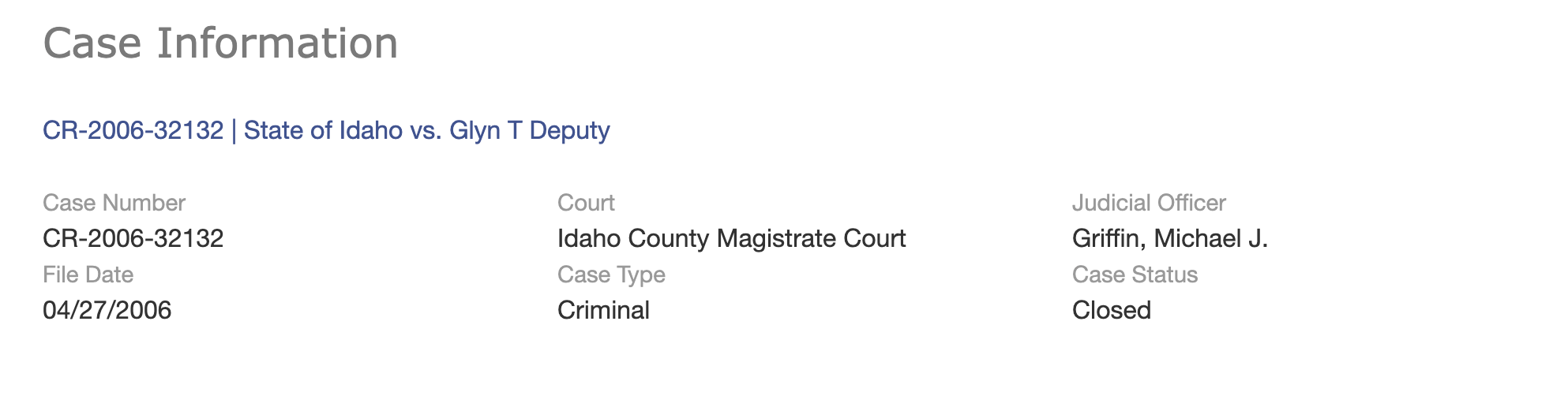
Court records from Idaho show that Deputy was charged with domestic violence related crimes, yet Deputy appears to perform domestic violence evaluations and work with victims.
Concealed Ties to Controversial Wilderness Industry
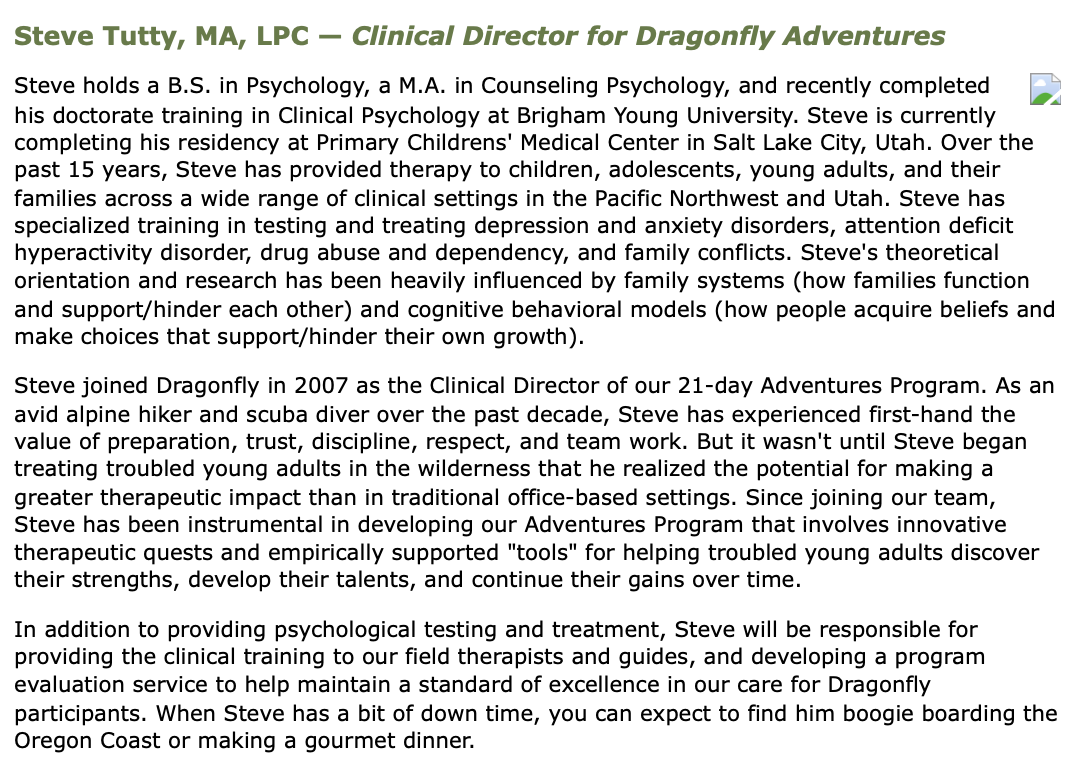
Our investigation into Tutty’s background reveals an effort to conceal his past role as “Clinical Director” for Dragonfly Adventures, a troubled teen wilderness program, which has since shut down.
Tutty’s CV used in courts omits his 2007 tenure at Dragonfly, where he oversaw psychological testing and treatment in the wilderness. This omission may be strategic. Dragonfly was founded by Glenn White and Mona Treadway, former leaders of the Crater Lake School. The Crater Lake School was forced to close by the state of Oregon in 2004 following investigations into “mistreatment of teen residents, sexual impropriety, lax oversight and poor record keeping.”
We were able to recover a copy of the deleted Dragonfly website through the Internet Archive. According to the website, Tutty joined in 2007 as Clinical Director of the 21-day Adventures Program. Tutty provided psychological testing and treatment, and clinical training to the therapists and guides.
We also submitted a public records act request for Tutty’s psychology licensing records in the state of Oregon during his time at Dragonfly.
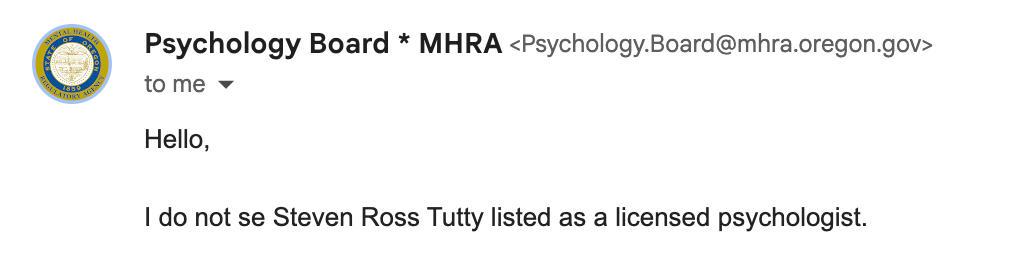
Surprisingly, Tutty has never been licensed as a psychologist in Oregon, even though the Dragonfly website states he performed “psychological testing and treatment.”
The concealment of this chapter in Tutty’s professional history raises further questions about his fitness as a custody evaluator. By aligning himself with the former leadership of a disgraced institution known for abuse and negligence, Tutty demonstrated a troubling tolerance for unethical and abusive treatment models. His subsequent decision to conceal this experience from his CV suggests he understood that this association would damage his credibility in family court.
A willingness to hide professional history to avoid scrutiny mirrors the very allegations currently facing Tutty—altering reports to suit a client’s narrative rather than adhering to objective clinical truth. Parents and courts relying on his “neutral” expertise may have been unknowingly subjecting children to the judgment of a clinician with a documented link to the industry’s darkest corners.
Washington State Dependency and Family Law Cases
Despite these controversies, Tutty has maintained a significant role in the state’s legal and child welfare systems. His resume lists extensive experience providing expert testimony in dependency matters for the Department of Social and Health Services and county courts.
Between 2011 and 2025, there are dozens of cases where Tutty served as an expert witness in Washington courts, weighing in on matters of “child abuse,” “parental fitness,” and “termination of parental rights.”
The current DOH charges, which question Tutty’s objectivity and willingness to alter reports for clients, cast a shadow over his history of influence in these sensitive family law cases.
Legal experts suggest that every custody decision based on Tutty’s evaluations may now need to be reviewed and potentially vacated.
Support The Olympic Herald
If this story mattered to you, help us report the next one
The Herald has no paywall and no corporate owner. Reader support is what pays for the records requests, court hours, and follow-through that accountability reporting takes.
Become a monthly supporter
Steady, recurring support is what lets us commit to long investigations instead of chasing quick hits. Members get no special perks — just the knowledge that fearless local reporting exists because of them.
$10/mo
or
$100/yr
Become a member
Cancel anytime · Secure checkout via Stripe
Give once with a card
Pick an amount below — secure Stripe checkout takes under a minute.
Want to give a different amount? Choose your own →
Secure checkout via Stripe · No account required
Republish this story
Our stories are free to republish, online or in print, under these rules:
- Credit The Olympic Herald and the author, and link back to this story.
- Don't edit the story except for style, length, or to update time references.
- If you republish online, use our canonical URL so search engines credit the original.
- Don't sell the story or use it primarily to sell advertising.
Questions? Contact us.