
Seattle Family Law Attorney Suspended Following Harassment Campaign During Personal Divorce

The Washington State Supreme Court has handed down an eight-month suspension to Seattle-based family law litigator Timothy Ronald Richards, following a series of severe professional misconduct violations that occurred during his own divorce proceedings.
The suspension, effective as of January 28, 2026, highlights the intense ethical boundaries lawyers must maintain, even when navigating their own personal legal disputes.
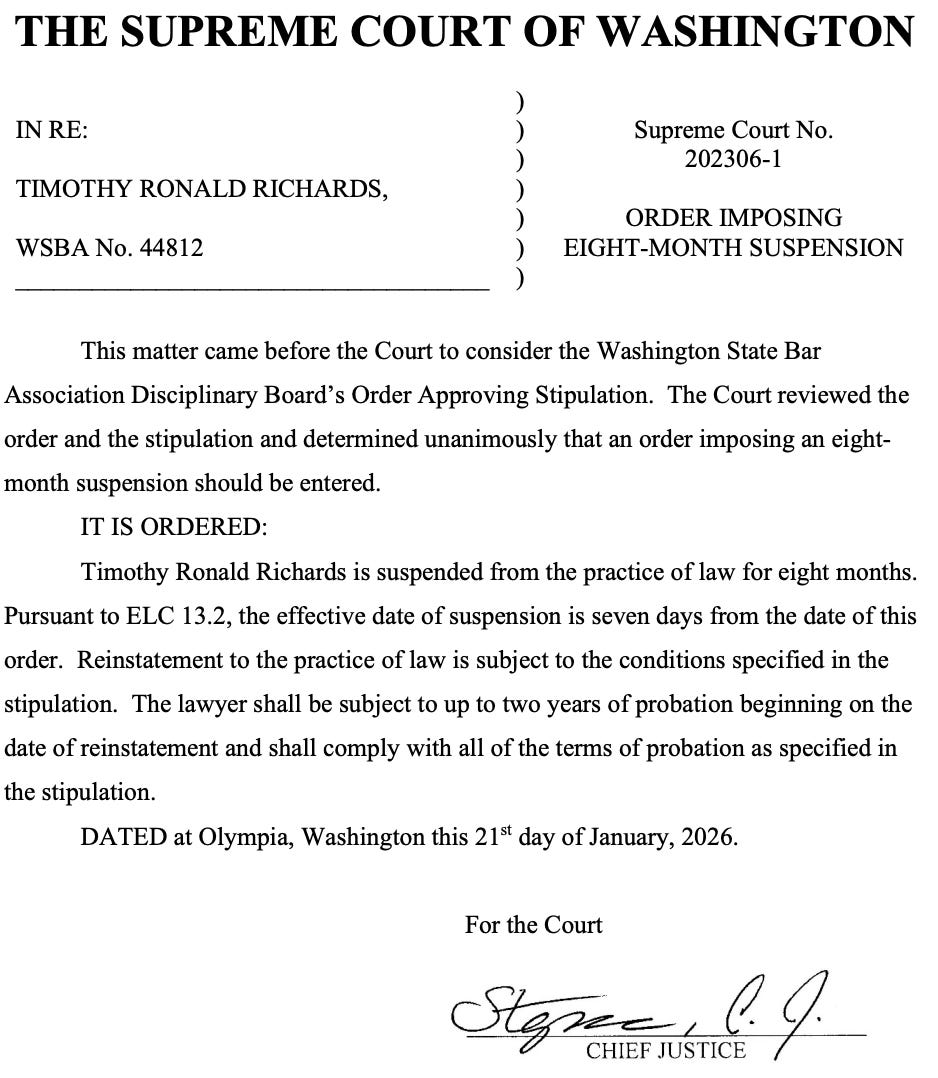
Richards’ disciplinary record paints a troubling picture of a legal professional disregarding court orders and harassing opposing counsel, his former spouse, and third-party citizens.
A Breakdown of Court Order Violations
The disciplinary board’s records detail a disturbing escalation of behavior stemming from a dissolution petition Richards filed against his then-spouse, in August 2022. While representing himself in the proceedings, Richards willfully violated multiple court orders.
Despite representing himself, Richards failed to adhere to the boundaries set by the court. On February 23 and February 24, 2023, the court entered a final restraining order and a parenting plan. The orders restricted communication, prohibited insults, and barred telephone contact except in bona fide emergencies.
Richards ignored these mandates shortly after they were issued. Between March 11 and March 12, he sent his former spouse multiple text messages filled with profanity and demeaning language, none of which constituted an emergency.
He further violated the restraining order by making repeated phone calls and sending harassing messages.
The misconduct continued even after the court issued a domestic violence protection order on March 15. In late April, Richards knowingly violated that order by repeatedly calling his former spouse and leaving voicemails.
Harassment of Opposing Counsel and Third Parties
The misconduct extended beyond his former spouse, severely impacting the broader legal proceedings and innocent bystanders.
After Sara Epler, the attorney representing his former spouse, informed Richards she would only communicate with him in writing, Richards escalated his behavior. On Sunday, April 23, 2023, Richards drove to Epler’s private residence, demanded to speak with her, and intentionally scratched her vehicle before leaving the property. This act of vandalism and harassment caused Epler to withdraw from representation.
Additionally, Richards targeted a tenant living in the former marital home, Elba Moreira. When Moreira refused to write a declaration supporting Richards in the divorce, he retaliated.
The retaliation began on January 27, 2023, when Richards contacted Moreira’s employer via email to falsely claim that she was mentally unstable.
When Moreira subsequently refused his pressure to vacate her rental unit in the marital home, Richards attempted to leverage city regulations against her. He reported the living arrangement to the Seattle Department of Construction and Inspections, alleging the unit violated city code.
The campaign included direct personal attacks as well, with records indicating he sent text messages addressing Moreira with derogatory names.
The Disciplinary Board noted that this conduct served no substantial purpose other than to embarrass, delay, or burden Moreira.
Mitigating Factors and Path Forward
The Washington State Bar Association’s Office of Disciplinary Counsel noted that Richards was experiencing severe anxiety and depression during the divorce, which the disciplinary counsel felt, “substantially contributed to his misconduct.”
His lack of a prior disciplinary record and demonstrated remorse were also considered mitigating factors. Richards has reportedly engaged in mental health treatment and shown successful rehabilitation.
A copy of Richard’s Stipulation is available here.
Attorneys and doctors…some are just plain assholes. The degree does not make them a good person.
I have two comments I want to make. First, isn’t it interesting to note how the effects of stress from the divorce were mentioned. He became victim of the same system he was part of.
Secondly, I find it noteworthy how the actions of someone working in Family Law suggest he knows perfectly well that there are relatively few penalties for men not following the family law orders. He clearly knows this and put it into practice. I’m sure not following orders still wouldn’t have been an issue had he not shown up at the home of a peer and vandalized her car.