
On paper, the Sequim School District boasts robust anti-discrimination policies, dedicated Title IX coordinators, and strict procedures mandating swift, five-day turnarounds for harassment investigations.
In reality, the district spent decades looking the other way. What began in the 1990s as a failure to monitor predators eventually hardened into a sophisticated retaliatory machine.
Controlled by an entrenched administrative clique known internally as the “six pack,” district leadership systematically punished whistleblowers, shielded abusive executives, and ultimately cost taxpayers and insurers more than $2.35 million in civil rights settlements.
Peterson Conviction
Dennis Peterson was an active, 49-year-old alternative education, computer literacy, and photography teacher employed by the Sequim School District until 2001.
Rather than serving as a safe educational environment, the Sequim Community School became his primary hunting ground, with the district unwittingly providing the daily access, physical classroom space, and school resources he used to facilitate his abuse.
This catastrophic institutional blind spot was fully exposed in December 2001, when Peterson was convicted in federal court of 10 counts of child pornography and related offenses, including four counts of the production of child pornography.
Federal court documents reveal a horrifying reality: Peterson was actively utilizing school resources and school property to facilitate his abuse.
Court records detailing the January 2001 search warrants reveal the staggering extent of his operations inside the school. Peterson, who taught computer literacy and photography, used his classroom as a primary recruitment ground.
Further forensic analysis of the seized media revealed that Peterson was using an Olympus digital camera to photograph the abuse, with digital timestamps placing some of the assaults between 11:00 a.m. and noon during November and December 2000.
Investigators even matched the background of explicit photos of a 17-year-old student to the exact layout of Peterson’s classroom, realizing the images had been captured directly from his desk.
According to the sworn FBI criminal complaint, Peterson approached underage female students—some as young as 16 and 17—directly inside his classroom, offering them thousands of dollars to pose for explicit photos intended for internet distribution.
During a meeting in his classroom at 8:15 a.m.—well before the 9:00 a.m. start of classes—Peterson attempted to recruit a 17-year-old student, offering her up to $5,000 for as few as 30 pictures, and promising to provide her with a car and an apartment in Arizona.
Peterson brazenly demonstrated his network by inserting a 3.5-inch floppy disk into his school-provided computer to show the student and a 20-year-old companion approximately 20 nude photographs of other females, including one he had taken locally at Dungeness.
Peterson chillingly bragged to one victim that he had recruited up to 100 girls over a four-year period. He operated with impunity right under the administration’s nose.
The FBI complaint details how Peterson conducted an initial nude photo shoot with a 17-year-old student early in the morning inside the Sequim Community School itself before classes started.
On January 19, 2001, Sequim Police obtained warrants to search that classroom and his 1993 Ford Escort, later expanding the search to his home.
A subsequent search of his classroom resulted in the seizure of a high-school-owned computer and zip disks containing hundreds of images of underage females in sexually explicit poses.
Peterson admitted to law enforcement that he brought the contraband disks with him to the school, storing them in his 1993 Ford Escort while on campus, though he confessed to bringing them inside the building to download templates onto the disks.
He was finally arrested at 7:30 a.m. on January 22, 2001, just as he was arriving at the school.
During his subsequent interrogation by Sequim Police Detective Kirk Chaney, Peterson desperately attempted to deflect blame. He initially claimed he only downloaded images from the internet on his home computer, and then shockingly attempted to smear one of his 17-year-old victims.
Peterson specifically tried to discredit the teenager by claiming she came from a “bad family” where she was told she would be kicked out at eighteen, and pointed to a large tattoo on her arm to imply she was untrustworthy.
The investigation eventually expanded to Peterson’s home, where police seized two Olympus digital cameras. Investigators also discovered emails referencing encrypted files labeled “my eyes only” from an associate, hinting at a broader, sophisticated network of distribution that Peterson was desperate to hide.
The software was an encryption package requiring a password with “no back door,” further demonstrating the calculated nature of his crimes.
The case, initially spearheaded by the Sequim Police Department, was eventually referred for federal prosecution in April 2001. This transition exposed the massive logistical nightmare of prosecuting such prolific abuse.
Federal authorities spent weeks transferring and cataloging the evidence, causing significant trial delays as both defense and prosecution experts required extensive time to forensically examine the “mirror-image” copies of the hard drives and zip disks.
The ensuing legal battle over this digital evidence was fierce, with Peterson’s federal defense attorney demanding physical “mirror-image” copies of the hard drives for a private lab analysis in Spokane. The government staunchly refused, arguing that replicating and distributing the materials—even to defense experts—would constitute the unlawful distribution of child pornography.
The government and defense eventually had to enter into strict stipulated agreements just to transport the contraband.
Court orders specifically mandated how the mirror image copies were created, handled, and shipped via Federal Express to the defense’s forensic expert in Spokane, underscoring the highly restricted, illicit nature of the files Peterson had amassed.
He even brought multiple teenage students to the local Ramada Inn for highly explicit photo shoots.
The horrifying scope of the evidence was staggering. During federal court proceedings, Assistant United States Attorney Kathryn Warma strongly opposed Peterson’s release on bail, pointing out that one of the photo shoots occurred in a student’s low-income shelter apartment after Peterson literally paid her $20 for child care just so her toddler son wouldn’t be present while he photographed her.
The prosecutor bluntly warned the court that “Dennis Peterson is a sexual predator who knows no bounds”.
The volume of evidence collected against him was so massive—including disks that contained “hundreds of pictures” with “175 to 200” coming from a single session—that the defense actually had to file a motion for a “Bill of Particulars” just to decipher which exact “Jane Does” and images the government was relying on for the indictment.
The audacity of Peterson’s defense further underscored how his professional standing was weaponized to deflect accountability.
Despite the mountain of physical evidence pulled from his Sequim Community School classroom, court records show Peterson formally pleaded not guilty to the four-count federal indictment—comprising three counts of production and one count of possession of child pornography—during his May 11, 2001, arraignment.
His defense team vigorously fought his federal detention, leaning heavily on his unblemished 25-year teaching career across California and Washington to argue he was neither a flight risk nor a danger to the community.
He used his tenure as an educator—the very position he exploited to access his victims—as a shield to request leniency.
As trial approached, Peterson’s defense team escalated their victim-blaming tactics in an effort to secure an acquittal. In a shocking legal maneuver, they argued that because one of the 17-year-old victims was legally considered an “emancipated minor” under Washington state law, federal child pornography laws should not apply to her exploitation.
As the forensic examinations of the hard drives progressed, the true, horrifying scale of Peterson’s network came into focus. On September 19, 2001, the federal grand jury handed down a devastating 10-count Superseding Indictment.
The new charges revealed that Peterson’s abuse was far wider than initially realized, identifying five different underage “Jane Does,” aged 16 and 17, and an 18-year-old.
The superseding indictment also exposed that Peterson was actively trafficking these images across state lines.
Federal prosecutors charged him with uploading the explicit photos of a 17-year-old student to an underground amateur pornography website based in Ohio.
Perhaps most chillingly, the court records revealed that Peterson weaponized his own students against one another: Count 7 of the indictment charged him with using a 17-year-old victim to actively assist in the sexual exploitation and photographing of another young woman.
In December 2001, Peterson was convicted in federal court of 10 counts of child pornography and related offenses, including four counts of the production of child pornography.
The Quiet Resignation
In January 2004, Dave Cross, an 18-year veteran high school and middle school choir teacher, was placed on administrative leave before being formally fired on March 12 following a six-week investigation.
According to the Sequim Gazette, administrators produced a 30-page report outlining ten specific allegations against Cross.
The findings included: inappropriate physical contact with students, breach of confidentiality, misuse of district technology, and demonstrated “grooming” behaviors intended to establish intimate relationships with students once they graduated.
The district’s own records showed Cross had already received two prior written reprimands regarding protocol, yet he remained in his position until the 2004 investigation forced the administration’s hand.
While Cross initially filed an appeal with the backing of a Washington Education Association lawyer, he abruptly withdrew it in April 2004 and surrendered his teaching certificate to the state.
According to the Peninsula Daily News, in exchange for Cross dropping his appeal, the district explicitly agreed to cease investigating any other allegations against him.
More egregiously, the district allowed him to collect his full salary and benefits—totaling approximately $60,000—through the end of the school year in August.
Rather than pursuing full, transparent accountability for an educator with documented grooming behaviors, the administration effectively paid him to walk away and formally promised to stop looking into his past.
The Chris Boushey Investigation
In another instance of a quiet departure superseding transparent accountability, the district allowed a middle school teacher to resign in late 2004 following highly inappropriate, late-night communications with a minor.
Chris Boushey, a 52-year-old technology teacher at Sequim Middle School, engaged in more than 20 hours of private Internet chats with a 13-year-old seventh-grade female student.
Using the chat service MSN Messenger on at least 17 different occasions between June and November, Boushey leveraged his position as her computers teacher—having previously helped her and her classmates set up online “blogs”—to regularly read her intimate journal entries and insert himself as a confidant.
The chat transcripts released by the district revealed deeply disturbing boundary violations. Boushey offered sympathy and empathy to the lonely student, inappropriately stepping into the role of both a soothing male elder and a fellow teenage gossip.
When the 13-year-old admitted to hacking her mother’s computer to bypass agreed-upon parental controls, Boushey actively encouraged the behavior.
During that same June 24 exchange, Boushey disturbingly asked the underage student, “So when do I get to see you without makeup?”
An independent reviewer, Sequim Middle School principal Jack Hedges, concluded that Boushey’s actions exhibited a clear pattern of “grooming” activities.
Furthermore, an investigator reported that Boushey actively continued his online chats with the student even after he knew she was deliberately hiding the communications from her parents.
When the district finally uncovered the correspondence in early November 2004, Boushey was immediately placed on paid administrative leave. However, following a six-week investigation into the extensive chats, Boushey was permitted to resign in December of that year.
As with other concurrent cases, the district accepted a quiet resignation, allowing an educator with documented grooming behaviors to simply walk away.
The Dave Trapp Settlement
Dave Trapp, a veteran science teacher at Sequim High School with a 40-year career, was initially discharged following multiple documented incidents of “bullying” and harassing behavior toward his students.
The district’s investigation detailed severe physical altercations, including a physical “skirmish” with a student over a beverage bottle that left red marks and scratches on the boy’s abdomen.
In a separate incident, 14 student eyewitnesses reported seeing Trapp engage in inappropriate physical contact that left a large red mark on another student’s chest.
Despite district administrators compiling these findings and noting that Trapp already had four prior written reprimands on his record, the administration’s resolve crumbled when Trapp formally appealed his termination and publicly blamed the students for his dismissal.
Rather than defending their investigation in a public appeals hearing—a proceeding that would have fully exposed the administration’s failure to act on Trapp’s four previous reprimands—the district opted for financial appeasement.
In April 2005, district officials signed a settlement agreement that officially rescinded his firing.
Trapp was allowed to formally resign at the end of the school year, while the district agreed to keep him on paid administrative leave, providing him with continued compensation until his retirement date.
The Pipeline of Predators
The district’s hiring and screening practices have also raised red flags about who is permitted access to its student body.
Meredith Powell, a Sequim native, was cleared by the district to work as a substitute teacher at Sequim High School in the spring of 2012.
Shortly after leaving the Sequim School District, she was hired as a teacher in Tacoma. There, she was arrested and ultimately pleaded guilty to having sex with her pupils at Lincoln High School.
In August 2014, a Pierce County Superior Court judge sentenced the 25-year-old former educator to six months in jail and ordered her to complete a three-year sex offender program.
While Sequim officials claimed no formal complaints were filed during her brief tenure substituting in their classrooms, the case underscores the terrifying reality of who the district allows to stand in front of its students, serving as an unmonitored pipeline for individuals who go on to commit severe abuses.
Importing Red Flags
The district’s failure to protect students extends beyond merely hiding its own internal problems.
In March 2012, Paul Brinkmann, then a 47-year-old math teacher at Stevens Middle School in the neighboring Port Angeles School District, was arrested.
The criminal charges leveled against him were horrifying: two counts of first-degree child molestation, four counts of second-degree rape of a child, three counts of third-degree rape of a child, and one count of second-degree rape by forcible compulsion, according to the Peninsula Daily News.
He was immediately placed on administrative leave by then-Port Angeles Superintendent Jane Pryne. In April 2013, Clallam County Superior Court Judge Brooke Taylor dismissed the charges.
However, this dismissal was not due to a definitive exoneration or exculpatory evidence. The charges were dropped simply because the alleged victim refused to testify at trial—a tragically common occurrence in severe abuse cases.
Despite this highly public, deeply disturbing history of severe felony child rape and molestation charges just one town over, the Sequim School District eventually hired him.
Today, Paul Brinkmann is listed on the official staff directory as an active Algebra and Geometry teacher at Sequim High School.
The district also entrusts him to be the head coach of the high school Cross Country team, granting him daily, direct access to student-athletes.
The overlap in administration makes this hiring even more troubling: Jane Pryne, the Port Angeles superintendent who oversaw Brinkmann’s initial administrative leave during his 2012 criminal case, later became the Interim Superintendent of the Sequim School District in 2020.
The Blind Spot
The district’s vetting and monitoring protocols have catastrophically failed to identify active predators operating within their own athletic programs.
In 2014, Jerry Jeff Pedersen, a 29-year-old volunteer assistant coach for the Sequim High School girls basketball team, was arrested and later pleaded guilty to five counts of communicating with a minor for immoral purposes.
Pedersen, who had been a volunteer coach for the district since November 2012, used his position to target a 15-year-old player on his team. He engaged in a highly inappropriate relationship with the student, sending her hundreds of text messages.
How did the district uncover this severe boundary invasion? They didn’t. The high school administration remained entirely unaware of the abuse operating right under its nose.
Instead, it took the mother of another student—who had heard rumors about the inappropriate contact—to bypass the school entirely and report the abuse directly to the police.
In October 2014, Pedersen was sentenced to 60 days, strictly split between 30 days in jail and 30 days of electronic home monitoring. Furthermore, he was legally mandated to register as a sex offender.
Hiding the Truth
How does a school district maintain this level of staggering dysfunction for so long? By actively breaking the law to keep the public in the dark.
For years, the Sequim School District routinely denied public records requests regarding its internal investigations, citing “privacy” to shield its administrators from scrutiny and hide the depth of the complaints piling up against them.
This pattern of evasion has repeatedly surfaced during the district’s most severe crises. For instance, when local news outlets filed public records requests in late 2020 and early 2021 seeking documents pertaining to the sudden, simultaneous administrative leaves of top leaders—including former Superintendent Robert Clark and high school principal Shawn Langston—the district actively stonewalled the press.
According to reports from the Sequim Gazette and Peninsula Daily News, the district repeatedly missed its own self-imposed disclosure deadlines and ultimately withheld crucial records from public scrutiny.
But in May 2024, the district was finally forced to pay the price for its secrecy.
According to Washington State public records actions reported by the Peninsula Daily News, the district agreed to a $40,000 settlement with Whidbey Island resident Eric Hood, who sued the district for blatantly violating the Public Records Act after submitting a request in May 2020.
The settlement forced the district to publicly admit that its initial responses to records requests were illegal and mandated a complete overhaul of its document disclosure procedures to ensure they no longer made assumptions about requester intent and actually searched the files of higher management.
It was a costly legal admission that the district’s default operational setting was to hide its internal turmoil from the very taxpayers funding it.
The Financial Hypocrisy
The millions of dollars the district and its risk pool have poured into settlements to cover up administrative retaliation stand in stark contrast to how the district treats the educators actually working in the classrooms.
While administrators were busy fabricating rumors and violating the Public Records Act, the district was simultaneously stonewalling its own teachers over basic compensation.
In September 2017, negotiations between the Sequim Education Association and the district deteriorated so badly that the state’s Public Employment Relations Commission had to intervene, according to the Peninsula Daily News.
Teachers crammed into school board meetings wearing red to protest the district’s refusal to pay them a fair wage, pointing out that Sequim lagged significantly behind surrounding Olympic Peninsula districts.
“We got our priorities out of order,” one teacher told the board, highlighting that the district consistently prioritized administrative bloat over the educators keeping the schools running.
The hypocrisy is impossible to ignore: the district fights its teachers for every dime, yet it effortlessly authorizes massive payouts when its own leaders violate civil rights laws.
Weaponizing the Grievance Process
The lengths the district went to hide its records make perfect sense when examining how it treated the employees who tried to expose the rot from within.
In a landmark federal lawsuit originally filed in May 2018, former middle school physical education teacher and athletic director Autumn St. George sued the district, alleging that colleagues and the administration had relentlessly targeted her sexual orientation.
According to her federal complaint, the hostile work environment began following a staff gathering at a local Applebee’s in January 2015.
After a middle school counselor, Catherine Shea, assumed St. George was gay, she allegedly suggested St. George ask a waitress there on a date, leaving St. George mortified.
The lawsuit states that Shea then began gossiping about St. George’s sexuality with several co-workers, repeatedly asking them if their “gaydar” went off around her.
When St. George went to Principal Vincent Riccobene to file a grievance about the harassment, the complaint alleges he failed to take meaningful action.
Instead, the district’s human resources department allegedly steered St. George away from an outside investigation by warning it would “bring the spotlight on Plaintiff’s sexuality,” opting to conduct a superficial in-house review that resulted in no discipline for Shea.
As the retaliation escalated, the administration actively weaponized its own personnel files.
According to court filings, Assistant Principal Rhonda Kromm authored an inflammatory document in 2016 that was placed in St. George’s file implying she might be engaged in “pedophilic behavior.”
While Kromm claimed it was a mistake and shredded a copy in front of St. George, the horrifying accusation was discovered back in her official personnel file a year later, complete with a sticky note bearing Kromm’s initials.
When confronted about the document’s reappearance, the complaint details a terrifying encounter where Kromm allegedly cornered St. George in her office, blocked the door, threw her keys on the floor, and screamed at her.
Perhaps the most glaring example of the district’s retaliatory grievance process occurred when Shea filed a formal complaint of “harassment and workplace hostility” against St. George—a complaint that coincidentally mirrored the very grievances St. George had been raising for two years.
The district immediately hired an investigative lawyer who, according to the complaint, used the meeting not to mediate, but to interrogate St. George about “being out of the closet.”
When St. George, emotionally shattered by the coordinated attacks, required an administrative day off, Principal Riccobene’s documented response to union leadership was to allegedly ask, “what the fuck is going on? [St. George] is being dramatic about this situation!”
The retaliation allegedly continued even after the lawsuit became public.
According to an amended complaint, Principal Riccobene retaliated against St. George again in June 2018—just weeks after the initial federal filing—by abruptly terminating a supplemental services contract for a highly successful student mentorship program known as “WEB” that St. George and another gay coworker had run for two years.
This brazen escalation forced St. George to amend her lawsuit, officially naming Principal Riccobene, Assistant Principal Kromm, and counselor Catherine Shea as individual defendants to hold them personally accountable alongside the district.
Yet, even when personally named in federal court, the administrators and the district closed ranks.
In January 2019, the district’s legal counsel filed an amended answer on behalf of both the school system and the individual administrators, issuing a wave of blanket denials.
Rather than acknowledging the documented termination of the WEB contract or the escalating hostility, the administration doubled down, raising affirmative defenses that attempted to shift the blame back onto St. George by claiming “comparative fault.”
However, the district’s aggressive legal shield was not built for a courtroom.
In March 2019, just months before the case was scheduled to go to a jury trial, the district abandoned its defense.
Court records confirm that all claims were abruptly resolved, resulting in a stipulated order dismissing the lawsuit with prejudice.
Rather than facing full public accountability for the coordinated retaliation, the district chose a massive financial settlement—effectively buying its way out of a public trial and keeping the full extent of the administration’s toxicity hidden from the taxpayers.
The Price of Retaliation
The most staggering example of this systemic administrative failure culminated in a catastrophic $1.5 million settlement paid to former student support specialist Hanna McAndie in March 2023.
The origin of this massive financial liability was shockingly simple: an employee tried to protect a vulnerable student.
According to a federal lawsuit and tort claim filings, the incident began on April 25, 2019, when McAndie was facilitating a Community Truancy Board hearing.
Because a parent was unable to attend, then-Sequim Middle School Principal Vincent Riccobene brought a special education student into the meeting instead.
According to federal court filings, Riccobene was belligerent and intimidating, verbally attacking McAndie and openly mocking the special education student in a discriminatory manner in front of staff and community volunteers.
Under the direction of Assistant Superintendent Jennifer Maughan, McAndie subsequently filed a formal incident report on May 9, 2019.
In a functional district, this report would trigger an immediate, neutral investigation. In Sequim, it triggered a coordinated campaign of administrative retaliation that effectively derailed an employee’s career.
The backlash was instantaneous. Court records show that McAndie faced such severe, immediate retaliation from Riccobene and then-Human Resources Director Randy Hill that she was forced to file a second complaint just eight days later regarding the mishandling and breaches of confidentiality surrounding her initial report.
In her sworn declaration, McAndie noted that Riccobene was part of an entrenched administrative faction self-referenced as the “six pack” who controlled the district.
Former Superintendent Robert Clark—who took over the district in July 2019—allegedly escalated this retaliation to destroy McAndie’s credibility.
According to the complaint, Clark launched a baseless, rogue investigation to substantiate a scurrilous rumor that McAndie had engaged in an extramarital affair with Clark’s predecessor.
In a glaring professional boundary violation, Clark allegedly approached McAndie’s own father-in-law, who worked as the Director of Maintenance for the district, to interrogate him about the fabricated affair, implying that McAndie was cheating on his son.
The hostility was reportedly systemic. Assistant Superintendent Maughan testified under oath that Clark “routinely” harassed female employees and engaged in conduct that promoted “favoritism and cronyism.”
When McAndie filed a formal sexual harassment complaint and initiated an Equal Employment Opportunity Commission charge in late 2020, the district’s instinct was institutional preservation.
Instead of completing the investigation into the superintendent, the district negotiated a separation agreement that allowed Clark to quietly resign, effectively sweeping the matter under the rug.
Adding insult to injury, the district allegedly released unredacted public records regarding McAndie’s complaint, leading a community member to publicly defame her on social media.
The administration’s vengeance extended to anyone who corroborated the abuse. Sworn declarations reveal that Assistant Superintendent Maughan was kept on administrative leave for an entire school year after identifying retaliation for participating in the investigations into Clark and Riccobene.
In a stunning conflict of interest, the Washington Schools Risk Management Pool—the district’s insurer—inexplicably assigned Clark’s personal defense attorney to oversee Maughan’s retaliation grievance.
The personal and professional toll on McAndie was absolute. In her tort claim, she revealed that the trauma of the administration’s harassment forced her to move in with her in-laws pending a divorce.
Furthermore, she was forced to un-enroll from her teaching certification program because she no longer felt safe completing her required student teaching within the Sequim School District, leaving her with an unfinished degree and a permanent loss of future earning power.
When forced to answer for this conduct, the district deployed its legal counsel to issue blanket denials. Clark’s attorneys argued that his actions were performed within the “scope of his employment,” shifting the liability entirely onto the district under the doctrine of respondeat superior.
The defense strategy became increasingly absurd as the litigation dragged on.
In December 2022, a federal judge had to strike down a motion for summary judgment filed by Clark’s legal team, explicitly noting that they were aggressively fighting claims that the plaintiff wasn’t even bringing against him.
“Defendant Clark continues to ask the Court to dismiss the claims, which do not exist,” the judge wrote in his order. “Curious, indeed.”
Despite this judicial rebuke and a failed mediation attempt, the district’s scorched-earth strategy persisted into 2023.
Even after McAndie filed a Second Amended Complaint detailing the extent of her damages in January 2023, the district’s attorneys filed yet another formal answer issuing blanket denials and asserting comparative fault.
The legal team continued to drag McAndie’s family and colleagues into the crossfire, issuing last-minute federal subpoenas and deposition notices for former Interim Superintendent Jane Pryne, staff members, and community bloggers just weeks before the trial date.
The district also launched highly invasive discovery tactics, issuing subpoenas demanding access to McAndie’s private psychiatric and counseling records.
The fallout from this relentless defense was catastrophic. After burning through legal fees and exhausting every avenue to intimidate witnesses, the district’s risk pool was ultimately forced to pay a massive $1.5 million to resolve the claims in March 2023.
The administration’s unwavering commitment to protecting its executives meant that the taxpayers financed the settlement, while the superintendent accused of orchestrating the retaliation walked away shielded from personal financial ruin.
A Slap on the Wrist
In October 2020, the district’s instinct for administrative self-preservation was once again on full display.
During the exact same week that Superintendent Robert Clark was ousted and placed on leave for his retaliatory actions, Sequim High School Principal Shawn Langston was also placed on administrative leave following formal complaints of sexual harassment and sex discrimination.
The allegations stemmed from Langston allegedly creating an uncomfortable work environment by sharing a sixth-grade school assignment titled “Girls” and playing an inappropriate song during a staff meeting, treating certain individuals more favorably than others.
The district’s response? According to internal district investigation findings, it was concluded that while Langston did violate district policy, his actions didn’t technically constitute unlawful sex discrimination.
He was given a letter of reprimand outlining future expectations, assigned a “mentor,” mandated to attend mediation to “facilitate healthy open dialogue amongst the staff,” and quietly returned to his post as the head of the high school.
The Administrative Shell Game
Rather than formally removing leaders implicated in severe civil rights lawsuits, the Sequim School District has repeatedly relied on a strategy of administrative shuffling—a shell game designed to keep problematic leaders on the payroll while hiding them from immediate public outrage.
Consider Vincent Riccobene. Despite being the inciting figure in the massive McAndie lawsuit, he was not fired. Instead, the district attempted to quietly remove him from the middle school and reassign him.
According to sworn declarations, former Superintendent Gary Neal originally planned to transfer Riccobene to Greywolf Elementary as a “co-principal” so his decision-making could be guided by a stronger administrator.
However, that plan collapsed when Robert Clark took over as superintendent.
In a sworn deposition, Clark admitted he canceled the Greywolf transfer and instead gave Riccobene what he termed a “lateral move”—reassigning him to serve as an alternative school principal and Career and Technical Education supervisor with absolutely no reduction in pay.
According to McAndie’s amended federal complaint, this administrative shuffle placed the victim directly back in harm’s way.
The filing states that in the autumn of 2020, despite McAndie explicitly expressing her discomfort to the administration, the district relocated Riccobene to the exact same building where she worked.
The proximity allegedly allowed the hostility to resume. According to the complaint, Riccobene later cornered McAndie at the beginning of a scheduled principal’s meeting, placing his right hand on her shoulder and gripping it hard in an aggressive, bullying manner while speaking directly into her face.
The court filing notes that this specific method of physical intimidation was so well known among district employees that staff commonly referred to it as his “vulture grip.”
The retaliatory nature of this faction was an open secret. In an October 2020 text message, School Board Director Jim Stoffer explicitly acknowledged that the rumors circulating about McAndie were orchestrated by “the 6 pack” as direct retaliation for her filing a complaint against Riccobene.
Sworn deposition testimony further exposed the mafia-like grip this group held over the district.
Witnesses testified under oath that if an employee crossed the “6 pack,” they were systematically “run out” of the district, specifically naming multiple female employees whose careers were allegedly derailed by the faction.
Assistant Superintendent Jennifer Maughan testified that Clark actively socialized with this group—golfing with Riccobene and other implicated leaders—noting that to survive in the district office, “you either have to be a male or you have to play the game.”
Despite this awareness at the board level, the shell game extended beyond physical locations to manipulate the chain of command to protect the administration’s own.
Court records reveal that an independent investigator, Shawn Flood, had officially substantiated McAndie’s claims that Riccobene acted in an aggressive, sarcastic, and intimidating manner.
Based on those findings, Assistant Superintendent Maughan drafted a formal letter of reprimand.
However, Clark explicitly ordered Maughan to abandon the reprimand and abruptly removed Riccobene from her supervisory authority.
Clark assumed direct supervision over Riccobene himself, despite lacking the state-mandated training to evaluate principals, effectively shielding his golfing companion from any professional accountability.
Retaliation at the Top
The board’s dysfunction was matched only by the continued retaliatory tactics of the administration.
When Robert Clark quietly resigned in January 2021, he dodged a full public reckoning while leaving the taxpayers to foot the bill for his misconduct. But the financial bleeding caused by his tenure was far from over.
Clark’s retaliation against whistleblowers who refused to “play the game” was systemic and vindictive.
According to her sworn declaration, after McAndie reported the harassment, Clark systematically dismantled her working conditions. He stripped her of her flex schedule, moved her from a private office to a monitored desk, and split her job responsibilities to create an impossible workload.
When that failed to force her resignation, Clark attempted to demote her position into the secretaries’ union to slash her pay and benefits—a move McAndie successfully defeated by testifying at a formal state Public Employment Relations Commission hearing.
The administration’s retaliatory reflexes remained fully intact even after Clark’s departure. When Assistant Superintendent Jennifer Maughan attempted to protect her staff and filed a formal statement supporting McAndie’s complaint, the district’s response was swift and punitive.
Maughan was stripped of her duties and placed on administrative leave for the entire 2021-2022 school year.
Furthermore, rather than conducting a neutral, timely review of Maughan’s own retaliation grievance, the district’s risk pool assigned Robert Clark’s personal defense attorney, Lori Bemis, to act as the equity compliance officer overseeing Maughan’s complaints.
Ultimately, the district paid Maughan over $700,000 to settle her claims.
The retaliation against McAndie culminated in a shocking breach of privacy during the litigation itself.
In late December 2022, the district’s legal counsel filed exhibits on the public federal court docket that contained McAndie’s highly sensitive, unredacted psychological evaluation.
According to sworn declarations from McAndie and her expert psychologist, publishing these intimate clinical details for the community to read triggered severe PTSD, panic attacks, and suicidal ideation, which McAndie viewed as a deliberate intimidation tactic designed to force her to drop the lawsuit.
Just as with previous whistleblowers, the district’s reflex was to financially appease the victims with taxpayer funds rather than publicly discipline the executives who perpetuated the toxic culture.
The Illusion of the Whistleblower
As the retaliatory campaigns spilled out of the schools and onto local social media pages, the trail of leaked internal information pointed directly to the dais.
In October 2021, the Sequim School Board scheduled a special meeting to vote on a resolution calling for the immediate resignation and censure of Board Director Jim Stoffer.
According to the proposed resolution, Stoffer knowingly and willfully violated district policy by disclosing highly confidential executive session information to a district employee who had active complaints against the administration.
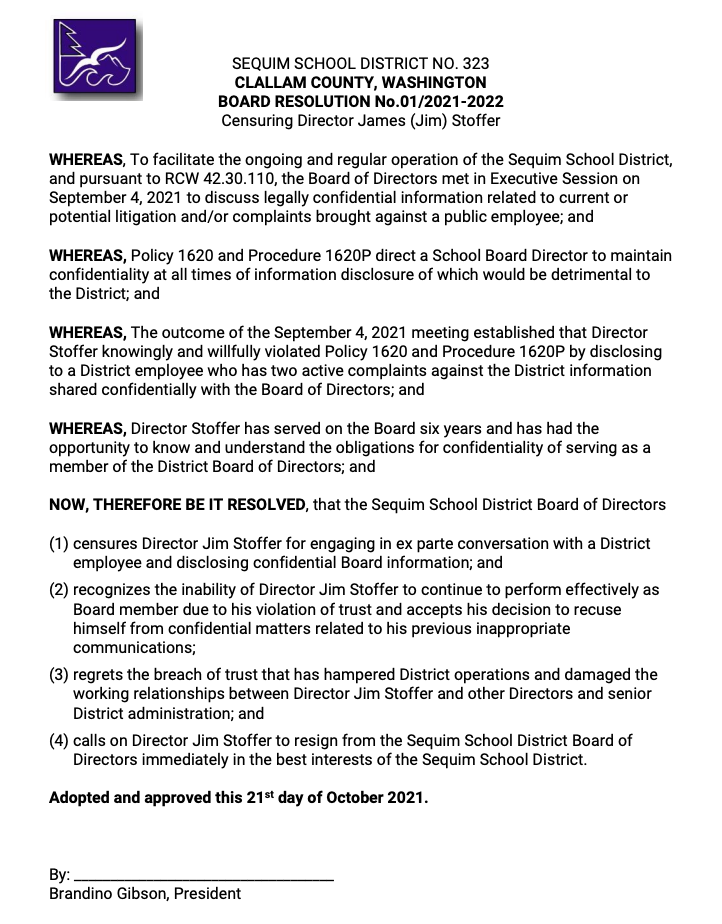
When confronted, Stoffer deployed the district’s favorite tactic: bureaucratic deflection. He managed to dodge formal censure by retiring on medical leave and having his attorney object to the due process of the resolution.
Through his legal counsel, Stoffer released a statement claiming he was the victim of a “smear campaign,” painting himself as a heroic whistleblower who was targeted simply because he took staff complaints seriously.
But federal court records and his own sworn deposition completely dismantle the illusion of the noble whistleblower.
The Hiring Blind Spot
According to his deposition, Stoffer was explicitly warned about Robert Clark before the district even hired him as interim superintendent.
During the vetting process, Stoffer reached out to two colleagues regarding Clark’s past employment. Carrie Sorensen, a board member from the Cascade School District, told Stoffer that Clark had left their district due to a “mutual parting of ways” and wasn’t a good fit.
When asked under oath if he pushed for details regarding why Clark was pushed out, Stoffer admitted he willfully ignored the red flag: “No, I didn’t want to go there.”
A second warning came from Derek Sarley, a school board member in Walla Walla, who explicitly told Stoffer to “use caution” regarding Clark because there were “rumors in the community.”
Again, Stoffer didn’t fight to uncover the truth to protect Sequim students. Instead, he testified under oath that he “felt good with that answer” because the district desperately needed an interim superintendent to get the schools open by August.
Stoffer proceeded to join the board in a unanimous vote to hire Clark anyway.
Ignoring Direct Pleas for Help
According to Stoffer’s deposition, the board was given explicit opportunities to intervene regarding Rob Clark’s behavior early on but actively chose to shut the door.
In the fall of 2019, three female district leaders—including Assistant Superintendent Jennifer Maughan—approached the board requesting a confidential executive session with the full board.
Stoffer testified the women were concerned about Clark’s behavior, noting they felt “creepy” around him and were disturbed by comments he made about their clothing.
Stoffer admitted the board leadership denied their request to be heard.
While Stoffer claimed in his deposition that he privately objected to this denial, asking his colleagues, “what is wrong with them coming and having a conversation with us?” He and the board ultimately failed to intervene, leaving the women unprotected.
Furthermore, when Hanna McAndie later filed her formal sexual harassment claim in October 2020, Stoffer learned that Rob Clark had decided to investigate the illicit rumors surrounding McAndie himself—even going so far as to interrogate McAndie’s father-in-law.
Stoffer testified under oath, “Clark decided to investigate it himself. And that bothered me a lot... There has to be some degree of separation.”
Yet, despite acknowledging this conflict of interest and the obvious inappropriateness of a superintendent investigating his own accuser, Stoffer and the board failed to immediately stop Clark from weaponizing the investigatory process.
The Leaks and the Text Messages
While Stoffer publicly claimed he was a champion of transparency being persecuted for taking staff complaints seriously, litigators confronted him with screenshots of his own text messages proving he was actively leaking sensitive information and gossiping with community members.
In November 2020, well after Clark was hired, Stoffer sent a text message to a local parent and community member, Shenna Younger, sharing illicit rumors.
Stoffer wrote: “Heard some interesting information from a former Leavenworth employee regarding Clark. He was apparently notorious for looking down blouses, ogling women, and, quote, ‘accidentally, unquote, brushing up against breasts routinely.”
When confronted with the screenshot of this text message during his deposition, Stoffer squirmed. He initially tried to discredit the evidence, complaining that the formatting of the text thread “looks like a cut-and-paste type of thing and I’m not comfortable with that whatsoever.”
However, when pressed, Stoffer was forced to admit under oath that he did, in fact, have that exact conversation and subsequently leaked the information to Younger.
Piersoll’s deposition also confirmed that Stoffer’s leaks were widespread.
Piersoll formally complained to the district that Stoffer was acting inappropriately by sharing sensitive Personal Identifiable Information and highly confidential investigative information with multiple individuals, including Jennifer Maughan, Shenna Younger, and Anita Benitez.
Rather than keeping confidential personnel investigations secure, Stoffer used his position to funnel rumors directly to the public and specific factions within the district.
First Amendment Hypocrisy and The Coast Guard Defense
The hypocrisy of Stoffer’s actions is staggering. While he felt entitled to leak information to community members via text message, he held deep contempt for district staff and taxpayers who utilized their First Amendment rights to publicly criticize the administration’s toxic culture on social media.
Stoffer routinely invoked his 31-year Coast Guard career to argue that staff and community members posting on social media were detrimental to the district’s “good order and discipline.”
When high school principal Shawn Langston defended his staff’s online criticisms as their First Amendment rights, Stoffer was appalled.
He testified: “I guess that is what separates me from my public service in the Coast Guard... there’s a time and a place. And to this day... you can’t just fall on your First Amendment rights.”
Stoffer’s monitoring of social media was so aggressive and intrusive that it actually triggered internal grievances against him.
Stoffer admitted under oath that he actively reported the social media posts of Dena Riccobene (the wife of an administrator) directly to Superintendents Gary Neal, Robert Clark, and Jane Pryne.
His relentless policing of her private online activity prompted Dena Riccobene to file a formal harassment complaint against Stoffer himself.
Targeting Critics
Stoffer’s commitment to silencing his critics went to alarming, retaliatory extremes. When Piersoll began posting heavily about the district’s dysfunction on NextDoor and Facebook, Stoffer didn’t just disagree with him—he actively tried to destroy the man’s career and his family’s livelihood.
Stoffer decided to bypass the school community entirely. He testified that he personally contacted Piersoll’s employer’s supervisor to report the social media posts, triggering an interview with an investigator.
Stoffer even admitted to personally driving Assistant Superintendent Jennifer Maughan all the way to Blaine, Washington, to file a formal complaint against the community member with his employer.
Stoffer justified this extreme retaliation by citing his own law enforcement background.
Piersoll’s sworn deposition reveals the sheer malice of Stoffer’s campaign. When his attempt to destroy Piersoll’s career failed, Stoffer escalated his vendetta.
According to Piersoll’s deposition, Stoffer ruthlessly targeted Piersoll’s wife, contacting her employer in a mirrored attempt to get her fired as well.
Piersoll testified that other board members were entirely unaware of Stoffer’s extreme, unilateral actions.
Stoffer’s intimidation tactics also extended directly to district staff who dared to agree with his critics. When a high school teacher merely “liked” one of Piersoll’s Facebook posts criticizing the district, Stoffer personally tracked her down.
According to Piersoll, Stoffer called the teacher and left a “very nasty message” on her voicemail, berating her and demanding she remove the “like”—which she did out of intimidation.
The Secret Veterinary Clinic Meeting
Even more damning for a self-proclaimed whistleblower championing transparency, Stoffer admitted to participating in clandestine board meetings deliberately designed to evade public scrutiny.
Stoffer testified that the school board held an unannounced, secret executive session regarding former Superintendent Gary Neal’s evaluation.
Instead of meeting at the district offices, the board met off-site at Board Director Heather Short’s private veterinary clinic.
According to Stoffer, the justification for holding a secret government meeting in a veterinary hospital was simply that the board “didn’t want to bother district staff.”
While Stoffer claimed in his deposition that he told his fellow board members the location was “bullshit” and violated the Open Public Meetings Act because “we’re not on district property whatsoever,” he ultimately still attended and participated in the secret pet clinic meeting.
This is not the behavior of a courageous whistleblower. Rather than utilizing proper, impartial investigatory channels, Stoffer bypassed procedure, compromised the board’s legal standing, and breached the fundamental trust required of an elected official.
The Hypocrisy of Procedure
The administrative incompetence in Sequim is defined by a staggering, punitive hypocrisy. When dealing with their own executives—men who create hostile work environments, retaliate against whistleblowers, or cost the district millions—the administration bends over backward to offer mediation, paid leave, and quiet reassignments.
But when tasked with handling student misbehavior, that same administration suddenly becomes draconian, weaponizing the criminal justice system to punish teenagers for infractions they refuse to handle internally.
In June 2025, a classic senior prank occurred when 45 high school seniors entered the school’s H-Building late at night. According to the Sequim Gazette, the prank resulted in smashed eggs inside classrooms.
In a functional district, this would be handled through standard, immediate disciplinary measures: detentions, community service, restitution, or withholding diplomas.
Instead, the Sequim administration went scorched-earth. Rather than taking the issue seriously as an internal disciplinary matter, the district pushed to involve the Sequim Police Department and actively advocated for severe criminal charges.
Because of the district’s aggressive escalation, dozens of teenagers suddenly faced criminal trespass, theft, and malicious mischief charges forwarded to the Clallam County Prosecutor.
The hypocrisy of this overreach is impossible to ignore. This is an administration that spent years actively covering up reports of sexual harassment, hiding predators, and retaliating against staff to protect adults from any real consequences.
Yet, when 45 students threw eggs, the district decided it was time to take a “zero tolerance” stand, aggressively attempting to derail the futures of graduating seniors to manufacture an illusion of strict leadership.
They used the police as a blunt instrument to distract from their own internal rot. The irony? The administration’s draconian overreach blew up in their own faces. In their zeal to criminalize the students, the district failed to follow its own internal disciplinary rules.
In an email to parents, Superintendent Regan Nickels had to humiliatingly admit that the students were ultimately allowed to walk at graduation because the administration made “procedural errors in the disciplinary process.”
They were so focused on having the police throw the book at the students that they tripped over their own bureaucracy, achieving neither discipline nor justice.
The Ultimate Cost
This era of the Sequim School District is defined by a chilling consistency: the administration’s first instinct is always to mitigate damage to the institution.
Whether it is a principal bullying a special education student, a volunteer basketball coach grooming a minor in plain sight, or a superintendent fabricating an affair to punish a whistleblower, the district repeatedly demonstrates shocking leniency toward toxic leadership.
For Clallam County parents and taxpayers, the reality is stark. A district can draft endless anti-bullying policies and spend millions on legal settlements to quietly make its problems disappear.
Until the Sequim School District stops protecting the institution over its people, its multi-million-dollar shield will only serve the administration—leaving the staff, the students, and the taxpayers to pay the ultimate price.
Support The Olympic Herald
If this story mattered to you, help us report the next one
The Herald has no paywall and no corporate owner. Reader support is what pays for the records requests, court hours, and follow-through that accountability reporting takes.
Become a monthly supporter
Steady, recurring support is what lets us commit to long investigations instead of chasing quick hits. Members get no special perks — just the knowledge that fearless local reporting exists because of them.
$10/mo
or
$100/yr
Become a member
Cancel anytime · Secure checkout via Stripe
Give once with a card
Pick an amount below — secure Stripe checkout takes under a minute.
Want to give a different amount? Choose your own →
Secure checkout via Stripe · No account required
Republish this story
Our stories are free to republish, online or in print, under these rules:
- Credit The Olympic Herald and the author, and link back to this story.
- Don't edit the story except for style, length, or to update time references.
- If you republish online, use our canonical URL so search engines credit the original.
- Don't sell the story or use it primarily to sell advertising.
Questions? Contact us.