
10 Days for the Judge’s Wife, 18 Months for the Public: Clallam County’s Two-Tiered Justice System
For a victim of domestic abuse, the legal system is supposed to offer an exit strategy. A swift, permanent protection order creates the only legally enforceable boundary between a victim and their abuser.
In Clallam County, however, the administration of justice operates with a brutal, two-tiered double standard.
For the average, unconnected citizen, the courthouse is a bureaucratic nightmare—a deadly bottleneck where cases languish for years and fundamental rights are literally stripped from the walls.
But if you happen to be the spouse of the Presiding Judge? The very same court system will move mountains to grant you lightning-fast relief, shattering local speed records while everyone else is left to fend for themselves.
The Secret Erasure of Victim Rights
Recently, local domestic violence survivors reached out to county administrators with a simple, desperate plea: they needed domestic violence awareness posters installed inside the Clallam County Courthouse.
These advocates argued that victims were being kept in the dark and desperately needed to be informed of their fundamental rights—specifically, their right to report crimes and cooperate with police investigations.
This push for visibility was a direct response to a deeply rooted culture of judicial intimidation. Victims reported feeling actively pressured and threatened by Judge Brent Basden to prevent them from reporting crimes to the police.
Judge Basden has a documented history of shifting the blame to police, publicly stating that law enforcement “deepens the problem” when interviewing child victims of crimes.
In an environment where the bench seems hostile to the very concept of criminal reporting, victims saw courthouse signage as a necessary lifeline so victims could understand their rights without fear of retaliation from the bench.
So, how did the Clallam County Superior Court administration respond to this plea for transparency?
In February, crime victims exercised their First Amendment rights, taking matters into their own hands.
They pinned posters onto the public courthouse bulletin boards explicitly outlining the protections guaranteed to crime victims under Washington state law.
The crime victims were engaging in protected, free speech to disseminate vital declarations of fundamental legal rights meant to shield the vulnerable. They stepped up to provide the critical safety information that the court itself refused to supply.
But this constitutionally protected effort for visibility was short-lived. At some point, these critical resources were quietly stripped from the boards.
In one swift, shadowy action, the court effectively erased the legal rights of victims from the public square while simultaneously trampling on the free expression of the community members who placed them there.
The 18-Month Trap for Everyday Citizens
To understand the true cruelty of this secret poster removal, one must look at the devastating reality facing average families navigating Clallam County’s domestic relations docket.
A recently released state report ranked Clallam County’s domestic courts dead last in the state of Washington. According to the 2026 Washington State of the Judiciary Report, Clallam County has become a devastating bottleneck.
The “Ratio of Active Cases Pending to Cases Resolved” for the county sits at an astronomical 11.23. For comparison, the statewide average is a manageable 1.18.
While the county managed to resolve only 127 total cases over the reported period, a crushing 1,426 active cases remained pending.
Even more horrifying, there were 1,120 domestic relations cases languishing in Clallam County that had been pending resolution for over 18 months. Despite Clallam County making up less than 1% of the statewide population, it is responsible for 11.5% of all statewide domestic relation cases stuck beyond the 18-month mark.
The state’s Board for Judicial Administration recommends that 100 percent of all domestic relations cases should be adjudicated within 18 months. Clallam County manages a dismal 80.31%.
The downstream effects of this judicial bottleneck are actively showing up in local crime statistics. Within the Clallam County Sheriff’s Office jurisdiction, reported violations of No Contact and Protection Orders jumped by 21.1% in a single year, while aggravated assaults rose by over 22% during the same period.
This systemic negligence has irreversible consequences.
Let us not forget that in 2014, Becky Kardonsky publicly begged the court for supervised visitation due to her fear, only for then-Commissioner Brent Basden to refuse—a ruling that preceded the murder of her boyfriend and her own kidnapping.
Visiting Judge Injustice
Presiding Judge Simon Barnhart’s administration doesn’t just delay justice, it actively uses visiting judges with controversial, anti-victim track records to preside over Clallam County cases.
Recently, Clallam County has increasingly utilized Judge Cadine Ferguson-Brown as a visiting judge.
Appointed to the bench by Governor Jay Inslee—first in Mason County and later to the Kitsap County Superior Court—Ferguson-Brown brings a deeply troubling history of being notoriously soft on violent offenders and enabling dangerous abusers.
Her judicial career itself is a testament to political insulation. After voters ousted her from her Mason County seat in the November 2023 election, Governor Inslee immediately intervened, appointing her to a vacant Kitsap County Superior Court seat less than two months later.
Her track record on the bench reveals exactly why Mason County voters overwhelmingly rejected her. In November 2023, citizens formally ousted Ferguson-Brown at the ballot box, voting her out by a massive 15-point margin in favor of her challenger.
Yet, the will of the voters meant nothing to the political establishment. Less than two months after she was democratically removed from office, Governor Inslee intervened, immediately appointing her to a vacant Superior Court seat in neighboring Kitsap County.
The controversial rulings that cost her the election are horrifying.
In February 2023, while serving in Mason County, Judge Ferguson-Brown presided over a catastrophic arson case. A 37-year-old man with a documented history of violence poured gasoline on the front porch of a Gethsemane Ministries rehab facility and set it ablaze in the middle of the night while nearly two dozen people were asleep inside.
When police tracked him down, he was armed with a flare gun loaded with 12-gauge buckshot and threatened to shoot law enforcement.
The motive behind this massive arson? The suspect admitted to detectives that he was angry, believing the ministry staff was “hiding his ex-girlfriend.”
Despite the suspect attempting to burn dozens of people alive over a domestic grievance, fighting with police, and posing an undeniable risk to his ex-girlfriend and the community, according to a King5 report and court records, Judge Ferguson-Brown set his bail at a shockingly low $25,000.
That very same month, according to a report by KOMO News, a woman shot her boyfriend multiple times in the face, chest, and arm. Despite police warning that the suspect posed an ongoing threat to public safety, and prosecutors requesting $500,000 bail for the first-degree assault charge, Judge Ferguson-Brown released the accused shooter a day later on a mere $5,000 bail.
Court observers have already expressed deep concern to the Olympic Herald over Judge Ferguson-Brown’s presence in Clallam County, citing her alarming leniency toward violent criminals and her shockingly poor treatment of domestic violence victims.
Observers also expressed concern that the Judge Ferguson-Brown is often unprepared for hearings in Clallam County, which has resulted in the waste of tax-payer funded court-resources.
Judge Barnhart’s decision to bring in a visiting judge with a known pro-crime, anti-DV track record to handle the public’s sensitive cases is a staggering dereliction of duty.
The 10-Day Barnhart Fast-Track
But what happens when the spouse of the Presiding Judge needs the court’s protection? Does she have to suffer the same 18-month trap? Does she have to navigate a courthouse actively stripping victim rights from the walls?
Absolutely not. For the judicial elite, the system works flawlessly.
Court dockets reveal the staggering hypocrisy. On April 6, 2026, Mia Marie Barnhart—the spouse of Clallam County Presiding Judge Simon Barnhart—filed a Petition for Order of Protection.
On the exact same day she filed her paperwork, April 6, Mia Barnhart was granted a Motion for Waiver of Fees and an Order to Proceed Without Payment. On that very same day, a Temporary Antiharassment Protection Order was successfully issued.
Two days later, on April 8, 2026, three local judges—Judge Elizabeth Stanley, Judge Simon Barnhart, and Judge Brent Basden—formally recused themselves from the case. This is a standard and necessary ethical step when a judge’s spouse is a litigant.
Instead of the case languishing in administrative limbo, a visiting judicial officer, Judge Kristin Ferrera from Chelan County, was immediately brought in to handle the matter.
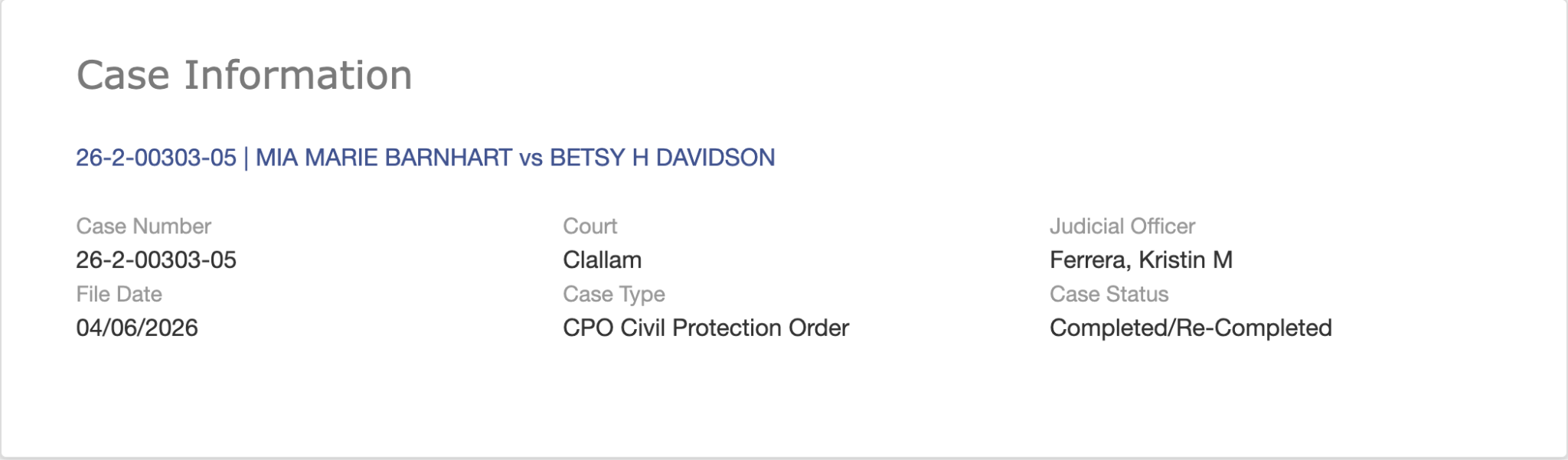
On April 16, 2026—just ten days after the initial petition was filed—Visiting Judge Ferrera presided over a Motion Hearing. By the end of that day, Mia Barnhart had secured a final Order for Protection From Civil Harassment and a strict Order to Surrender Weapons.
From the date of filing to a finalized, permanent protection order mandating the surrender of firearms, it took exactly ten days.
The Reality of a Broken System
There is nothing inherently wrong with a victim of harassment receiving a protective order in ten days. In a functioning, healthy judicial system, swift and decisive action is precisely how vulnerable individuals are kept safe.
Swift resolution is what every single citizen of Clallam County deserves when they walk through the courthouse doors fearing for their safety.
But Clallam County has a severely broken, two-tiered machine that protects its own while abandoning the public.
When an average citizen enters the Clallam County Courthouse, they are greeted by bulletin boards stripped of the very posters designed to inform them of their rights to report abuse.
They are subjected to judges who have a track record of intimidating victims and blaming law enforcement for “deepening the problem.”
And they are thrown into a crushing backlog where nearly one in five families is left in legal limbo for over a year and a half.
Yet, when Presiding Judge Barnhart’s wife needed the court’s swift intervention, filing fees were waived immediately. Visiting judges were brought in from across the state. The administrative rot that plagues everyday citizens evaporated overnight, and justice was delivered in just ten days.
This is the epitome of the “good ol’ boy” justice system. It is a system that demands absolute submission from the vulnerable while offering white-glove, VIP service to the connected.
It is a system that secretly erases the rights of domestic violence victims in the shadows, even as it proves it is fully capable of providing rapid, life-saving protection when the beneficiary happens to share a last name with the Presiding Judge.
"Motion for Waiver of Fees and an Order to Proceed Without Payment"
That one sentence says it all. Waiver of Fees DO NOT HAPPEN THAT FAST. In fact, proof needs to be presented that you do not have the funds to pay...and it is worded explicitly along with bank records and/or your federal tax return. It has to be proven.
Anthony, keep turning on the kitchen light so we can watch the cockroaches scramble for cover!
In one swift, shadowy action, the court effectively erased the legal rights of victims from the public square while simultaneously trampling on the free expression of the community members who placed them there. ---- Pretty much sounds like everyone at the courthouse needs to go :(