

Yesterday afternoon, the Clallam County Superior Court appeared to delete its official Facebook page entirely. The abrupt removal of the court’s digital presence comes less than 48 hours after the Olympic Herald reported that the court had ceased unconstitutionally censoring public comments.
It appears that when the court lifted its censorship filters and allowed the public to speak freely for the first time, they did not like what the public had to say.
From Viewpoint Discrimination to Total Blackout
Earlier this week, we sent a formal letter to Judges Simon Barnhart, Elizabeth Stanley, and Brent Basden. The letter detailed a troubling pattern of censorship where the court’s Facebook page administrator was limiting participation to a select class of users who expressed favorable views.
Specifically, the court had been using Facebook’s restrictive tools to “limit who can comment” on posts celebrating court officials, such as the swearing-in of Judge Elizabeth Stanley, while silencing dissenters.
In response to our inquiry, the court initially appeared to change course. On February 13, we reported that the court had lifted these restrictions, seemingly bringing their social media policy into compliance with the First Amendment.
The Parker Problem
Once the digital padlocks were removed, constituents immediately began exercising their First Amendment rights. According to reports and observations of the page prior to its deletion, users began leaving critical comments, specifically regarding former Court Commissioner Brian Parker.
It appears that a fresh wave of scrutiny, unleashed after the court stopped filtering comments, prompted a drastic reaction. Rather than moderating within constitutional limits or enduring the criticism inherent in public service, the court pulled the plug.
By yesterday afternoon, the Clallam County Superior Court page was no longer accessible. Users attempting to view the court’s public notices were met with error messages.
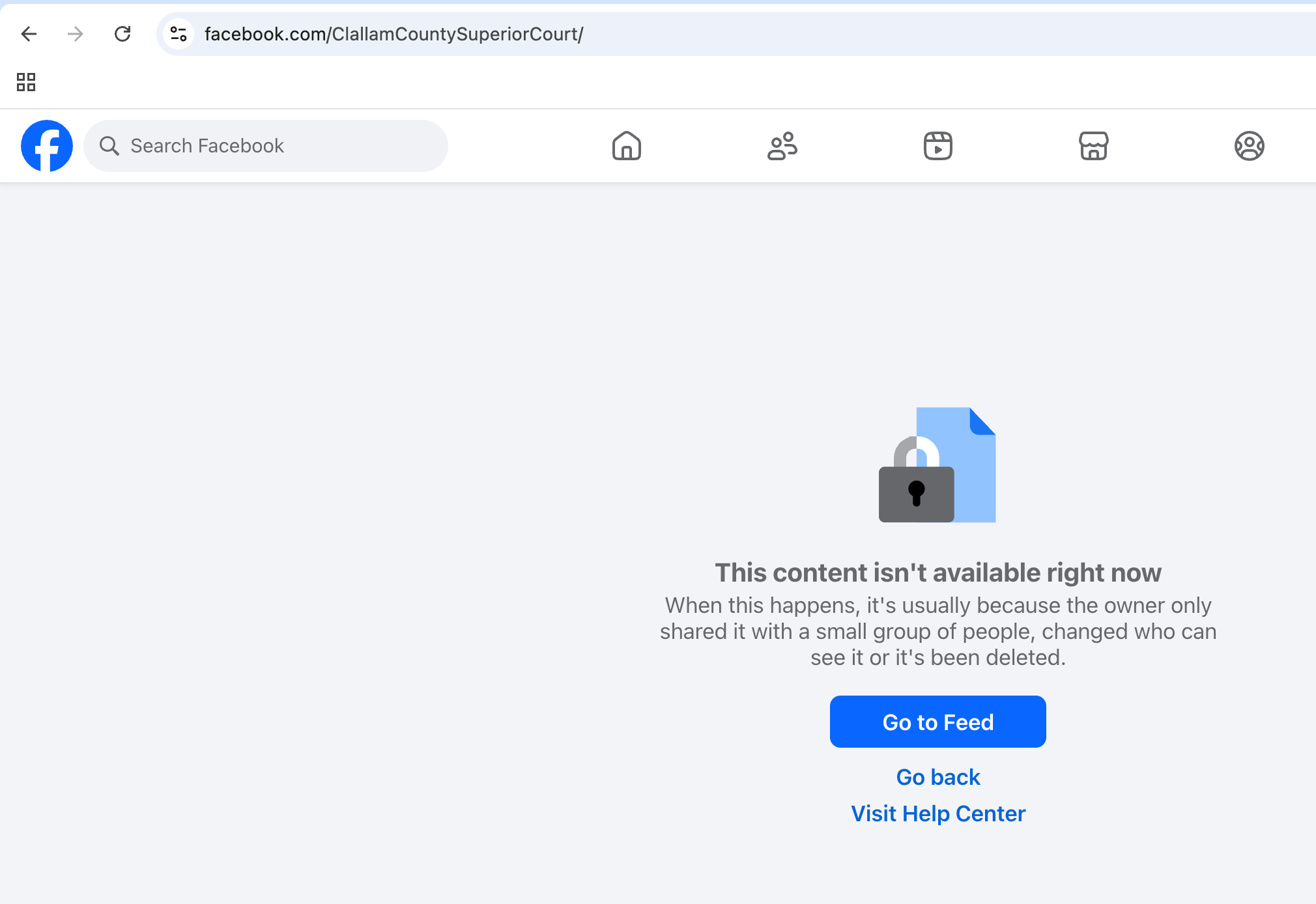
“Did they delete their page or block me lol,” asked a local constituent, on the Olympic Herald’s Facebook page.
The Constitutional Implication
While a government entity is not always required to open a social media account, closing an established public forum specifically to avoid criticism raises significant questions about transparency and accountability.
The court initially picked and chose which citizens got to speak. Now, faced with an open forum where they could no longer control the narrative, they have bizarrely chosen to silence everyone by destroying the forum itself.
Republish this story
Our stories are free to republish, online or in print, under these rules:
- Credit The Olympic Herald and the author, and link back to this story.
- Don't edit the story except for style, length, or to update time references.
- If you republish online, use our canonical URL so search engines credit the original.
- Don't sell the story or use it primarily to sell advertising.
Questions? Contact us.