

In a sharp rebuke of a trial judge’s reliance on a contested expert evaluation, the Washington State Court of Appeals Division I has reversed a King County Superior Court decision that vacated a domestic violence protection order. The unpublished opinion, filed today, explicitly cites “significant flaws” in a domestic violence assessment performed by Dr. William Singer of the Northwest Evaluation Center.
The appellate court’s ruling comes less than three weeks after we reported that the Department of Social and Health Services issued a “founded” finding against Dr. Singer and Northwest Evaluation Center for failing to meet state standards in its domestic violence assessments.
“Significant Flaws” and Regulatory Violations
In the case before the Court of Appeals, the respondent sought to end a protection order which protected his ex-wife and children and relied heavily on an assessment provided by Dr. Singer.
Singer’s evaluation assessed the respondent at a “Level 0,” concluding that he did not exhibit abusive behaviors and did not require domestic violence intervention treatment. Instead, Singer recommended the respondent merely engage in individual therapy.
However, the Court of Appeals found that the lower court abused its discretion by relying on this assessment to find that the respondent had changed his behavior. The appellate panel identified critical failures in Dr. Singer’s methodology, noting that the assessment relied primarily on the respondent’s self-reporting, specifically citing Singer’s note that the man “denies all DV.”
More critically, the court highlighted that Dr. Singer assigned the “Level 0” designation because “no arrests or charges stemmed” from police calls regarding the respondent. The appellate opinion bluntly stated that reliance on a lack of arrests violates the standards established in the Washington Administrative Code.
“The recommended level of treatment must not be diminished by factors such as the absence of legal charges,” the court wrote, citing WAC 388-60B-0400(19)(f)(i).
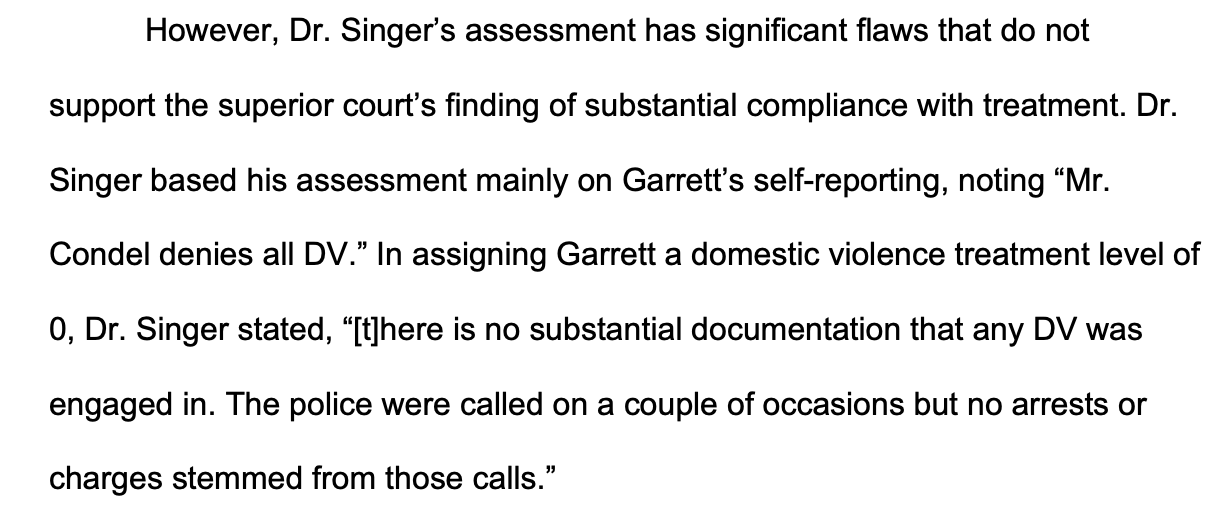
The court further noted that the absence of legal charges is not a “reasonable and valid rationale” for recommending individual therapy over state-certified domestic violence treatment when intimate partner violence has occurred.
The appellate court reversed the Superior Court’s decision to vacate the protection order, reinstating the full protection for the petitioner. The court also awarded attorney fees to the petitioner for the cost of the appeal.
Republish this story
Our stories are free to republish, online or in print, under these rules:
- Credit The Olympic Herald and the author, and link back to this story.
- Don't edit the story except for style, length, or to update time references.
- If you republish online, use our canonical URL so search engines credit the original.
- Don't sell the story or use it primarily to sell advertising.
Questions? Contact us.