
A History of Tragedy: The Past Ruling of a Frequent Clallam Visiting Judge
A distinct and horrific pattern of judicial decisions denying protection to the public has emerged within our regional courts, linking visiting Kitsap Judge Cadine Ferguson-Brown to preventable tragedy.
Just as Clallam County residents have seen in previous catastrophic failures within the local justice system—such as the deadly 2014 and 2015 rulings by then-Commissioner Brent Basden, where explicit pleas for safety were callously ignored by the bench—court records and public statements from state lawmakers paint a grim picture of a judge whose extreme leniency directly preceded a devastating loss of life.
In 2023, urgent requests for public safety measures were rejected by Judge Ferguson-Brown shortly before the violent suspect in that hearing took her own life while free on the streets.
As the community reflects on these systemic failures, the records reveal a judicial officer who consistently bypasses her own discretion, leaving victims, suspects, and the general public exposed to severe harm.
Yet, despite her documented track record of endangering the public, Clallam County administrators continue to voluntarily invite her into our courthouse to pass judgment on vulnerable families.
The Night of the Attack
The tragedy stems from a catastrophic February 2023 domestic violence case presided over by Ferguson-Brown while she was still seated on the Mason County Superior Court bench.
In the early morning hours of February 12, neighbors in the 1900 block of Summit Avenue in Shelton called 911 to report the terrifying sound of gunshots and a man screaming, “You shot me.”
When police arrived, they found 29-year-old Chantel Dawn Peterson covered in blood.
Her boyfriend, Elijah Gossett, had been shot multiple times. He suffered severe gunshot wounds to his face, chest, and arm. Gossett was shot in the back as he looked for something to watch on television.
Gossett was flown to Harborview Medical Center in Seattle. According to the police incident report, he arrived with a “high probability of death.”
Peterson was arrested at the scene and booked into jail.
In the booking report, when asked if the safety of an individual or the public would be threatened if the suspect were released on bail or recognizance, the responding Shelton police officer explicitly indicated “yes.”
A $5,000 Bail for Attempted Murder
Peterson was charged with first-degree assault, a Class A felony. Because the charge included a domestic violence enhancement, she faced a maximum penalty of life in prison.
Recognizing the extreme ongoing danger she posed to the community, prosecutors requested a $500,000 bail.
Despite the sheer violence of the crime, the life-threatening injuries to the victim, and the explicit warnings from law enforcement and prosecutors, Judge Ferguson-Brown inexplicably ruled that a mere $5,000 bail was sufficient.
A single day after her arrest, a bail bond was posted, and Peterson simply walked out of custody.
The victim’s loved ones were horrified by the court’s refusal to keep an accused shooter behind bars.
“I would like to know where the justice is in this situation,” Trina Robinson, a friend of Gossett, told KOMO News at the time. “You don’t have to sit here and actually be accountable for your actions. You get to call in a Zoom meeting with your dog barking in the background in your pajamas on your couch while our friend is in the hospital.”
Robinson explicitly warned that the community was in danger. “She is free to walk on the streets where our children ride their bikes and we are not discussing the violence of this situation,”
Robinson said. “That’s ridiculous. She’s an ongoing threat to everybody.”
The Preventable Death of Chantel Peterson
Ferguson-Brown’s leniency ultimately proved fatal. While free awaiting her May trial date, Peterson jumped from a local bridge and took her own life.
On March 21, 2023, the Mason County Coroner officially deemed her cause of death to be a suicide.
The catastrophic failure of the justice system prompted immediate outrage from state lawmakers, who argued that holding Peterson accountable behind bars would have quite literally saved her life.
State Rep. Dan Griffey and Rep. Travis Couture publicly condemned Ferguson-Brown’s ruling as a deadly failure of the criminal justice system.
“This judge’s decision to release this woman on such a low bail—completely disregarding the warning of prosecutors about the threat she posed to both the victim and the public—is not only outrageous, it cost this woman her life,” Griffey stated. He added, “The criminal justice system and judge should be ashamed of themselves.”
Couture echoed the sentiment, noting the cascading damage caused by the court’s failure to act. “The criminal justice reform experiment we have dealt with over the past several years is clearly failing all. Not only did it fail the victim in this case, it failed the suspect. Now the victim is damaged for life and this woman is dead, all because she wasn’t put in jail.”
Couture summarized the tragedy bluntly: “Sure, this woman would have had to serve her time had she been correctly held accountable—but she’d also be alive.”
Performative Empathy and Deadly Results
In the wake of the tragedy, Judge Ferguson-Brown attempted to shift the blame to statutory frameworks. She claimed that state law regarding the “presumption of release” constrained her ability to set a higher bail.
Lawmakers dismissed the defense as a complete cop-out. Griffey noted Judge Ferguson-Brown “could have easily used her judicial discretion,” but chose not to.
“She not only had the right to use that discretion, she had the responsibility. She chose not to. She did not do the right thing,” Griffey said.
To understand how Judge Ferguson-Brown justifies bypassing safety protocols, one only has to examine her own stated judicial philosophy.
During a September 2023 interview with MasonWebTV, Judge Ferguson-Brown was asked to explain her approach to the bench.
She detailed an elaborate, almost theatrical process of putting on her judicial garment to signify her commitment to the law.
“Every time I’m gonna go up on the bench, instead of just putting on my robe, I step into my robe,” Judge Ferguson-Brown explained to the interviewer. “So I put my feet in first, and then I put my hands in, and then I zip myself up, and what that does is that signifies to me that, okay, here we go, my oath to uphold the Constitution now applies. My oath to follow the laws of the state of Washington now applies.”
She also boasted about her temperament in complex cases, claiming, “I am not someone who’s quick to judge. I’m not someone who’s arrogant. I’m someone who’s gonna take the time that is needed to think through, to apply the law, and to listen to those who are before me.”
She further emphasized that her priority is ensuring people feel validated in her courtroom.
“One of the comments that I keep hearing from people who have appeared before me is that I make them feel like they have been heard, whether or not I rule in their favor,” Ferguson-Brown said. “That is what we want, because that is how we build confidence in our judicial system.”
When discussing alternative sentencing in that same interview, Ferguson-Brown revealed a worldview heavily skewed toward the offender rather than the victim.
She described sentencing alternatives as “tools that equip our judicial system with ways in which we can hold people who are convicted accountable and also offer to them rehabilitative measures... to get them to a place where they can re-enter society and contribute to society in a good manner where they themselves are now safe and healthy.”
But the moment her robe is zipped, those grand declarations of upholding the Constitution and taking time to “apply the law” routinely vanish.
When a judge’s overriding philosophy involves refusing to be “quick to judge” an accused attempted murderer, and prioritizing the feelings and rapid societal re-entry of dangerous individuals, public safety pays the ultimate price.
A Track Record of Putting the Public Last
Ferguson-Brown’s tenure on the bench has included extreme leniency toward dangerous individuals and a complete disregard for the public.
That very same month in February 2023, Ferguson-Brown presided over a catastrophic arson case.
A 37-year-old man poured gasoline on the front porch of the Gethsemane Ministries rehab facility and set it ablaze in the middle of the night while nearly two dozen people were sleeping inside.
When tracked down, he fought police with a loaded flare gun, admitting he committed the arson as retaliation over his ex-girlfriend. Despite his attempt to burn dozens of people alive, Ferguson-Brown set his bail at a shockingly low $25,000.
Her sentencing record is equally disturbing.
Earlier this month, on June 5, 2026, Judge Ferguson-Brown sentenced 58-year-old John Michael Daly for sexually abusing his five and nine-year-old daughters over a four-year period.
Ferguson-Brown granted the child molester a Special Sexual Offender Sentencing Alternative.
She suspended a 78-month prison sentence for the remainder of his life, ordering him to serve just 12 months in the county jail.
Despite her claims about stepping into her robe to “uphold the Constitution,” her record on the bench also demonstrates a glaring willingness to trample fundamental constitutional rights.
In March 2026, bypassing the rigorous standards of the First Amendment, Ferguson-Brown willingly signed a blatant, unconstitutional civil order.
She explicitly ordered a private citizen to cease publishing identifying information about another adult online.
The mandate she signed executed the exact brand of “plain and simple prior restraint” that appellate courts and constitutionally literate Kitsap judges have firmly and repeatedly declared entirely invalid.
Voter Rejection and Political Insulation
The public quickly recognized the danger Ferguson-Brown posed from the bench. In November 2023, Mason County citizens formally ousted her at the ballot box, voting her out by a massive 15-point margin.
Yet, the clear will of the voters meant nothing to the political establishment.
Less than two months after she was democratically removed from office, Governor Jay Inslee intervened, bypassing the voters to immediately appoint her to a vacant Superior Court seat in neighboring Kitsap County.
Because of that politically insulated appointment, Clallam County Presiding Judge Simon Barnhart’s administration has increasingly brought her into the local courthouse to act as a visiting judicial officer.
Her presence in Clallam County has mirrored her disastrous tenure elsewhere.
Observers report she is frequently unprepared for local hearings, wasting taxpayer-funded court resources.
True to form, she recently processed the procedural mechanisms that allowed Johnny Watts—the former Clallam County Drug Court Coordinator accused of running a fentanyl and methamphetamine ring—to bond back out onto the streets.
Kitsap Prosecutors Have the Power to Intervene
While Clallam County officials consider their options, legal precedent suggests that Kitsap County prosecutors possess the power to unilaterally prevent Judge Ferguson-Brown from hearing criminal cases in her newly appointed jurisdiction.
In Washington State courts, the process for disqualifying a judge is governed by RCW 4.12.050. The statute allows a party or attorney to file a “Notice of Disqualification”—historically known as an “Affidavit of Prejudice”—against a judge.
As long as this notice is filed before the judge makes any discretionary rulings in a case, it automatically forces the reassignment of the matter to a different judicial officer.
Kitsap County prosecutors have a well-documented history of utilizing this exact mechanism to protect the public from judges whose rulings they deem problematic.
According to a 2016 report in the Kitsap Sun, the Kitsap County Prosecutor’s Office utilized blanket affidavits to systematically remove veteran District Court Judge Marilyn Paja from all criminal cases after a disagreement over her rulings, which included releasing a drunken driving suspect.
“Now this person is on the street, and they should not be on the street,” then-Prosecutor Tina Robinson stated at the time. “That is concerning for us.” By routinely filing these notices, prosecutors effectively restricted Paja’s docket to only infractions and civil matters.
The strategy is not unprecedented in Kitsap Superior Court, either.
Former Kitsap Prosecutor Russ Hauge utilized affidavits to keep Superior Court judges off criminal cases for extended periods following mistaken rulings.
Similarly, Robinson’s office routinely removed another Kitsap Superior Court judge from presiding over certain cases.
Given this established prosecutorial playbook, current Kitsap County prosecutors could conceivably issue blanket Notices of Disqualification against Judge Ferguson-Brown for all upcoming criminal matters.
Considering her track record of shockingly low bail for violent offenders and extreme leniency in sentencing, Kitsap prosecutors have both the statutory capability and the historical precedent to sideline her.
Whether they will take this extraordinary but necessary step to safeguard their community remains to be seen.
Clallam County Could Be Saved By An Administrative Order
Clallam County is already suffering under a brutal, two-tiered justice system characterized by an 18-month family court backlog and a documented hostility toward domestic violence victims.
Bringing in a visiting judge who prioritizes the feelings of violent offenders over the safety of the public is adding gasoline to a five-alarm fire.
In a June 16 email responding to my inquiry regarding his oversight, Judge Barnhart attempted to wash his hands of this responsibility.
“In general it is not the role of the presiding judge to address grievances regarding other judges, visiting or otherwise,” asserting instead that general oversight “lies with the Washington Commission on Judicial Conduct.” Judge Barnhart told me.
However, a closer look at Washington State Court Rules reveals that the Presiding Judge possesses the clear, statutory authority to act immediately.
Washington State General Rule 29 explicitly states that the Presiding Judge is responsible for leading the management and administration of the court’s business and allocating resources to ensure disputes are resolved fairly and expeditiously.
GR 29(f)(1) mandates that the Presiding Judge supervise the judicial district to ensure the “expeditious and efficient processing of all cases.”
Judge Barnhart leaned heavily on this exact language, attempting to narrowly define his responsibilities by claiming he is directed “to supervise judicial officers only as necessary to ensure the timely and efficient processing of cases.”
Yet, considering that observers report Judge Ferguson-Brown is frequently unprepared and wastes taxpayer-funded court resources, her conduct easily triggers his own stated threshold for intervention.
The rule goes further in GR 29(h), establishing that it is the duty of the Presiding Judge to supervise judicial officers. If a judicial officer fails to perform their duties, the Presiding Judge “shall have the authority to address a judicial officer’s failure...and to propose remedial action.”
Judge Barnhart himself acknowledged this specific disciplinary mechanism. Judge Barnhart told me that under GR 29, “the presiding judge may address a judicial officer’s failure to process cases timely and efficiently, and, where appropriate, may propose remedial action.”
Most importantly, GR 29(f)(2) gives Judge Barnhart the direct authority to “establish general policies governing the assignment of judges.”
Using this statutory authority, Presiding Judge Barnhart can issue an administrative order that prevents Judge Ferguson-Brown from being used as a visiting judge in Clallam County.
Will Judge Barnhart Protect Clallam County?
Removing a visiting judge from the court is a severe administrative measure, but it must be a standard practice when a court’s integrity is compromised and lives are demonstrably put at risk.
Judge Barnhart clearly knows how to manage the bench when it suits him. He previously made the executive decision to terminate Court Commissioner Brian Parker.
He also knows exactly how to utilize visiting judges to fast-track justice when his own family is involved, recently ensuring his wife secured a finalized protection order from a visiting judge in just ten days.
Barnhart possesses the clear, undisputed authority to oversee case assignments to ensure the local court system runs in an orderly, fair, and safe manner.
The last thing this community can afford is a visiting judicial officer who imports an absolute ignorance of the Constitution and a documented history of deadly decisions into our local courthouse.
Will Judge Barnhart have the courage to use his administrative authority and protect the community by issuing an administrative order that prevents Judge Cadine Ferguson-Brown from being used as a visiting judge in Clallam County?
It appears he may have already done so.
According to the Washington Courts Odyssey Portal, Judge Ferguson-Brown is no longer scheduled to preside over any hearings in Clallam County.
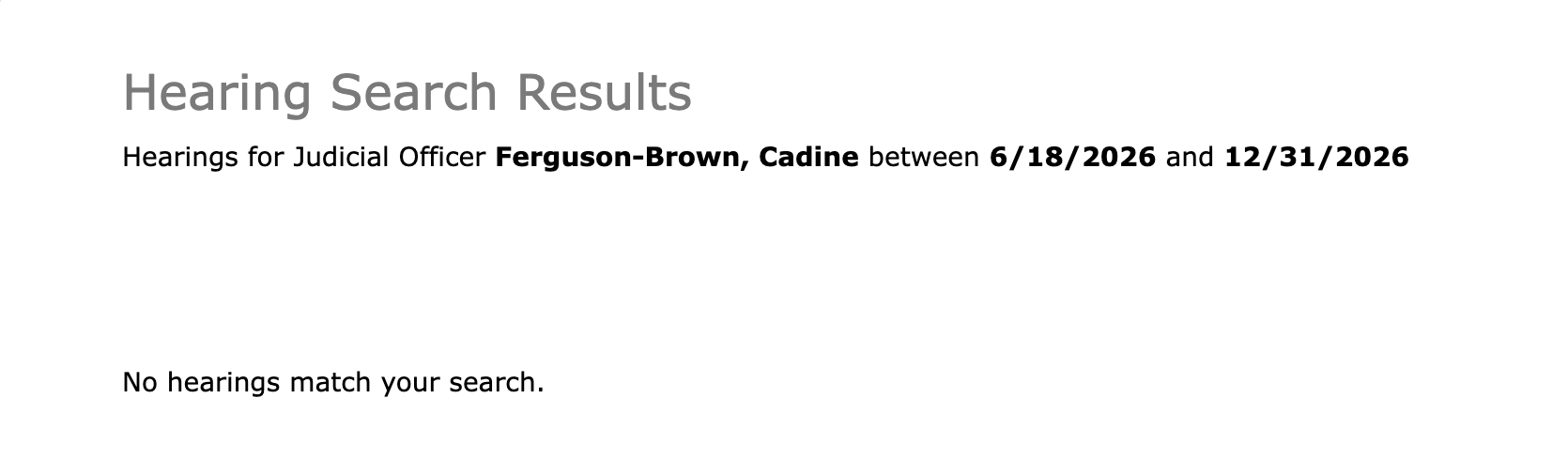
Earlier records obtained from the Odyssey Portal stated that Judge Ferguson-Brown was scheduled to preside over a July 1, 2026 modification hearing. Current records show that Judge Houser is presiding over that hearing.
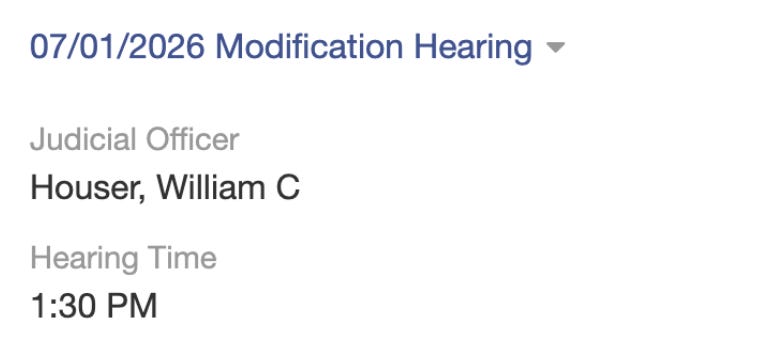
While this sudden reassignment may offer temporary relief to the vulnerable individuals involved in that specific July docket, it raises critical questions about transparency and permanence.
Has Presiding Judge Barnhart officially recognized the profound liability Judge Ferguson-Brown presents to Clallam County, or is this merely a quiet reshuffling intended to dodge public scrutiny?
The residents of Clallam and Kitsap counties cannot afford to rely on unannounced calendar adjustments or the desperate hope that prosecutors will endlessly file Notices of Disqualification to keep a dangerous judge at bay.
The catastrophic consequences of judicial leniency are painfully measured in shattered families, entirely preventable violence, and irreversible loss of life.
If the regional justice system is to regain the trust of the public it is sworn to serve, court administrators must move beyond performative empathy and quiet bureaucratic maneuvers.
Until a formal administrative order is issued, the threat of Judge Ferguson-Brown’s return looms large, and the community must continue to monitor the local docket—and the judges who manage it—with uncompromising scrutiny.