
Institutional Betrayal and the Fight for Accountability at QVSD
Following a $250,000 federal verdict against the Quillayute Valley School District for cultivating a hostile work environment, the bureaucratic shield is shattering.
At a recent school board meeting, families openly confronted district leadership, citing decades of alleged abuse and demanding an end to the administration’s long-standing culture of deflection.
Now, new videos provide firsthand accounts that the systemic failures at QVSD are deeply intertwined with the overlapping power structures of the local Church of Jesus Christ of Latter-day Saints.
In two videos recently shared with The Olympic Herald, local mother Elizabeth Tolliver details her family’s harrowing experience.
Tolliver’s videos paint a disturbing picture of a tight-knit community where religious loyalty consistently overrides objective morality, and where predators are sheltered by the very institutions mandated to protect children.
Praising a Convicted Rapist
The catastrophic failure of student safety in Clallam County is perhaps best defined by Tammy Leask, a former QVSD para-educator who pled guilty to the severe and ongoing sexual abuse of a 13-year-old student.
According to probable cause documents, Leask confessed to detectives that the abuse began directly inside a Forks Middle School classroom before moving off-campus.
Leask has deep, multi-generational ties to the Port Angeles Stake of the LDS Church. In her video testimony, Tolliver—who provides photographic proof of her own lifelong immersion in the local LDS Forks Ward—exposes exactly how the LDS community handled Leask’s crimes.
For residents of Washington State, the most chilling historical example of an institution blindly protecting a predator is the LDS church’s embrace of Ted Bundy.
In 1975, Bundy weaponized the church’s wholesome environment in Utah, undergoing an LDS baptism to mask his monstrosity behind the halo effect of the faith. When he was finally arrested, his LDS ward flatly refused to believe his crimes.
Instead of condemning him, ward members sent Bundy letters of support in his jail cell—including a “get well” style card explicitly signed by the young children of the congregation, according to the Netflix docuseries, Conversations with a Killer.
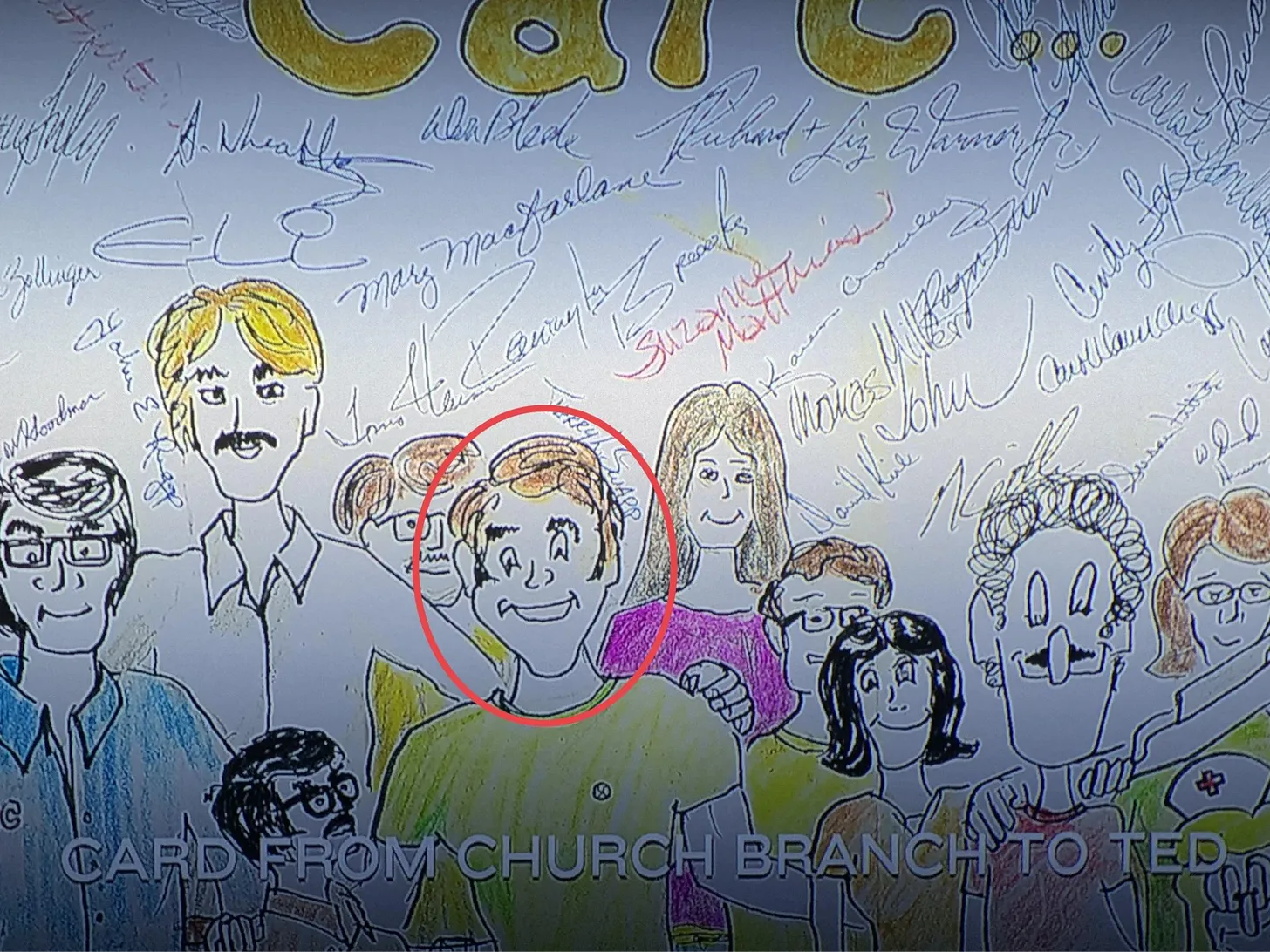
Today, history is tragically repeating itself in Clallam County.
Displaying screenshots of Facebook posts made by Leask’s mother, Tolliver reveals that prominent members of the local LDS church actively praised and supported Leask after Leask was locked up.
The comments featured local LDS members congratulating Leask on “doing so well” and telling her “awesome job.”
Among the commenters was the wife of a local LDS Bishop, who posted: “That is so wonderful. So excited for her.”
This blind ecclesiastical loyalty goes far beyond social media. Sources tells The Olympic Herald that LDS members are actively writing letters of support directly to Leask while she serves her 102-month prison sentence for child rape.
“People who rape children do not deserve ‘happy Thanksgiving’ or ‘great days,’” Tolliver stated in the video, condemning the church’s blind loyalty.
The Bureaucratic Shield
Tolliver’s outrage is rooted in her own family’s trauma inside QVSD facilities. In her first video, she details how her son was sexually harassed and assaulted by two male students at school in 2022.
She claims the boys shoved pencils up his backside, poked him, and directed “disgusting, disturbing fantasies” at him.
When Tolliver attempted to hold the alleged abusers accountable—gathering documentation, statements, and witnesses to bring to the Chief of Police—the district stepped in to run interference.
According to Tolliver, the middle school principal confiscated all of her paperwork and statements, claiming she was violating “student privacy.”
This reflects a widely documented, devastatingly consistent district tactic. A recently obtained Office for Civil Rights complaint filed by another local mother, shows the district routinely minimizes physical assault to manage its own liability.
When the mother reported that her son was sexually assaulted in the middle school locker room, Title IX Coordinator Kyle Weakley allegedly laughed off the report, characterizing the severe boundary invasions as “cherry picking” and “something that boys do to each other in fun.”
When the mother later escalated complaints regarding alleged retaliation by Coach Trevor Highfield, Superintendent Diana Reaume allegedly blackmailed the family, threatening a counter-investigation against the biracial student unless the mother dropped her complaints.
Recognizing that the administration would similarly weaponize its power to protect the alleged abusers instead of her child, Tolliver pulled her kids from the district altogether and began homeschooling them.
The Men at the Top
The rot, according to Tolliver, extends directly to the highest levels of local leadership. She explicitly names QVSD School Board Chair Bill Rohde—also a member of the Forks LDS Ward—asserting that he knew exactly how her son was being harassed and assaulted at school, yet did “nothing to help us.”
Tolliver also highlights the dual authority of veteran QVSD coach Brian Weekes.
Just weeks ago, a federal jury found the district liable for a hostile work environment, awarding $250,000 to former coach Kari Larson over allegations that Weekes spent years sexually harassing and stalking her.
At a recent board meeting, a community member openly alleged Weekes’s inappropriate behavior spans an astonishing 29 years.
In sworn deposition testimony, Title IX Coordinator Kyle Weakley admitted he had previously advised Weekes to avoid “stretching” female athletes—not to protect the physical boundaries of the students, but for Weekes’s “own protection, so that false accusations couldn’t be made against them.”
In her video, Tolliver confirms what many in the community have long suspected: Weekes wielded immense spiritual authority alongside his coaching whistle. Tolliver states that Weekes served as the Bishop for the LDS Forks Ward and he even officiated her wedding.
This chilling overlap is concerning. As an LDS Bishop, Weekes operated under the church’s highly centralized abuse reporting protocols, which are fundamentally designed to protect the institution.
According to Section 38.6.2.1 of the official LDS General Handbook, local leaders who learn of abuse are directed to “promptly call the help line”—a toll-free number that connects the local bishop not to child welfare advocates or local police, but to “legal and clinical professionals” at Church headquarters in Utah.
A blistering 2022 national investigation by the Associated Press exposed the grim reality of this policy, revealing how attorneys at Kirton McConkie—the powerful Salt Lake City law firm representing the church—have repeatedly advised bishops not to report child sexual abuse to civil authorities, citing state clergy privilege loopholes.
In Washington State, the LDS Church has actively lobbied to maintain this legal shield. In May 2025, the state enacted Senate Bill 5375, attempting to finally strip clergy of the exemption from mandatory reporting laws.
Within months, the LDS Church deployed its formidable legal weight to support federal lawsuits which argued the mandate violated the First Amendment.
The pressure campaign succeeded: in October 2025, Washington’s Attorney General signed a legal stipulation agreeing not to enforce the reporting requirements.
The preservation of this loophole leaves the Forks community with a horrifying question: Did Tammy Leask confess her abuse of a 13-year-old student to Bishop Weekes? And if so, were LDS attorneys using Washington’s clergy privilege laws to successfully hide an ongoing predator operation within a public school?
A County-Wide Crisis
Tolliver’s willingness to step forward and provide receipts adds a deeply personal, undeniably painful layer to the Olympic Herald’s ongoing investigation into Clallam County’s institutions.
Her testimony proves that the failures of the Quillayute Valley School District are part of a broader, systemic culture of concealment that stretches from the middle school principal’s office to the Clallam County Superior Court.
This is most evident in the courtroom of Judge Brent Basden, who is currently facing an investigation by the Washington State Commission on Judicial Conduct.
Basden, who previously served as Tammy Leask’s Stake President, did not recuse himself from Leask’s criminal proceedings.
More recently, he took over a court case involving an LDS member accused of child sexual abuse and wildlife crimes, according to a CJC complaint.
The CJC complaint alleges that Basden took testimony from the wife of his own LDS Bishopric co-counselor.
According to the complaint, when a non-LDS member attempted to involve law enforcement, Basden was caught on video threatening her in open court, stating that “law enforcement deepens the problem.”
Furthermore, the complaint alleges that fellow LDS Port Angeles stake members actively interfered with law enforcement investigations, retrieving and hiding children from the police to protect LDS members from criminal liability.
Normalization of Compliance
The systemic failures in Clallam County depend entirely on the quiet, sustained compliance of the broader community. In isolated towns where institutional power is concentrated in overlapping school, church, and judicial leadership, pushing back against the grain can carry immense social and personal risk.
Elizabeth’s husband, Jon Tolliver, shared his own reasons for speaking out. “I love this media coverage that breaks the silence because silence is compliance,” Jon told me.
He articulated the isolation and exhaustion that comes with challenging a closed-loop system, especially when the community’s response is overwhelmingly apathetic. “It is hard to sound the alarm and realize only so much people care, however, I’ll do my part to speak out,” he continued.
“I think the lack of concern is proof how much this has all been normalized.”
The apathy Jon describes for Indigenous communities is an extension of centuries of marginalization, jurisdictional black holes, and institutional neglect.
“The corruption here is so bad Forks QVSD is a puddle hop compared to Neah Bay and its injustice,” he stated. “Natives don’t have law and order, we have to suffer in silence or go missing. We have had several people gone ‘missing’ here.”
Jon’s words cut to the heart of a crisis that has long plagued Washington. According to data provided by the Washington State Patrol, 108 Indigenous individuals remain missing in the state as of April 21, 2026.
The Tollivers’ testimonies, alongside the staggering array of judicial and administrative complaints, outline the devastating human consequence of the systemic failures The Olympic Herald has spent weeks documenting.
GETTING SNARED IN RELIGIOUS WEB WEAVING: HOW IT WORKS
It’s a strategy. It starts with victim blaming/shaming into forgiving the perpetrator who then continues their predatory behavior.
It’s a loyalty mode. The Church has moved from building belonging to demanding obedience.
It’s systemic failures. Nothing is more important in the LDS church than their claim to the sole authority to act in the name of God.
Throw in LDS members in higher places of power, and you have built a social matrix.
At this point, it's pretty clear that Basden is a serial pedophile protector.