
Overlapping Loyalties May Have Shielded Abuse in Forks
Editor’s Note: The Olympic Herald plans to publish multiple articles related to our recent investigation into the Quillayute Valley School District. Tips can sent to anthony@olympicherald.com
Behind the locked doors of the Quillayute Valley School District and the private offices of the local LDS wards, a troubling convergence of institutional loyalties has quietly shaped the reality of student safety in Clallam County.
When an institution prioritizes its own liability over public accountability, the community suffers. But what happens when the overlapping power structures of a public school district, a powerful religious community, and the local judiciary all intersect?
A deep dive into the backgrounds of the central figures in the QVSD abuse scandals reveals a closed-loop system where community loyalties routinely supersede transparent, public accountability.
Dual Roles
The catastrophic failure of student safety within QVSD is perhaps best defined by the case of Tammy Ann Leask, the former para-educator who pled guilty to the rape of a 13-year-old middle school student.
The abuse, which Leask confessed, occurred directly inside a school classroom and sent shockwaves through the West End.
But Leask’s presence in the school district is only half the story. She also has long-standing, multi-generational ties to the Port Angeles Stake of the Church of Jesus Christ of Latter-day Saints.
A source told the Olympic Herald, that prior to her arrest in August 2020, Leask was actively counseled by veteran QVSD track and cross-country coach Brian Weekes.
At the time, our source tells us that Weekes was serving in a high-level leadership capacity—possibly the role of Bishop—within the Forks Ward of the LDS Church. The Olympic Herald was unable to verify Weekes’s title, but has confirmed he is a member.
This potential dynamic introduces a terrifying conflict between church confidentiality protocols and public school safety.
Following her arrest, Leask told detectives that her abuse of the middle schooler “got out of control” and that she “couldn’t stop it.” Her alleged counseling sessions with Weekes, if true, would create a catastrophic paradox regarding who knew what, and when.
A Theological Precedent for Secrecy and Coercion
The psychological hold of an LDS Bishop cannot be understated, particularly when considering the foundational doctrines of the faith.
The concept of leveraging spiritual authority to justify crossing moral boundaries, coercing the vulnerable, and maintaining strict secrecy to protect the institution is not a modern anomaly—it is woven directly into the LDS origins.
For a community reeling from the sexual abuse of a 13-year-old, the historical reality of the LDS founder, Joseph Smith, is profoundly unsettling.
Official LDS historical records and Gospel Topics Essays acknowledge that Smith utilized his absolute spiritual authority to secretly marry multiple teenage girls, some as young as 14.
The mechanism of these secret marriages relied heavily on intense spiritual coercion, often leveraging a family’s eternal salvation to force a child’s compliance.
When faced with rejection, Smith established a dangerous theological precedent: that spiritual authority could override objective morality when it served the interests of the leader.
In his 1842 “Happiness Letter” to 19-year-old Nancy Rigdon after she rejected his secret proposition, Smith wrote: “That which is wrong under one circumstance, may be, and often is, right under another... Whatever God requires is right, no matter what it is.”
Just as alarming was the founder’s willingness to brazenly lie to the public to protect the church’s reputation. In May 1844, while secretly married to dozens of women and teenagers, Smith stood before his congregation and flatly denied the rumors to maintain the institution’s public image.
Theocracy, Violence, and the Weaponization of the Courts
When Brigham Young assumed leadership, he transformed the church into a literal theocracy in the Utah Territory. Under Young, the concept of prioritizing the “Kingdom of God” over secular law reached a terrifying, violent apex.
This culture of militant, insulated loyalty culminated in the Mountain Meadows Massacre of September 1857, when an LDS militia slaughtered over 120 innocent men, women, and children in a pioneer wagon train traveling through Utah.
When the horror of the massacre threatened the survival of the LDS, Brigham Young and his leadership apparatus engaged in a massive, coordinated cover-up.
But the cruelty extended far beyond the initial slaughter, revealing a chilling willingness to erase the identities of the vulnerable to protect the perpetrators.
Seventeen children were taken from the bloody arms of their murdered parents. Instead of turning them over to federal authorities, LDS leadership distributed the traumatized orphans to local LDS families as spoils of war.
To ensure this kind of absolute control over the territory and protect his flock from federal prosecution, Brigham Young explicitly weaponized the legal system.
In 1852, the church-controlled Utah Territorial Legislature passed an act granting local county probate courts—which were staffed entirely by loyal LDS bishops and church officials—original jurisdiction over both civil and criminal cases.
This deliberately bypassed the federally appointed judges. It created a closed-loop justice system where loyalty to the church guaranteed a favorable outcome, and outsiders had virtually no chance at a fair trial.
The Bundy Precedent
This insular culture—where the reputation of the church and the perceived goodness of its “priesthood holders” overrides objective reality and public safety—did not die in the 19th century.
For residents of Washington State, the most chilling modern example of an institution blindly protecting a predator is the LDS church’s embrace of Ted Bundy.
Before he sought refuge in religion, Bundy initiated a horrific reign of terror across Washington State in 1974. But his pathology began much earlier.
Criminologists and the FBI have long established a direct psychological link between animal cruelty and escalated interpersonal violence. Long before murdering dozens of women, a young Ted Bundy derived sadistic pleasure from torturing animals.
Childhood neighbors recalled Bundy hanging a stray cat from a clothesline and setting it on fire, while his defense attorney noted he would buy mice to brutally pull apart just to “play God.”
As the King County police dragnet intensified, Bundy fled to Utah in late 1974.
Seeking the ultimate disguise of unquestionable morality, he aggressively integrated himself into the LDS Church. Bundy began attending the Salt Lake City Emigration Ward, and was officially baptized into the LDS faith in September 1975.
Bundy recognized that within the LDS community, the “halo effect” of being a newly baptized, clean-cut “brother” provided an almost impenetrable shield of trust. He purposefully weaponized the church’s wholesome environment to mask his monstrosity from neighbors and law enforcement.
When Bundy was finally arrested in Utah in late 1975 for the aggravated kidnapping of Carol DaRonch—and as law enforcement began connecting him to the trail of butchered women back in Washington—the reaction of his LDS community was staggering.
Despite mounting evidence of his horrific crimes, his ward members simply refused to believe that “Brother Bundy” could be capable of such evil. Local LDS leaders and congregants provided glowing character references to the court, attempting to use the church’s reputation to vouch for a serial killer.
As highlighted in the Netflix docuseries Conversations with a Killer, the tragic absurdity of this blind loyalty reached its peak while Bundy was sitting in a jail cell awaiting trial: his LDS ward sent him letters of support, including a get-well-style card that was explicitly signed by the young children of the congregation.
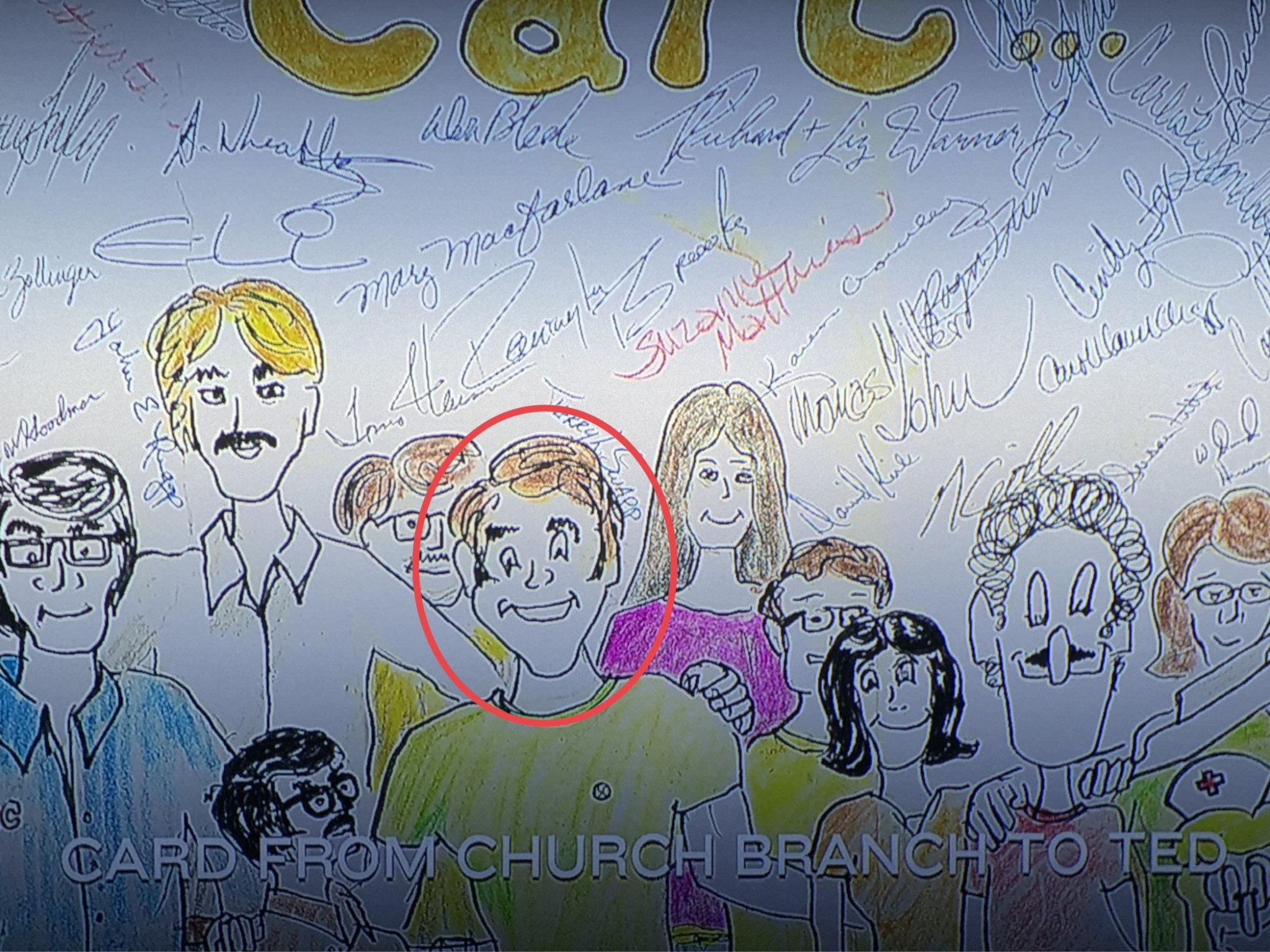
The instinct of the community was absolute: protect the brother in the faith, distrust the secular authorities, and ignore the dead women on the outside.
Risk Management vs. Child Safety
Today, that instinct to protect the institution has been corporatized.
As a public school coach and teacher in Forks, Brian Weekes was a state-mandated reporter of child abuse. However, if Weekes was acting as a Bishop hearing a confession from Tammy Leask, he would have operated under a completely different set of rules.
Within the LDS faith, the handling of abuse confessions is highly centralized, legally insulated, and fundamentally designed to protect the institution.
According to Section 38.6.2.1 of the official LDS General Handbook, if a local leader learns of possible abuse, they are directed to “promptly call the help line.” This toll-free number connects the local bishop not to child welfare advocates, but to “legal and clinical professionals” at Church headquarters.
This protocol effectively transforms a moral crisis into a corporate liability issue.
A blistering 2022 national investigation by the Associated Press exposed the grim reality behind this policy, highlighting the horrific case of Paul Adams in Arizona. When a local bishop learned Adams was sexually abusing his 5-year-old daughter, he followed protocol and called the LDS helpline.
The AP investigation revealed that attorneys at Kirton McConkie—the powerful Salt Lake City law firm representing the church—advised the bishop not to report the abuse to civil authorities, citing state clergy privilege loopholes.
Because the church prioritized its legal shield over the child’s safety, Adams was allowed to continue abusing his daughter, and eventually her infant sister, for seven more years.
The Collapse of Senate Bill 5375
Crucially, the legislative timeline of Washington State provided the church with a massive legal shield locally.
Leask’s crimes took place between November 2019 and January 2020. At that time, Washington law included the “clergy-penitent privilege,” a loophole exempting religious leaders from mandatory reporting laws if they learned of child abuse during a sacred confession.
In May 2025, Washington State enacted Senate Bill 5375, attempting to finally strip clergy of this exemption. However, the victory for child advocates collapsed within months. The LDS Church quickly threw its formidable legal and political weight behind federal lawsuits to block the mandate, deploying religious freedom lobbying coalitions to argue that forcing clergy to report abuse violated the First Amendment.
The pressure campaign worked. In October 2025, Washington’s Attorney General signed a legal stipulation agreeing not to enforce the reporting requirements. The loophole was cemented back into place.
This triggers an urgent question for the parents of Forks: During the alleged counseling sessions in 2020, did Leask confess to Weekes? And if she did, did a public school educator dial the help line? Were Kirton McConkie attorneys analyzing Washington’s clergy privilege laws to successfully hide an ongoing predator operating within the public school’s own facilities?
The Stake Presidency and the Chain of Command
The institutional overlap extends even higher up the ecclesiastical ladder, pointing directly to former Port Angeles Stake President Brent Basden.
The timeline of Basden’s tenure as Stake President overlaps directly with some of the most severe allegations of abuse against Weekes himself.
According to a formal Title IX grievance filed against the school district, Kari Larson alleged that Weekes’s pervasive sexual harassment and assault began in the fall of 2017.
Furthermore, according to deposition transcripts, the school district received formal, written reports detailing allegations of Weekes inappropriately touching and massaging female athletes in April 2019.
Because Weekes was reportedly serving in a top ward leadership capacity during this era, serious disciplinary matters or confessions within the church would mandate direct coordination with the Stake Presidency.
Was Stake President Basden aware of the allegations surrounding Brian Weekes?
The Final Stop: The Clallam County Courts
The entanglement of these institutions reaches its most troubling apex within the Clallam County justice system.
When Tammy Leask was eventually arrested, her case entered the jurisdiction of Brent Basden, who had transitioned from his role as Stake President to serving as a Superior Court judge.
The bedrock of the justice system is outlined in Rule 2.11 of the Washington Code of Judicial Conduct, which explicitly mandates that “a judge shall disqualify himself or herself in any proceeding in which the judge’s impartiality might reasonably be questioned.”
A judge presiding over the felony rape case of a defendant from his own former flock—especially if his former Bishop is intertwined in the defendant’s counseling—shatters that ethical standard.
Yet, court records show Basden did not fully distance himself from the admitted child rapist’s legal proceedings, actively presiding over a hearing in Leask’s criminal case on February 17, 2021.
This perception of a two-tiered, closed-loop justice system designed to protect LDS members is no longer just a theory whispered among critics. In March 2026, the Washington State Commission on Judicial Conduct officially opened an investigation into Judge Basden.
The complaint centers on a recent family court case where Judge Basden allegedly failed to recuse himself despite deep ecclesiastical ties, instead utilizing his courtroom to grant an accused abuser unsupervised access while openly discouraging the protective parent from involving law enforcement.
Official state records now explicitly corroborate this weaponization of Judge Basden’s courtroom for religious retribution, highlighting a dynamic eerily similar to Bundy’s time in Utah.
According to a July 2024 Child Protective Services case note regarding the underlying custody dispute, a court-appointed Guardian ad Litem explicitly warned social workers of this exact dynamic.
The GAL reported that the LDS member held the “upper hand in the case as the judge is also Mormon and knows [the mother] said negative comments about the religion.”
Just as Bundy’s LDS ward ignored the brutal, escalating warning signs of his psychopathy, Judge Basden’s courtroom appears to be shielding a man who is allegedly exhibiting similar terrifying precursors to lethal violence.
The GAL formally documented that the LDS member was actively “weaponizing religion, and money to sway the court decision,” despite known and documented safety concerns, including the LDS member having killed the family cats.
Despite these blaring, textbook indicators of escalated violence—the exact type of animal cruelty that preceded Ted Bundy’s rampage—this CPS narrative underscores a terrifying reality: a mother deemed “a great mom, a safe mom and a loving beautiful person” by the GAL was penalized for criticizing the LDS faith, while a father with a documented history of dangerous behavior was shielded by shared religious loyalties on the bench.
Silence Across Borders
The real-world consequences of the LDS’s insular culture and the Clallam County cover-ups extend far beyond the Olympic Peninsula.
Just last week, this human toll was laid bare in a devastating letter sent to Bishop Mellor of the Pullman YSA Ward of the Pullman Washington Stake.
The letter, penned by a survivor, formally demanded the removal of their church records. But the underlying abuse—and the ecclesiastical efforts to hide it—did not happen in Pullman. The allegations originated hundreds of miles away in the Port Angeles Washington Stake.
As victims relocate to escape their abusers or seek a fresh start, they frequently find that the trauma of the institutional cover-up has followed them across jurisdictional lines. The resignation letter sent to the Pullman leadership connects the dots between the alleged Port Angeles cover-up and a complete loss of faith in the institution.
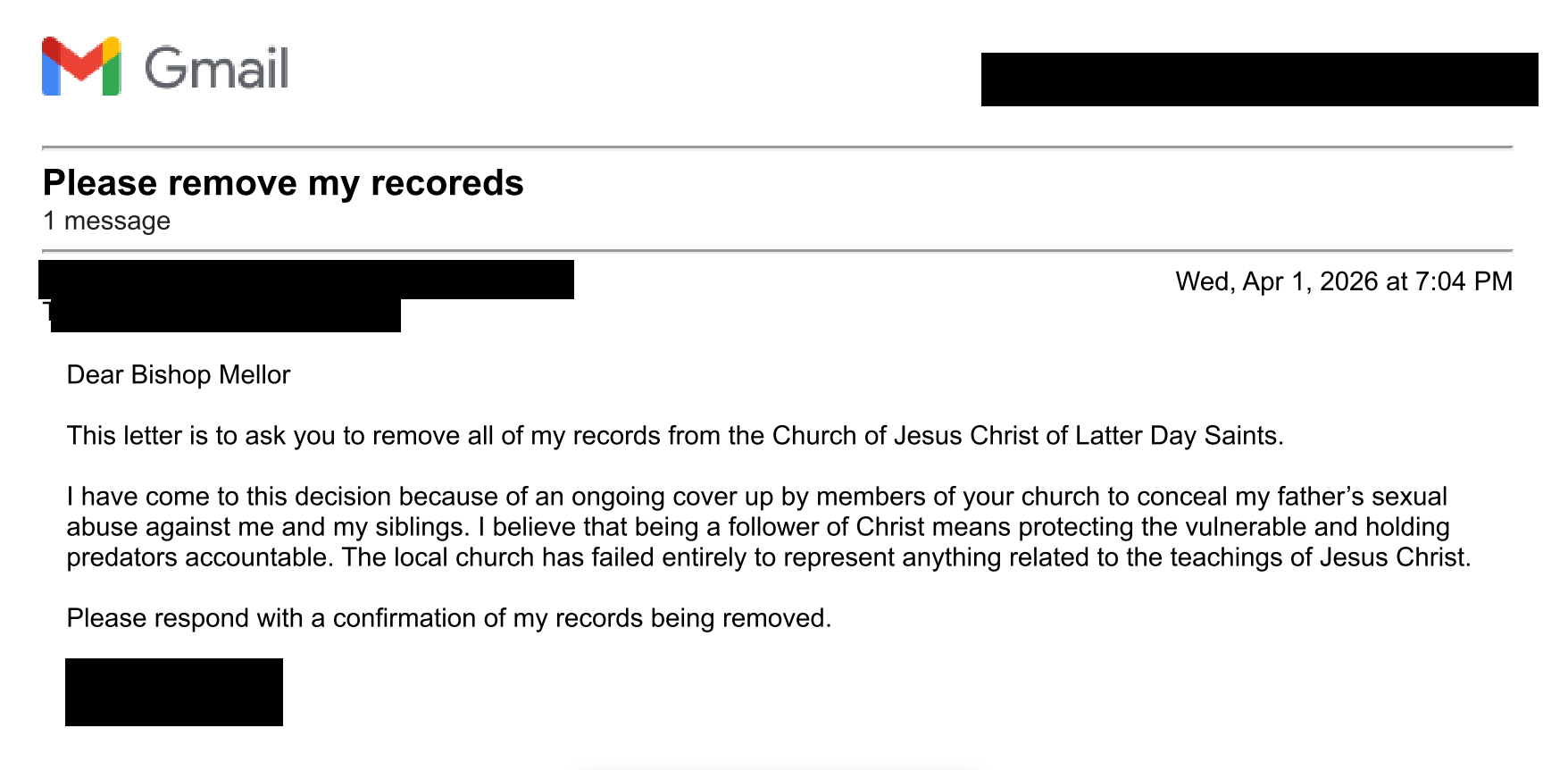
While it remains to be seen how the LDS Church will officially respond to this recent letter, this desperate plea for accountability perfectly illuminates the moral bankruptcy of a closed-loop system.
As victims are begging LDS leaders to act like followers of Christ by “protecting the vulnerable,” the institution’s localized cover-ups fracture the faith of its members, sending shockwaves of disillusionment across the state.
A Broader Pattern of Judicial Cronyism and Negligence
The culture of a closed-loop justice system in Clallam County extends beyond strictly religious affiliations, manifesting as a broader, deeply entrenched pattern of judicial cronyism and administrative negligence overseen by Judge Basden.
Court records reveal that Basden has a documented history of utilizing his bench to enrich and protect his personal inner circle. For instance, Basden was involved in awarding his longtime personal friend, former business partner, and former LDS bishop, Lane Wolfley, a lucrative, $6,250/month court contract.
This cronyism extends directly to the hiring and firing of judicial officers. Internal records show that Basden bypassed standard vetting protocols to fast-track the hiring of Court Commissioner Brian Parker. That appointment ended in disaster. Parker was recently terminated by the Presiding Judge Simon Barnhart.
Upon his abrupt, taxpayer-funded exit, Parker absconded with highly sensitive legal documents, forcing human resources to scramble and formally demand the return of a missing Search Warrant Log he had removed from the courthouse.
For Basden, the mishandling of warrants is a recurring theme of his career.
During his own four-year tenure as court commissioner from 2007 to 2011, court records reveal that Clallam County lost nearly 13% of its search warrants.
It was a staggering administrative failure that set the historical stage for the court’s current inability to safely manage sensitive legal records.
The Necessity of Outside Intervention
The historical parallel to Brigham Young’s Utah theocracy offers a prescient warning—and a stark contrast in how such monopolies are broken.
By 1857, Young’s control over the local probate courts had become so absolute, and his blending of ecclesiastical and state power so egregious, that U.S. President James Buchanan took decisive action.
Exercising his federal authority over the territory, Buchanan officially removed Young as governor and deployed federal troops to forcefully break the LDS’s judicial monopoly and restore secular law.
Today, Clallam County faces a strikingly similar jurisdictional crisis—one where the quiet protection of abusers by those entrusted with public safety feels agonizingly familiar. We need only look to recent headlines out of Utah to understand the devastating consequences of a compromised bench.
In March 2025, former Utah 1st District Justice Court Judge Kevin Christensen was arrested and charged with multiple felonies for the sexual exploitation of minors. The parallels between Christensen and Judge Basden offer a chilling look at how the bench can be weaponized to protect a specific inner circle of LDS members.
In Utah, Judge Christensen, who is LDS, actively utilized his judicial authority to shield his co-conspirator, former Tremonton Fire Chief Ned Brady Hansen, who is also LDS.
When law enforcement requested that Hansen be held without bail due to the severe danger he posed to children, Christensen—who was secretly sharing abuse materials with the Fire Chief—quietly denied the request and released him. Christensen weaponized his gavel to protect his ally, prioritizing their shared secrecy over the safety of the community.
Earlier today, Christensen pled guilty to one count of enticing a minor and two counts of dealing in materials harmful to a minor.
Similarly, Judge Basden has a documented history of utilizing his bench to enrich and protect his personal inner circle, manipulating the scales of justice to grant leniency to an accused abuser who shares his LDS loyalties.
By utilizing his courtroom to grant an accused abuser unsupervised access to children while openly discouraging the victims from involving law enforcement, Basden’s actions effectively mirror Christensen’s: using the protective veil of the judiciary to shield a dangerous ally from secular accountability.
For modern citizens demanding a swift executive stroke will find direct removals constitutionally barred.
The state constitution strictly separates powers. Washington State Governor Bob Ferguson cannot simply issue an order to remove Judge Basden. However, the Governor is not powerless.
Governors across the country have historically used the weight of their office to formally refer judges to state conduct commissions or publicly demand investigations into egregious judicial bias.
Governor Ferguson could use his executive influence to formally request that the independent Washington State Commission on Judicial Conduct expedite and expand its current probe, placing immense public pressure on the judicial branch to act.
Similarly, any hopes of unilateral federal intervention from the Oval Office are legally impossible.
The Tenth Amendment and the bedrock of American federalism strictly protect state courts from a direct presidential firing.
However, President Trump does have a powerful mechanism for oversight at his disposal. Under federal law, the U.S. Department of Justice’s Civil Rights Division can launch a “pattern or practice” investigation into local justice systems accused of systemic constitutional violations.
There is strong historical precedent for this type of federal intervention.
In 2012, the DOJ launched a massive civil rights investigation into the juvenile court system of Shelby County, Tennessee. The federal probe revealed systemic due process and equal protection violations, ultimately placing the local court system under a strict federal settlement agreement.
If Clallam County’s courtrooms are indeed operating a two-tiered justice system that systemically deprives citizens of their civil rights in favor of loyalists, friends, and fellow congregants, the President could direct the DOJ to initiate a similar civil rights probe into the superior court system.
While the threat of federal DOJ oversight looms, the most direct path to breaking a modern judicial monopoly runs entirely through the CJC investigation, which has become the critical flashpoint in Clallam County’s history.
INVASION OF THE BODY SNATCHERS! "Don't ask, don't tell"
The Church of Ladder Day SECRETS absolutely has become powerful because its ideological indoctrination from birth. The shaping of a child’s future starts from their beginnings. Own the mind first, then you will own their bodies and souls to do with as you please and at your pleasure.
Keeping the sexual abuse a secret followed by massive, coordinated cover-up is a perfect storm for power and control. The children don’t stand a chance to break the cycle.
Hopefully the upcoming court case against you Anthony will bring focus to the cancer within the LDS church. Maybe there will be justice? You are entering a mighty fight. We will be watching and backing your victory.
Thank you for writing this! It's unthinkable that anyone could be so evil! And yet they are! Thank you for telling the truth!