
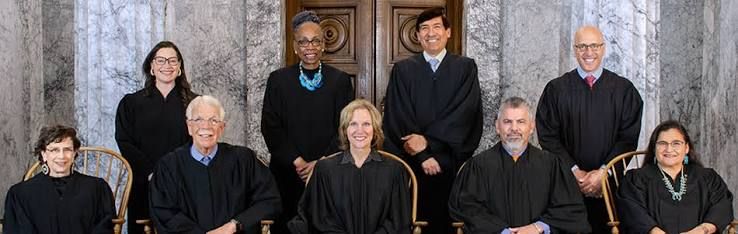
The Washington Supreme Court on October 15 ruled that a restriction barring a man convicted of child molestation in Kitsap County from possessing or accessing “sexually exploitive materials” was unconstitutionally vague.
The 6–3 decision concerns one condition of Jeremiah J. Jeffries-Porter’s supervision after prison. It does not overturn his conviction or shorten his prison sentence.
The court reversed the Court of Appeals and sent the case back to Kitsap County Superior Court for further proceedings.
The decision leaves intact a separate condition prohibiting sexually explicit materials. The majority said that restriction already covered everything the state’s proposed definitions of “sexually exploitive materials” would prohibit.
Jeffries-Porter pleaded guilty to one count of first-degree child molestation and was sentenced to 51 months in prison followed by 36 months of community custody, according to the opinion.
The judgment under review was signed by Kitsap County Superior Court Judge Michelle B. Adams and filed January 22, 2024.
The challenged condition left the definition of “sexually exploitive materials” to Jeffries-Porter’s treating therapist or community corrections officer.
Writing for the majority, Justice Sheryl Gordon McCloud said courts may rely on those professionals to supervise offenders and refine restrictions. But the court’s order must give both the defendant and the people enforcing it enough guidance to understand its limits.
“Sexually exploitive” had multiple possible meanings, the majority concluded, and neither the sentencing documents nor other sources supplied a clear definition applicable to the condition.
The state’s own explanations illustrated the problem, the majority said. In its written argument, the state described materials showing people engaged in sexually explicit conduct.
At oral argument, it described materials showing minors engaged in such conduct. The state also expressed uncertainty about whether the restriction covered depictions of simulated conduct.
Those differences mattered because a restriction covering simulated sexual conduct by adults would reach a broader range of material than one limited to live or photographed sexual acts involving minors, the majority explained.
The Court of Appeals had upheld the condition in a split decision in August 2025, relying on statutes addressing sexual exploitation of a minor and defining sexually explicit conduct.
The Supreme Court majority found that those statutes did not resolve the ambiguity. Neither defined the phrase used in Jeffries-Porter’s restriction, and the condition did not refer to them.
The majority held that the restriction failed to provide fair notice, protect against arbitrary enforcement or narrowly tailor its reach to public safety and rehabilitation. It also found that the potential restriction of material protected by the First Amendment required greater clarity.
Chief Justice Debra L. Stephens dissented, joined by Justices Charles W. Johnson and G. Helen Whitener.
Stephens argued that the condition was sufficiently clear when read in the context of Jeffries-Porter’s child-molestation conviction and statutes concerning sexual exploitation of children.
Under that reading, she wrote, it prohibited materials depicting the sexual exploitation of a minor, which are not protected by the First Amendment.
She argued that the court’s precedents did not require the condition to explicitly cite those statutes. She also said the majority blurred the distinction between an unclear restriction and one that reaches too broadly into protected expression.
“Our vagueness analysis has never demanded perfection in drafting,” Stephens wrote. “It requires fair notice and ascertainable standards, judged in context, including the nature of the conviction, related statutes, and ordinary dictionary meanings.”
↺ Republish this story
Our stories are free to republish, online or in print, under these rules:
- Credit The Olympic Herald and the author, and link back to this story.
- Don't edit the story except for style, length, or to update time references.
- If you republish online, use our canonical URL so search engines credit the original.
- Don't sell the story or use it primarily to sell advertising.
Questions? Contact us.