
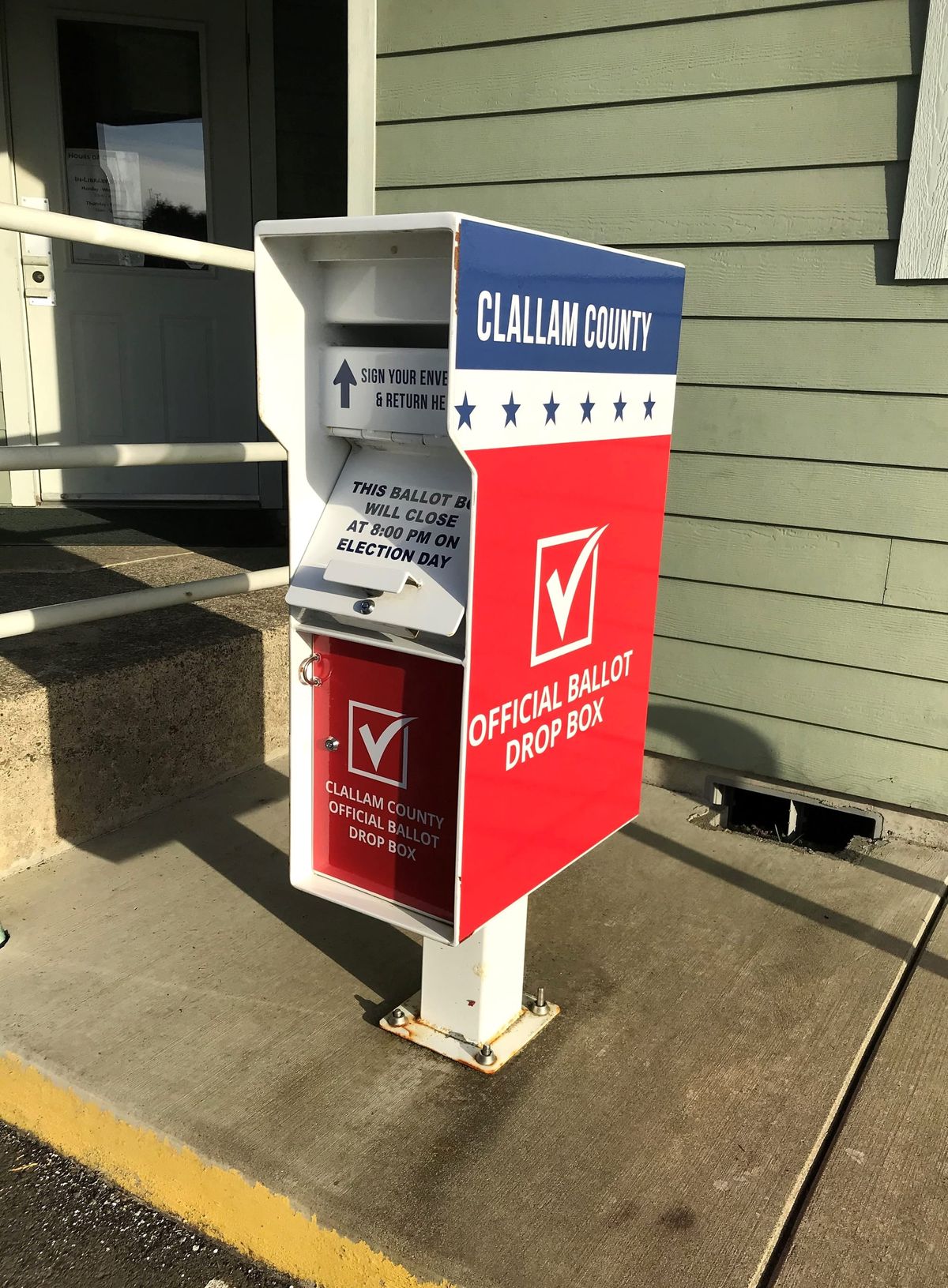
Ballots for the August 4 primary went in the mail on July 17. They are sitting on kitchen counters across Washington right now, next to a voters' pamphlet that tells you what each candidate says about themselves and nothing about who paid to get that message in front of you.
That second question has always been answerable. Washington has required campaigns to disclose their money since voters passed Initiative 276 in 1972, and the Public Disclosure Commission publishes every filing as an open dataset.
Answering it has just been tedious—the records are spread across more than a dozen tables, keyed by filer IDs, and built for people who already know what they are looking for.
Starting today, The Olympic Herald is publishing a free tool that does the tedious part for you.
https://www.olympicherald.com/campaign-finance
You can point it at the whole state or narrow it to one county or legislative district, then look at a race, a candidate, a donor, a vendor a campaign paid, or a committee spending money from outside a campaign. There is no account to make and nothing to pay. Reader support built it, and reader support is what will keep it running through the general election and beyond.
What Clallam County looks like
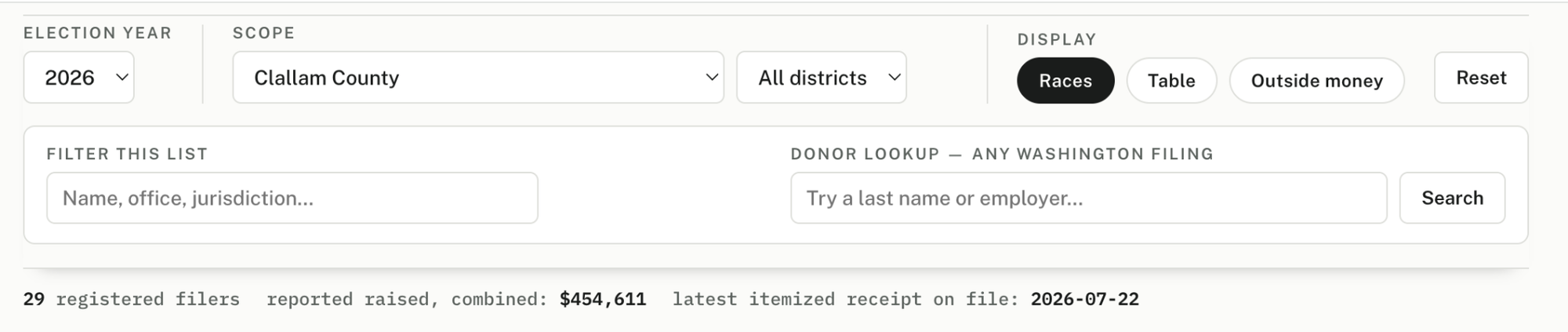
Narrowed to Clallam on July 26, the tool listed 29 registered filers reporting a combined $454,611 raised this cycle. The most recent itemized receipt on file that day had arrived four days earlier.
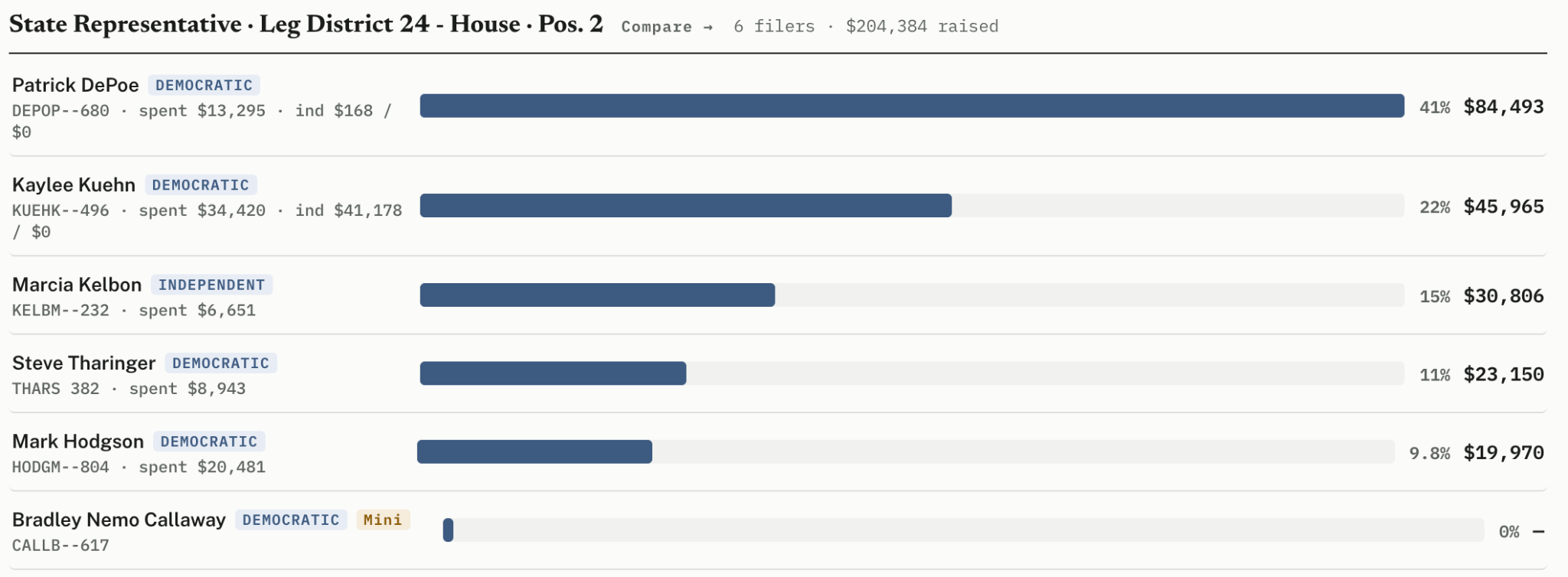
Most of that money is in two legislative races. Six filers in the 24th District's House Position 2 contest have reported $204,384 between them.
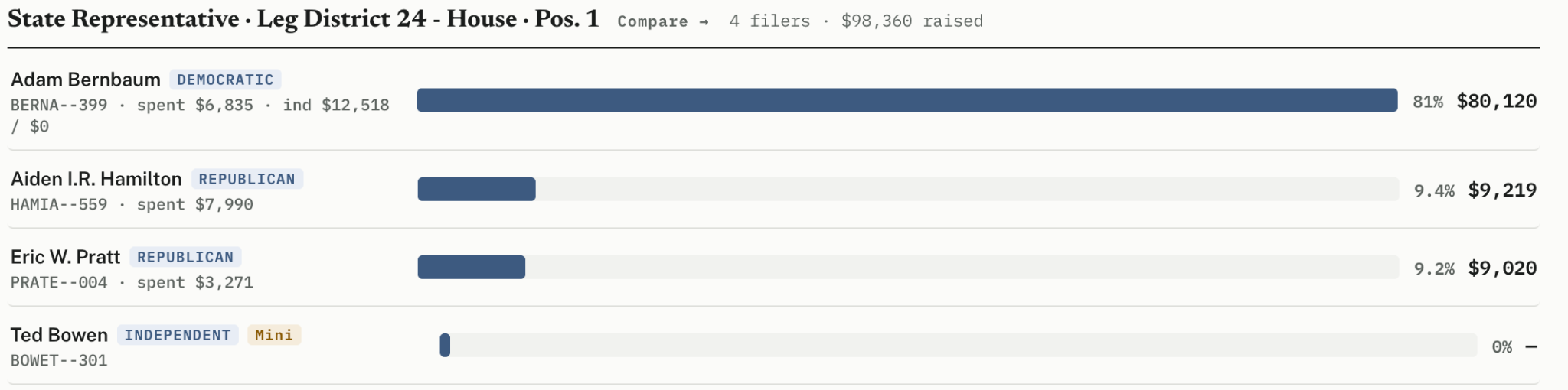
Four filers in Position 1 account for another $98,360.
Below those, the county's own offices: $79,944 across the two candidates for County Commissioner, Position 3, and $40,173 in the contested District Court judgeship.
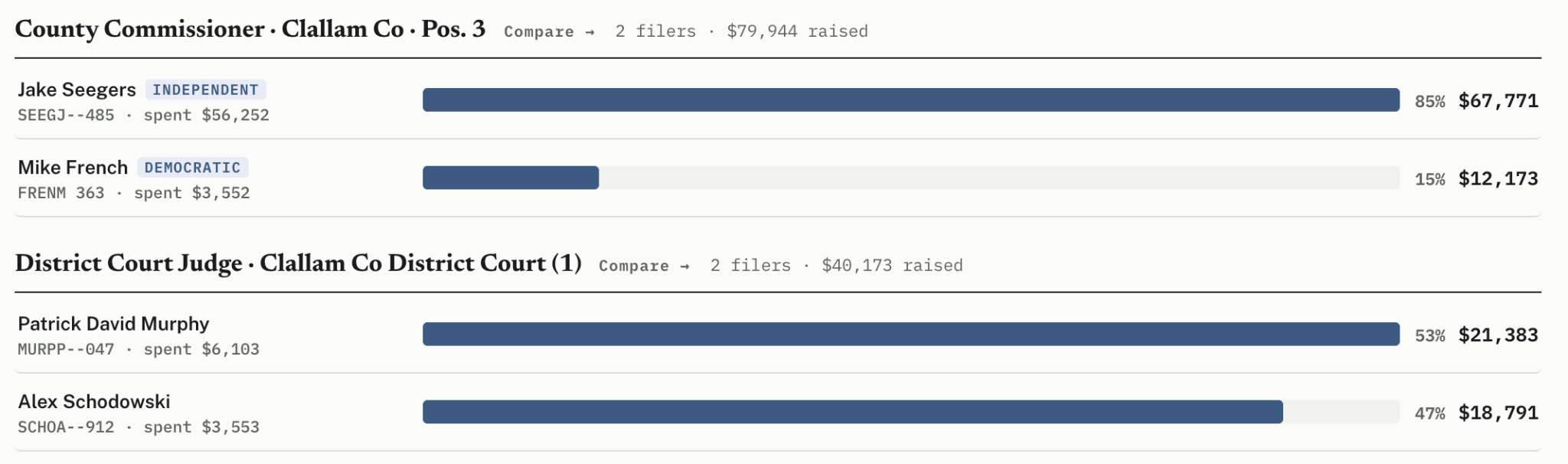
Then there is the long tail, which is the part that rarely makes the news. Five filers are running for a Clallam County PUD commissioner seat and have reported $5,481 among them.
The county auditor's race shows $1,212. The assessor's, $1,187. Candidates for sheriff, treasurer, and director of community development have reported nothing at all—some as mini-reporting filers, who tell the state up front they will stay under the threshold that triggers itemized disclosure.
How it works
The Herald has no campaign finance database. There is no nightly import and no archive here.
The page queries data.wa.gov from your browser, each time you load it, across fifteen PDC datasets—contributions, expenditures, independent spending, last-minute gifts, loans, debt, surplus funds, enforcement cases, filing histories, imaged documents and the reporting calendar.
What appears on your screen is what the state was publishing at that moment. Every contribution row and every document links back to the PDC's own filing.
Names, amounts and offices appear the way the filer typed them. Nothing is silently corrected.
Amendments supersede originals in the state's data, and where the record marks a report superseded, the page says so. Refunds and corrections show up as negative numbers, because that is how they are filed.
If you use it in something
Every view has its own address, and a copy-link control puts it on your clipboard. CSV exports carry the date you pulled them in the filename.
Pair a link with the date you looked—filings amend constantly, and reopening a link re-runs the query against current data, so it reproduces the view rather than the numbers.
If a figure here disagrees with the PDC's own site, the PDC is right and we want to hear about it. Send the link and the date you looked.
The full methodology is published alongside the tool. It is built on the premise that these records already belong to you and the only thing standing between you and them is the work of looking.
That work—on this tool, and on the next story—is what reader support pays for.
Republish this story
Our stories are free to republish, online or in print, under these rules:
- Credit The Olympic Herald and the author, and link back to this story.
- Don't edit the story except for style, length, or to update time references.
- If you republish online, use our canonical URL so search engines credit the original.
- Don't sell the story or use it primarily to sell advertising.
Questions? Contact us.