
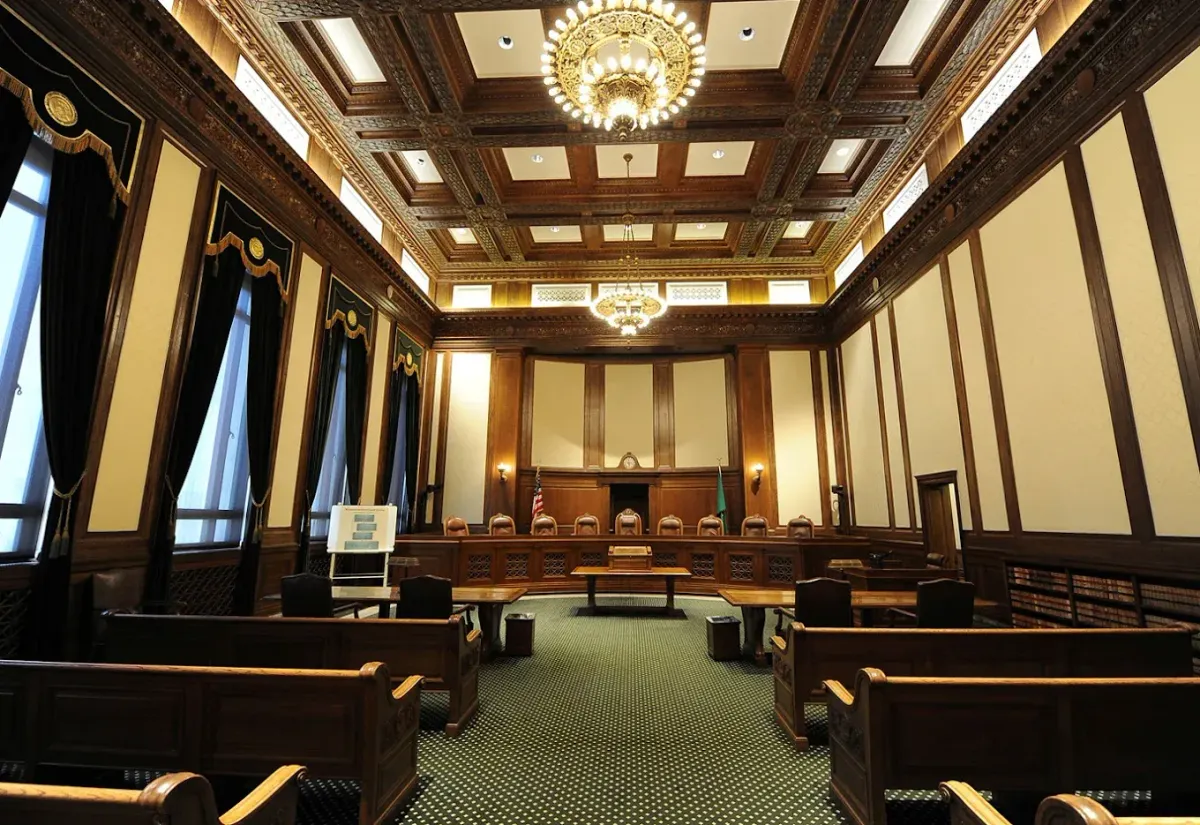
The Washington Supreme Court ruled Thursday that Initiative 2066, the voter-approved measure restricting state and local efforts to discourage natural gas use, is unconstitutional because it violates Washington’s single-subject rule.
The 6-3 decision in Climate Solutions v. State affirms a King County Superior Court ruling that invalidated I-2066 in its entirety, but on narrower grounds.
The Supreme Court held that the initiative combined four constitutionally distinct subjects that could not be separated without the court effectively deciding which portions voters would have approved on their own.
Chief Justice Debra Stephens wrote the majority opinion, joined by Justices Steven González, Raquel Montoya-Lewis, G. Helen Whitener and Colleen Melody, along with Justice Pro Tem Barbara Madsen. Justice Salvador Mungia dissented, joined by Justices Charles Johnson and Sheryl Gordon McCloud. Justice Theodore Angelis did not participate.
I-2066 was approved by Washington voters in November 2024 with 51.71 percent of the vote, receiving 1,941,474 votes in favor and 1,813,169 against.
Results varied across the Olympic Peninsula and nearby counties. Clallam County voters rejected the measure 50.86 percent to 49.14 percent, while Jefferson County rejected it 63.9 percent to 36.1 percent. Mason County approved it with 56.42 percent of the vote, and Kitsap County approved it with 51.38 percent.
What I-2066 Changed
The initiative concerned natural gas and electrification policy across several areas of Washington law.
Among other provisions, I-2066 required gas companies, large combination utilities, and cities and towns that furnish natural gas to continue providing it to qualifying consumers.
It also restricted the Utilities and Transportation Commission from approving certain plans that could limit access to natural gas.
Other sections restricted the State Building Code Council from adopting or amending building and energy codes in ways that would prohibit, penalize or discourage gas use.
The initiative also removed a statutory energy-code goal aimed at achieving zero fossil-fuel greenhouse gas emissions from homes and buildings by 2031.
I-2066 separately barred cities, towns, counties and local air pollution control agencies from taking actions that prohibit, penalize or discourage gas use for heating, appliances or equipment in buildings.
Climate Solutions, joined by other organizations, King County, the City of Seattle and other plaintiffs, challenged the initiative in King County Superior Court.
They argued that it violated the Washington Constitution’s single-subject and subject-in-title requirements and also improperly amended existing laws without setting those laws out in full.
The State of Washington, joined by the Building Industry Association of Washington and Ashli Penner, defended the initiative. Superior Court Judge Sandra Widlan ruled in May 2025 that I-2066 was unconstitutional on all three grounds.
Supreme Court Finds Four Distinct Subjects
Article II, section 19 of the Washington Constitution provides that “[n]o bill shall embrace more than one subject, and that shall be expressed in the title.”
The same constitutional restriction applies when Washington voters exercise legislative power through the initiative process.
The Supreme Court said Thursday that I-2066 crossed that line.
The majority identified four distinct subjects within the measure: requirements intended to maintain access to natural gas, restrictions on local air-quality regulation, changes to statewide building and energy codes, and the repeal of a severability provision in the Washington Decarbonization Act.
While each provision had some connection to energy or natural gas, the court said that was not enough. Under the court’s precedent, provisions in an initiative must have what it calls “rational unity” both with the measure’s general title and with each other.
The majority found that the restrictions on air pollution control agencies had a different regulatory purpose from requirements governing the supply and delivery of natural gas.
It reached a similar conclusion about the initiative’s changes to statewide building codes, finding those provisions primarily regulated construction standards and the authority of the State Building Code Council.
The court also rejected arguments that I-2066 could be treated as permissible omnibus legislation addressing the broader issue of “energy choice.”
Even accepting that description, Stephens wrote, the initiative did not comprehensively address a single problem in the manner of other omnibus laws upheld by Washington courts.
Instead, the majority said its provisions operated separately across utility regulation, local government authority, air quality and statewide building codes.
Court Declines to Save Portions of the Initiative
I-2066 included a severability clause stating that if one provision were found invalid, the rest of the initiative would remain in effect.
The Supreme Court nevertheless concluded that the constitutional problem could not be fixed by removing individual sections.
The majority said there was no way to determine which of I-2066’s four distinct subjects voters would have approved if each had appeared separately on the ballot. Choosing which provisions to preserve would require the justices to decide that some subjects were more important than others, the court said, a judgment it concluded belonged to voters rather than judges.
Because of that, the court affirmed the complete invalidation of I-2066.
The majority did not decide whether the initiative also violated the Constitution’s subject-in-title requirement or its prohibition on so-called silent amendments to existing law.
Those were additional grounds on which the King County court had invalidated the measure.
Three Justices Would Have Preserved Most of I-2066
Mungia’s dissent would have reached a different result.
He concluded that nearly all of the initiative’s provisions were sufficiently connected to the general subject of protecting consumers’ access to natural gas. In his view, only subsection 12(5), which repealed the Decarbonization Act’s severability clause, introduced a separate subject under article II, section 19.
The dissent also concluded that sections 9, 10 and 11 violated a separate constitutional provision, article II, section 37, because their restrictions on cities, counties and air pollution authorities changed existing legal duties without adequately disclosing those effects in the initiative itself.
Rather than invalidate the entire measure, Mungia would have removed sections 9, 10 and 11 and subsection 12(5) and allowed the remainder of I-2066 to stay in effect.
He wrote that the initiative’s own severability clause supported preserving the remaining provisions and that those provisions could still accomplish the measure’s purpose of maintaining natural gas access and availability.
The majority rejected that approach, concluding that selecting which subjects to preserve would require the court to make assumptions about what Washington voters would have approved if the provisions had been presented separately.
Thursday’s decision affirms the King County Superior Court judgment invalidating I-2066 in full.
Support The Olympic Herald
If this story mattered to you, help us report the next one
The Herald has no paywall and no corporate owner. Reader support is what pays for the records requests, court hours, and follow-through that accountability reporting takes.
Become a monthly supporter
Steady, recurring support is what lets us commit to long investigations instead of chasing quick hits. Members get no special perks — just the knowledge that fearless local reporting exists because of them.
$10/mo
or
$100/yr
Become a member
Cancel anytime · Secure checkout via Stripe
Give once with a card
Pick an amount below — secure Stripe checkout takes under a minute.
Want to give a different amount? Choose your own →
Secure checkout via Stripe · No account required
↺ Republish this story
Our stories are free to republish, online or in print, under these rules:
- Credit The Olympic Herald and the author, and link back to this story.
- Don't edit the story except for style, length, or to update time references.
- If you republish online, use our canonical URL so search engines credit the original.
- Don't sell the story or use it primarily to sell advertising.
Questions? Contact us.