
The Legislature will not gavel in again until January. To most people that reads as the off-season. It isn’t. The interim is when the next session gets written—in committee work groups, agency rulemaking, and the budget requests that land in the governor’s office this fall—and every month of it, someone is paid to be in the room.
Who pays them has always been answerable. The same 1972 initiative that made campaigns disclose their money made lobbying disclose its money too, and the Public Disclosure Commission publishes every filing as an open dataset.
Answering it has just been tedious. Employers, firms, individual lobbyists and public agencies file on different forms into different tables, and the name a company files under is rarely the name you would type.
Starting today, The Olympic Herald is publishing a free tool that does the tedious part for you.
https://www.olympicherald.com/lobbying/
You can look at it four ways: who pays for lobbying, who gets paid, which individual lobbyists work for whom, and which public agencies are lobbying the Legislature with public money.
Any name in any list opens into its own page. There is no account to make and nothing to pay. It is the second tool in a series that began in July with campaign finance, and reader support built both.
What the record looks like right now
Pulled on September 2, the tool showed employers reporting $53.2 million paid for lobbying so far in 2026, with four months of filings still to come.
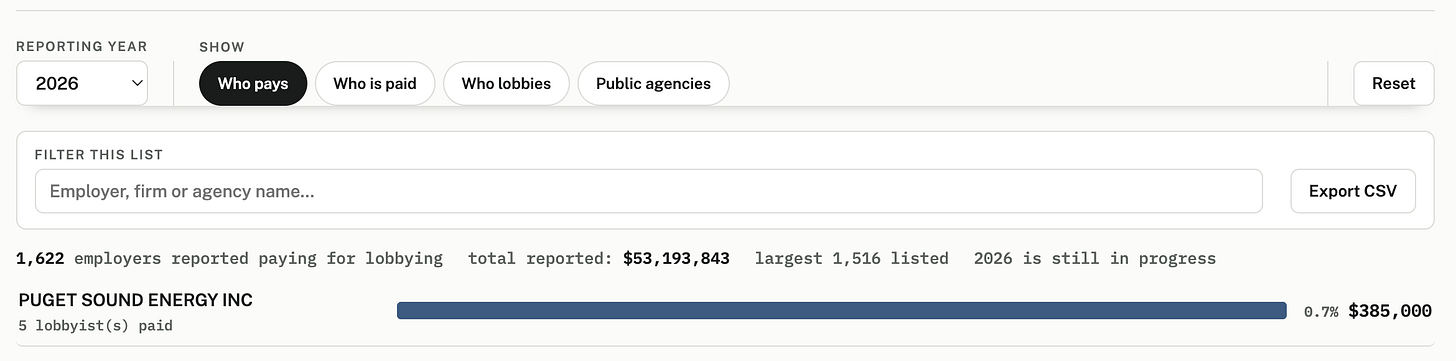
Puget Sound Energy leads, at $385,000 across five lobbyists. Amazon is next at $338,660, then Boeing at $321,424, Microsoft at $317,591 and the Western States Petroleum Association at $317,322—the last of those through just three people.
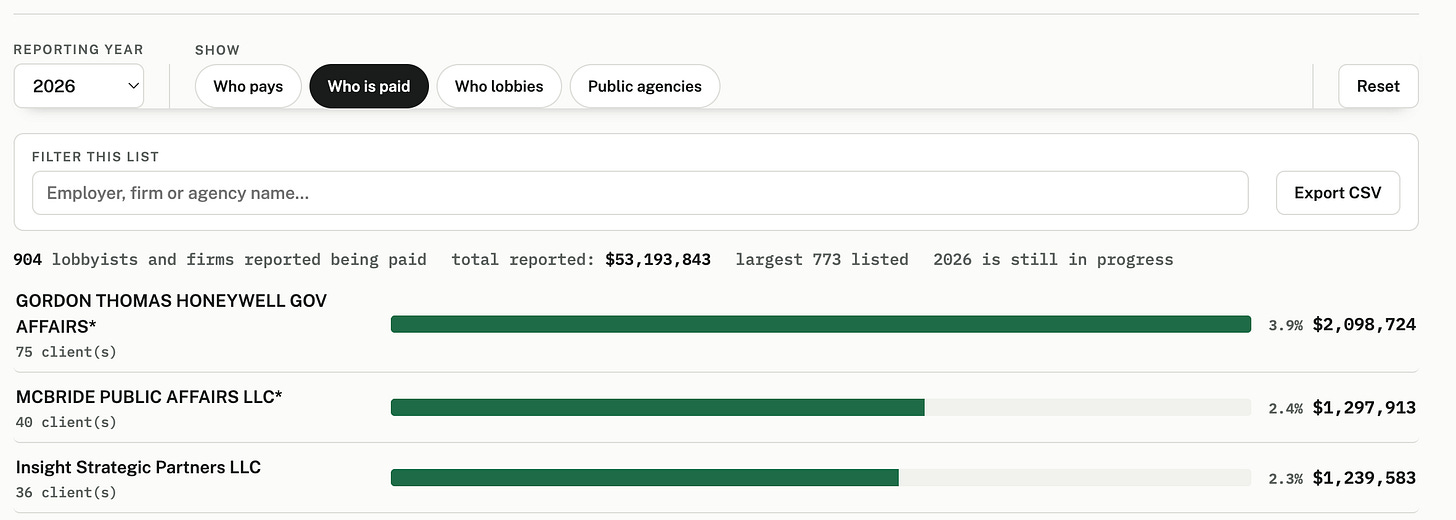
On the other side of the same money, Gordon Thomas Honeywell Governmental Affairs has been paid $2.1 million this year by 75 different clients. McBride Public Affairs follows at $1.3 million across 40.
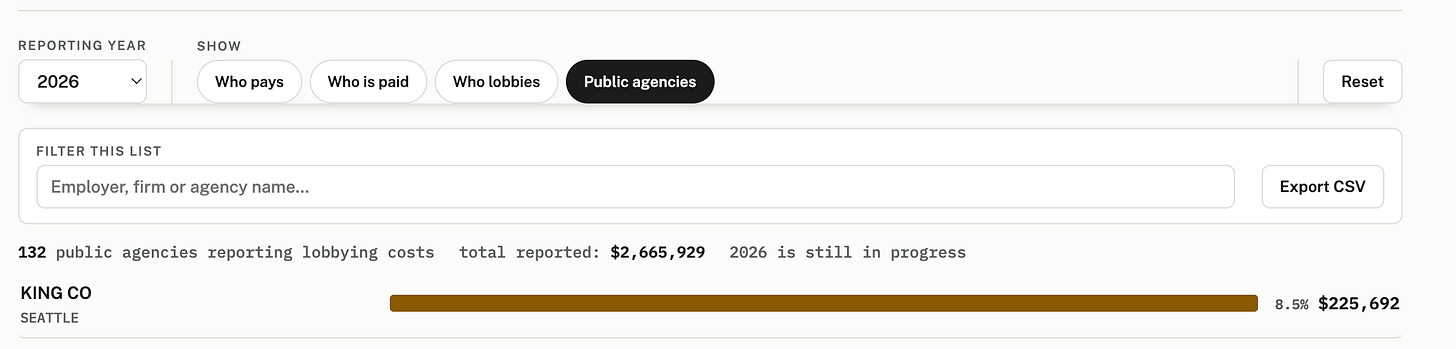
Then there is the part that rarely makes the news: government lobbying government. King County reported $516,178 lobbying the Legislature in 2025, more than any other public agency in Washington. Chelan County’s public utility district reported $233,824.
Open either one and the tool breaks it into the four quarterly reports the agency filed, each linked to the document itself.
How it works
The Herald has no lobbying database. There is no nightly import and no archive here.
The page queries data.wa.gov from your browser, each time you load it, across four PDC datasets—lobbyist compensation and expenses, the Commission’s own annual employer summaries, public agency lobbying totals, and the register of lobbyists and the firms they work through.
What appears on your screen is what the state was publishing at that moment. Every row links back to the PDC’s own filing.
Names appear the way the filer typed them. Boeing is on file as “BOEING,” not “The Boeing Company,” and if you arrive with a name that matches nothing on record, the tool says so plainly rather than showing a zero.
Every view has its own address, and a copy-link control puts it on your clipboard. Lobbying reports arrive monthly through the session and quarterly after it, so a number you cite today may have a later filing behind it by the time someone checks—and reopening a link re-runs the query against current data, so it reproduces the view rather than the numbers.
The full methodology is published alongside the tool. Like the campaign finance tracker before it, it is built on the premise that these records already belong to you and the only thing standing between you and them is the work of looking.
The work on this tool, and on the next story, is what reader support pays for. Please help support my work by becoming a paid subscriber or by making a one-time gift.
Republish this story
Our stories are free to republish, online or in print, under these rules:
- Credit The Olympic Herald and the author, and link back to this story.
- Don't edit the story except for style, length, or to update time references.
- If you republish online, use our canonical URL so search engines credit the original.
- Don't sell the story or use it primarily to sell advertising.
Questions? Contact us.