
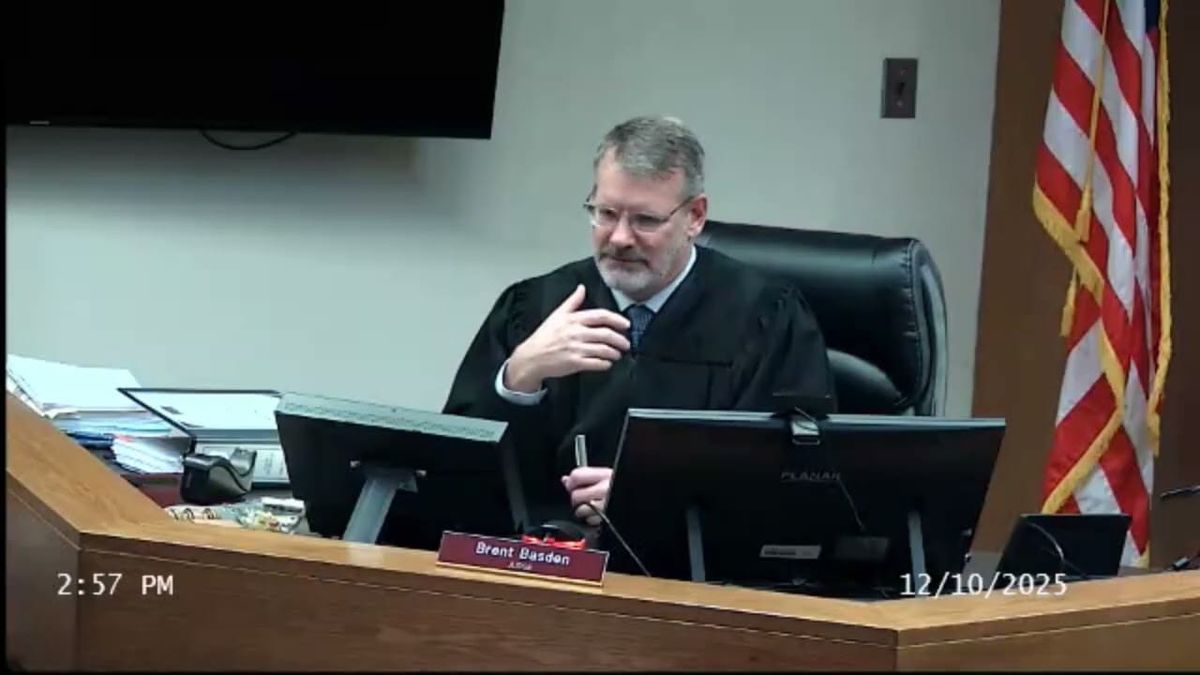
Clallam County Superior Court Judge Brent Basden served on an LDS church council that discussed a family while he presided over its custody case, according to a fellow council member who said participants excluded him from those conversations “knowing it would be a conflict of interest.”
Brittney Hales described the arrangement in an October 13 response to The Olympic Herald. She said Judge Basden left before substantive information was shared and that she knew of no information being passed to him afterward.
The Herald’s review of the entire court file found no disclosure by Basden of his council role. Asked whether she knew if he had disclosed that role to the parties, Hales did not address that question.
Hales said she and Basden served together on a weekly ward council from approximately 2022 through the first half of 2026. She recalled four occasions when the Mavy family’s name came up while Judge Basden was present.
“He was completely kept out of any discussions/conversations revolving around the Mavy family, both by his own efforts as well as everyone else's, knowing it would be a conflict of interest,” she wrote.
Her response described a procedure extending beyond one family.
“This has been his protocol anytime any name comes up with which he has judicial dealings, not just the Mavy family, so it was nothing new,” Hales wrote.
What the council discussed
In February 8, 2026, correspondence reviewed by the Herald, Hales identified herself as the congregation’s Young Women president and Basden as ward mission leader. She wrote that Benjamin Mavy, a party in the custody case, attended Basden’s congregation of The Church of Jesus Christ of Latter-day Saints.
Both served on the ward council, which addresses members’ spiritual and practical needs.
In her October response, Hales said discussions about the family were infrequent and did not concern issues in the custody case.
She described questions about whether the family lived within one congregation’s boundaries or another’s, to determine which youth or children’s group they should attend, and which members should receive ministering assignments involving them.
She said a speaker would ask Judge Basden to leave before substantive information was shared, or Judge Basden would excuse himself as soon as the family’s name came up. Afterward, a council member would retrieve him from the hallway.
Hales said there were no exceptions. She also recalled at least one conversation outside the council in which someone mentioned one of the children and Basden immediately interrupted, excused himself and walked to another room.
She based her conclusion that Basden adequately separated his church and judicial responsibilities on those observations.
Hales said she spoke solely in her personal capacity, based on firsthand experiences, and did not represent the congregation or the Church.
Shared church roles and friendships
Hales’s earlier defense of Basden rested partly on personal familiarity. A friend of Mavy’s, she described years of contact with him and wrote of Basden: “I know him and his character very well.”
Basden previously led the church’s Port Angeles Stake, a regional group of congregations. His connections to Mavy extended beyond their shared congregation.
Both men were friends with Matt Kiddle. Basden called Kiddle a “good personal friend” during a December 8, 2025, trial.
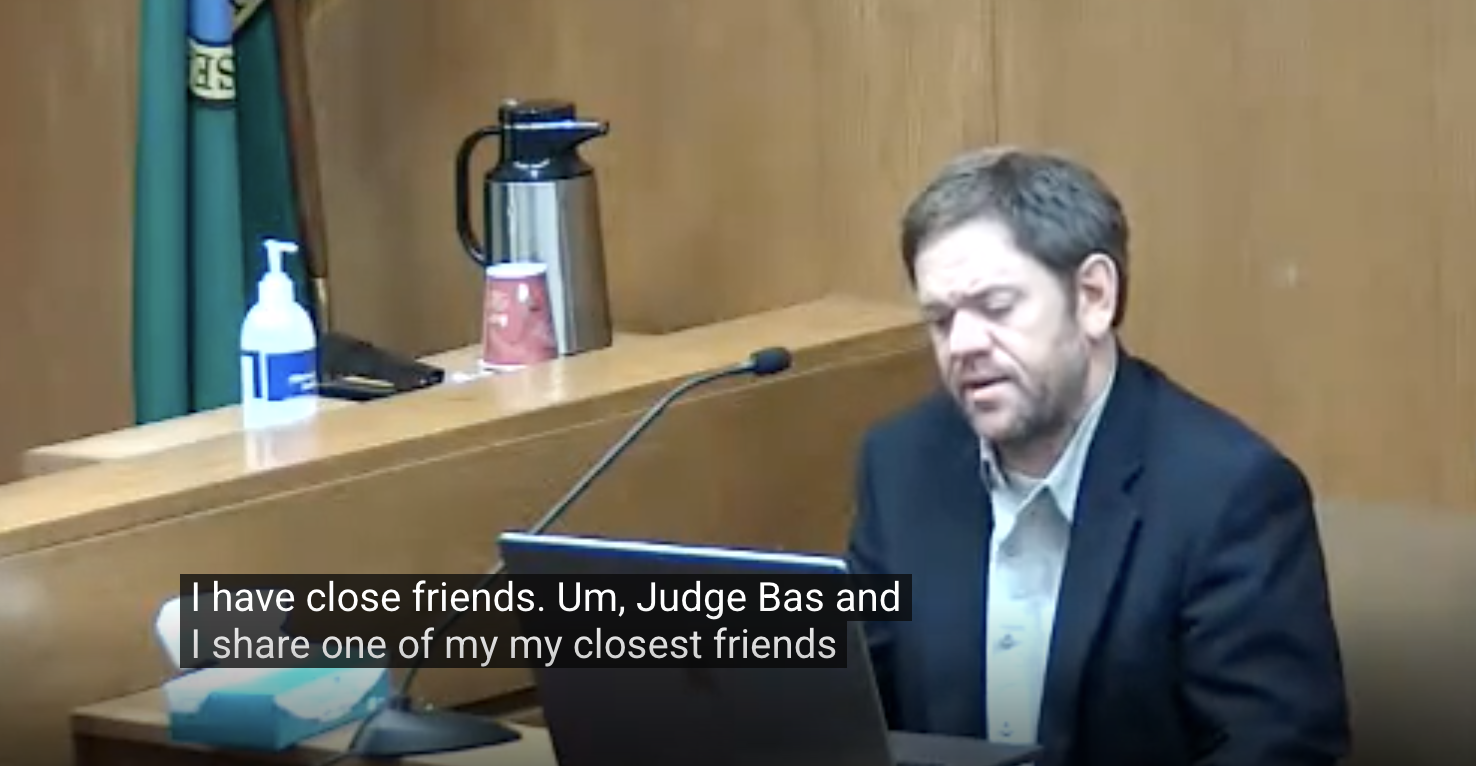
In December 2025 courtroom testimony published by the Herald, Mavy said: “Judge Basden and I share one of my closest friends.”
Basden and Kiddle also served together in church leadership. In a May 17, 2022, podcast description, Bishop Jason Bringhurst described selecting them as his two counselors after Basden’s service as stake president ended.
Their shared friend was also connected to Mavy’s housing, a subject of the custody litigation. Hales wrote that the family had rented at the Kiddles’ property.
The Herald reported on March 2 that a judicial-conduct complaint alleged Basden heard testimony from Amanda Kiddle, Matt Kiddle’s wife, in the custody case.
Matt Kiddle also publicly defended Basden. In a response published by the Herald on January 22, he questioned which cases demonstrated bias, while acknowledging his limited experience and that such cases might exist.

Church leadership and outside information
Ken Meek, a lifelong LDS member who had served twice as a bishop and twice as a bishopric counselor, challenged Basden’s overlapping church and judicial roles in a September 30, 2026, declaration.
“I served in the same mission as Brent Basden,” Meek wrote. He said Basden was an assistant to the mission president in Cali, Colombia, when Meek began his missionary service.
Meek cited Basden’s service as stake president and in a bishopric, the leadership of a local congregation, while Basden also served as a judge.
“For whatever reasons, Brent Basden has continued to serve in those Church leadership callings even as he professionally carries out the duties of community judge,” he wrote.
Meek said church leaders counsel members about divorce, custody, domestic-violence allegations, neglect and financial hardship.
“A member of a bishopric who is also a judge would not be able to do his job at church without getting outside information about a contentious custody battle,” Meek wrote.
“It is my opinion that a person who is or was an LDS religious leader, such as a stake president or bishop, would have a conflict of interest in presiding over a legal proceeding involving a current or former member of his congregation,” he wrote.
An April 15 judicial-conduct complaint similarly alleged that Basden’s church responsibilities exposed him to information about Mavy outside court.
Hales disputed that Basden received information through the discussions she described. Her October response elaborated on her February statement that he left whenever the family came up.
“He has gone above and beyond separating the two,” she wrote in February.
Her account describes precautions taken at church. It does not identify a disclosure of his council role in the custody proceeding.
Police scrutiny of Mavy’s living conditions
Hales’s February correspondence also defended Basden’s criticism of law enforcement.
In a clip from the December 2025 trial, Basden said, “Whenever law enforcement gets involved, for any reason,” it necessarily involves the children again. That, he said, “deepens the problem.”
The Herald’s May 12 report described testimony that Mavy was living in a camper beside a condemned former drug house in Port Angeles. Mavy challenged how the property had been observed, maintaining that the trailer and its connected garden hose could not be seen from the road.
The report also described a 911 recording Mavy played during the December 10, 2025, trial.
An Olympic Medical Center nurse requested a welfare check after children reported lacking running water, heat and food at Mavy’s residence.
“No running water, no heat,” the nurse told the dispatcher. “No food.” She described the children as ill with vomiting and fevers.
The recording documented a medical professional’s request for police to check reported conditions at the residence.
“I KNOW why he said that,” Hales wrote of Basden’s remarks, calling Child Protective Services checks “close to harassment.”
“I'd say it was finally time for a judge to step in and say something about it,” she wrote.
Hales acknowledged limits to her knowledge of other reported investigations. Asked about domestic-violence-related investigations of Mavy in other states, she said she did not know the details, whether investigations had opened or whether the assertion was true.
Deference to a former judge

In a separate dispute over downtown property, the Peninsula Daily News reported in October 2020 that city officials had cited reports of unsafe living conditions, overdoses and felony-level assaults at former Superior Court Judge Brian Coughenour’s properties behind Safeway on East Fifth Street.
The newspaper later described scrap, abandoned vehicles and other debris on the parcels. Coughenour said homeless people had been drawn there during the pandemic and that the state’s eviction moratorium made removing them difficult.
In a September 1 letter quoted by the newspaper, City Attorney Bill Bloor acknowledged Coughenour’s service as an attorney and judge before writing: “Considering these circumstances, the City will not initiate formal enforcement action at this time.” He asked Coughenour to remedy the conditions.
The city’s code-enforcement officer issued a violation notice on September 30. By December, Deputy Police Chief Jason Viada reported substantial cleanup progress: nearly a dozen dump-truck loads of refuse had been removed. Debris remained, but Viada said Coughenour was cooperating and could avoid court action by continuing at a satisfactory pace.
The cleanup followed the city’s decision to pursue enforcement after initially withholding formal action. In Mavy’s separate case, a nurse sought police scrutiny of reported living conditions.
Mavy’s effort to remove reporting
Judge Basden also presided over a separate civil case Mavy brought against me in August 2025. On October 21, 2025, he denied revision of an order issued by former Clallam County Superior Court Commissioner Brian Parker, leaving it in place.
Mavy filed the civil petition after Wyoming authorities charged him with making a false statement to obtain an elk license.

In the petition, he alleges that my communications with wildlife investigators constituted harassment. Those communications consisted of providing public records and disclosing that Mavy resided at Matt Kiddle’s address.
Clallam County Superior Court Presiding Judge Barnhart terminated Commissioner Parker on February 10, 2026. Judge Basden later recused himself from the case on February 23, 2026.
Judge Basden later characterized reporting about his potential conflicts as “cyberbullying” during a hearing, the Herald reported on January 23. The coverage included his appointment of former law partner Lane Wolfley to represent a defendant in a murder case.
Mavy later attempted to use the civil proceeding to seek the removal of more than 30 Herald articles, including coverage of Judge Basden’s relationships and Mavy’s own testimony about their shared friend.
The Herald reported on March 5 that the targeted coverage also included its February 2 report on a courthouse protest. Residents had gathered outside the Clallam County Courthouse on January 29 to protest Basden and Parker.
Mavy characterized the reporting as stalking or harassment and asked for a coercive fine of up to $2,000 a day until the articles were removed.
A visiting Kitsap County judge denied the removal motion, the Herald reported on April 16. Mavy then sought restrictions on publishing information identifying him, including contextual details that could identify him without his name.
Kitsap County Superior Court Judge Houser rejected that proposed restriction on May 28 as an impermissible and unconstitutional prior restraint, the Herald reported that day.
Judge Ian Birk on Basden’s Decision: “an error of constitutional magnitude”
Court of Appeals Judge Ian Birk, now a Washington Supreme Court candidate endorsed by Governor Bob Ferguson, previously faulted Judge Basden’s handling of impartiality.
In a case that the Herald examined on January 24, a court bailiff replaced a juror with a temporarily excused alternate without first notifying Judge Basden or the parties. After learning of the substitution, Judge Basden said, “I think what actually happened was appropriate.”
Judge Birk disagreed and called the failure to notify and consult the parties “an error of constitutional magnitude.”
He wrote that Judge Basden compounded the constitutional implications by failing to decide whether to discharge the seated juror or question the alternate.
Confidentiality and judicial disclosure
The LDS Church’s General Handbook limits what leaders may share about members and how they participate in members’ legal cases.
Section 4.4.6 says leaders generally seek permission before sharing a member’s personal information with a council. They must respect confidentiality requests, and some matters are too sensitive for the full council. Information should be shared outside it only as needed to fulfill an assignment from its leader.
Sections 38.8.24.1 and 38.8.24.2 direct leaders to consult Church legal counsel before becoming involved in members’ legal cases and require approval from the Office of General Counsel before providing evidence in a church leadership capacity.
Hales said her comments reflected her personal observations and did not represent the Church. Her response identified the subjects she recalled the council discussing but did not establish whether the family had authorized sharing information with the council.
For Judge Basden, Washington’s judicial rules impose separate obligations. Rule 2.4 prohibits allowing social or other relationships to influence judicial conduct or judgment. Rule 2.9 generally restricts communications about pending or impending matters outside the parties’ presence, subject to exceptions.
Rule 2.11 requires disqualification when a judge’s impartiality might reasonably be questioned. Its commentary says judges should disclose on the record information they believe parties or lawyers might reasonably consider relevant to disqualification, even when the judge believes stepping aside is unwarranted.
Hales described council members recognizing a conflict concern and taking steps to exclude Basden from conversations. She maintained that those precautions worked.
The Herald found no disclosure of his council role in its review of the custody court file.
Judge Basden had not responded to the Herald’s request for comment as of publication. The Herald also sought comment from Presiding Judge Simon Barnhart, whose automated email reply stated that he was “away from the office until Thursday morning, April 23, 2025.”
Republish this story
Our stories are free to republish, online or in print, under these rules:
- Credit The Olympic Herald and the author, and link back to this story.
- Don't edit the story except for style, length, or to update time references.
- If you republish online, use our canonical URL so search engines credit the original.
- Don't sell the story or use it primarily to sell advertising.
Questions? Contact us.