
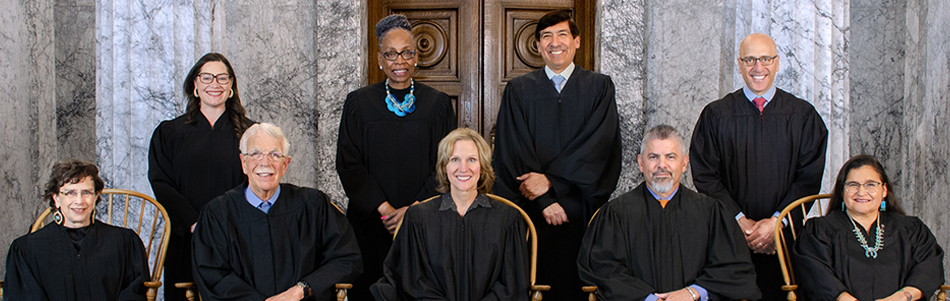
The Washington Supreme Court ruled Thursday that Virginia Mason Medical Center violated patient protections by privately communicating with three of its former physicians who had participated in a patient’s surgery.
The court ordered a trial judge to reconsider the remedy for those contacts, which occurred without the patient’s knowledge or consent.
The 6-3 decision also requires further review of records the hospital withheld and concludes that Virginia Mason at least partly waived legal protection for its quality improvement materials.
The ruling does not decide whether the hospital committed malpractice or grant patient Michael Snyder’s request for a default judgment on liability.
It sends the case back to King County Superior Court for further proceedings, including reconsideration of that request.
Writing for the majority, Justice Steven C. González said a patient need not prove that improper contacts damaged his ability to litigate before a court can provide relief.
Harm to the doctor-patient relationship is presumed when the rule against those contacts is violated, the court held.
Snyder suffered permanent, disabling injuries during surgery at Virginia Mason in January 2018, according to the opinion.
Two residents, Drs. Molly Downey and Weslee Chew, were responsible for threading a needle and wire through his jugular vein to place a catheter. The court said the line’s tip apparently passed through an artery into his chest.
The lead surgeon, Dr. Jared Brandenberger, called vascular surgeon Dr. Nathan Aranson for assistance.
After an attempt to locate the tip using contrast dye and imaging failed, Aranson suggested slowly withdrawing the line, according to the court’s account. Snyder then suffered a massive hemorrhage and prolonged cardiac arrest. The medical team saved his life.
Snyder sued in March 2019. Downey, Chew and Aranson were not named as defendants in his complaint and had left Virginia Mason by then.
The hospital remained contractually obligated to defend them and cover any liability they might have for Snyder’s injuries. It arranged for a separate attorney to represent the three doctors.
The majority described communications involving the hospital’s legal team, risk managers, a third-party claims administrator and the doctors’ attorney that Snyder did not know about during the first few years of litigation.
In an April 2020 witness disclosure, Virginia Mason said Snyder’s attorney could contact the providers while defense counsel could not.
“This statement was, at least, misleading,” González wrote. By then, the majority said, the hospital’s legal team had been actively communicating with the three doctors’ lawyer about the case, directly and through its claims administrator.
Shortly before that disclosure, a hospital risk manager had spoken with Aranson for an hour and told him he was essential to preparing the case, according to the opinion.
A privilege log listed more than 400 instances of communication that potentially violated Snyder’s rights, the majority said.
The dispute centers on Washington’s Loudon rule, named for a 1988 Supreme Court decision.
In personal injury cases, it generally requires defense lawyers to use formal discovery procedures or obtain the patient’s consent before communicating privately with the patient’s treating doctors who are not parties to the lawsuit.
The court has recognized a limited exception for privileged communications with a hospital’s current employees or their functional equivalents about the facts of the alleged negligent incident. The majority declined to extend that exception to the former employees in Snyder’s case.
Virginia Mason argued that the rule should not apply to doctors whose care could make the hospital liable. It also relied on its continuing contractual obligations to the doctors and asserted protections for attorney-client communications and parties sharing a common legal interest.
The majority rejected those arguments as grounds for allowing the contacts in this case. It said the hospital had not made a sufficient factual showing of a common legal interest and shared expectation of confidentiality with the doctors.
It also emphasized that the hospital could still communicate with them through formal discovery or with Snyder’s knowledge and consent.
Snyder argued that the hospital’s contacts had irreparably influenced critical witnesses and sought a default judgment establishing liability.
The trial court denied that request because it lacked enough information to determine whether he had been substantially prejudiced.
The Supreme Court held that the violation itself carries presumed harm, while leaving the trial judge discretion to select a remedy based on its extent.
Depending on the prejudice shown, the majority said, remedies could range from a monetary sanction to a default judgment on liability.
The trial court must reconsider the issue after a full review of relevant records, including private judicial review where necessary to assess the hospital’s privilege claims.
A separate part of the ruling concerns the hospital’s quality improvement committee, which investigated Snyder’s surgery. As the court explained, state law protects certain internal committee materials from disclosure in civil litigation to encourage candid reviews of patient care.
The dispute involved Dr. Michael Glenn, who was Virginia Mason’s chief medical officer and a member of the committee during the events described in the opinion.
Glenn traveled to Prosser in December 2019 to meet with Chew. According to the majority, the hospital’s defense team helped coordinate the visit and provided talking points.
Glenn later testified that he did not discuss the surgery or litigation details at the meeting and had not received written talking points.
The majority concluded that Glenn’s involvement in the litigation tainted the committee’s work. Information about his role as a litigation witness and records arising from his conversations with former employees whose treatment of Snyder was at issue could not be shielded by the quality improvement privilege, it held.
Justice Sheryl Gordon McCloud dissented, joined by Justice G. Helen Whitener and Justice Pro Tempore Barbara A. Madsen.
Gordon McCloud argued that the majority applied Loudon too broadly and burdened the hospital’s ability to investigate and defend claims based on its former doctors’ care.
She also disputed the conclusion that the hospital had waived the statutory protection for quality improvement materials.
Virginia Mason is the sole remaining defendant. The appropriate remedy for its improper communications remains for the trial court to determine.
↺ Republish this story
Our stories are free to republish, online or in print, under these rules:
- Credit The Olympic Herald and the author, and link back to this story.
- Don't edit the story except for style, length, or to update time references.
- If you republish online, use our canonical URL so search engines credit the original.
- Don't sell the story or use it primarily to sell advertising.
Questions? Contact us.