

The Olympic Herald has taken the Clallam County Superior Court to court.
Today I filed an Application for Writ of Mandamus and, in the alternative, Writ of Certiorari in Clallam County Superior Court, challenging the court's refusal to release two sets of its own search warrant logs.
The lawsuit names the Clallam County Superior Court and Court Administrator Lacey Halberg, in her official capacity as the court's Public Records Officer, as respondents.
No judicial officer is named as a respondent, because under the court rules, records requests are answered by the court's public records officer, not by judges personally.
The action asks a judge to order access to: (1) the search warrant log or logs kept during the tenure of former Court Commissioner Brian Parker, from his start in January 2025 through his termination on February 9, 2026; and (2) the search warrant log or logs of then-Commissioner W. Brent Basden covering 2007 to 2011, years before his 2019 appointment to the Superior Court bench, where he now serves as a judge.
What Is a Search Warrant Log, and Why It Matters
A search warrant log is a chronological index of official judicial acts: the warrant applications presented to a judicial officer, and the warrants that officer issued. It is, in effect, a docket of the court's warrant proceedings.
As the petition explains, access to these records serves the accountability function the Washington Supreme Court identified in Cowles Publishing Co. v. Murphy (1981), a case in which the Supreme Court affirmed a writ of mandamus directing district court judges to make search warrant materials kept in their own offices publicly available.
Such access lets the public evaluate the conduct of prosecutors and police, and judge whether the issuing judicial officer acted as a neutral magistrate.
As the United States Supreme Court put it in 1947, "What transpires in the court room is public property."
How We Got Here
On February 27, 2026, I submitted a written records request to Court Administrator Lacey Halberg, assigned Request No. 2026-12. The request included the Brian Parker and Brent Basden logs as Items 3 and 4.
On April 10, 2026, the court's Public Records Officer denied both items in full. The denial was two sentences long.
It asserted only that any such records "are categorically exempt under GR 31.1 as chambers records," and stated that the denial was "the final communication" I would receive.
The denial did not identify any responsive record, did not say whether responsive records exist or who has them, did not cite any subsection of the rule, and did not address redaction.
I petitioned for internal review under GR 31.1(d)(3).
On July 13, 2026, Presiding Judge Simon Barnhart affirmed the denial in a two-page memorandum opinion, resting entirely on the chambers-records label.
The Herald reported on that decision last month. The internal review decision declared that the logs' "only purpose is to assist the judicial officers in performing their duties in authorizing the issuance of search warrants," that they "are used exclusively by the judicial officers," and that "they are maintained solely under chambers control."
As the petition points out, those findings were made without any identified record, evidence, or hearing.
That memorandum opinion exhausted the court's internal review process. Under GR 31.1(d)(4), a requester may then file a civil action within thirty days. This lawsuit is filed within that window.
The Legal Arguments
The petition presents several independent reasons why the denials were wrong:
The rule doesn't reach the Basden logs at all. GR 31.1, by its own terms, applies only to records created on or after January 1, 2016.
The Basden logs were created between 2007 and 2011. The rule the court invoked as its sole basis for denial simply does not govern those records; their public availability is instead analyzed under other court rules, statutes, and the common law balancing test.
Search warrant logs are court records. GR 31(c)(4) defines "court records" to include any "index, calendar, docket, register of actions, official record of the proceedings."
A chronological log of warrant applications and warrants issued is exactly such an index, presumptively open under GR 31, the common law, and article I, section 10 of the Washington Constitution, which commands that "[j]ustice in all cases shall be administered openly."
Even under GR 31.1, these are not "chambers records." The rule defines a chambers record by conjunctive elements, including that it be "maintained under chambers control," and expressly warns that records "do not become chambers records merely because they are in the possession or custody of a judicial officer."
Here, the court's own conduct undercuts the label.
As the Herald previously reported, after Parker's termination, the court could not locate "the Search Warrant Log document" in his office, and the county's Human Resources Director wrote to Parker asking him to return it.
Parker responded that he had the log and would arrange its return. As my petition argues, an institution does not demand the return of a departed officer's personal papers; it demands the return of its own records.
The denials were procedurally defective. The petition alleges the responses violated GR 31.1's requirements of written justification and a written summary of review procedures, and that a categorical, class-wide denial without any individualized determination is precisely what the Washington Supreme Court condemned in Allied Daily Newspapers v. Eikenberry (1993).
The petition asks the court to issue the writ and order access, subject only to narrowly tailored redactions supported by specific written findings, or alternatively to order the records identified and reviewed in camera.
It also asks the court to order the records preserved, and to require the respondents to confirm in writing whether the log removed from the courthouse by Parker has been returned, and to identify its current custodian, something the court has never confirmed in writing.
The allegations in the petition are exactly that: allegations, which the respondents will have an opportunity to answer in court.
The Herald in Print
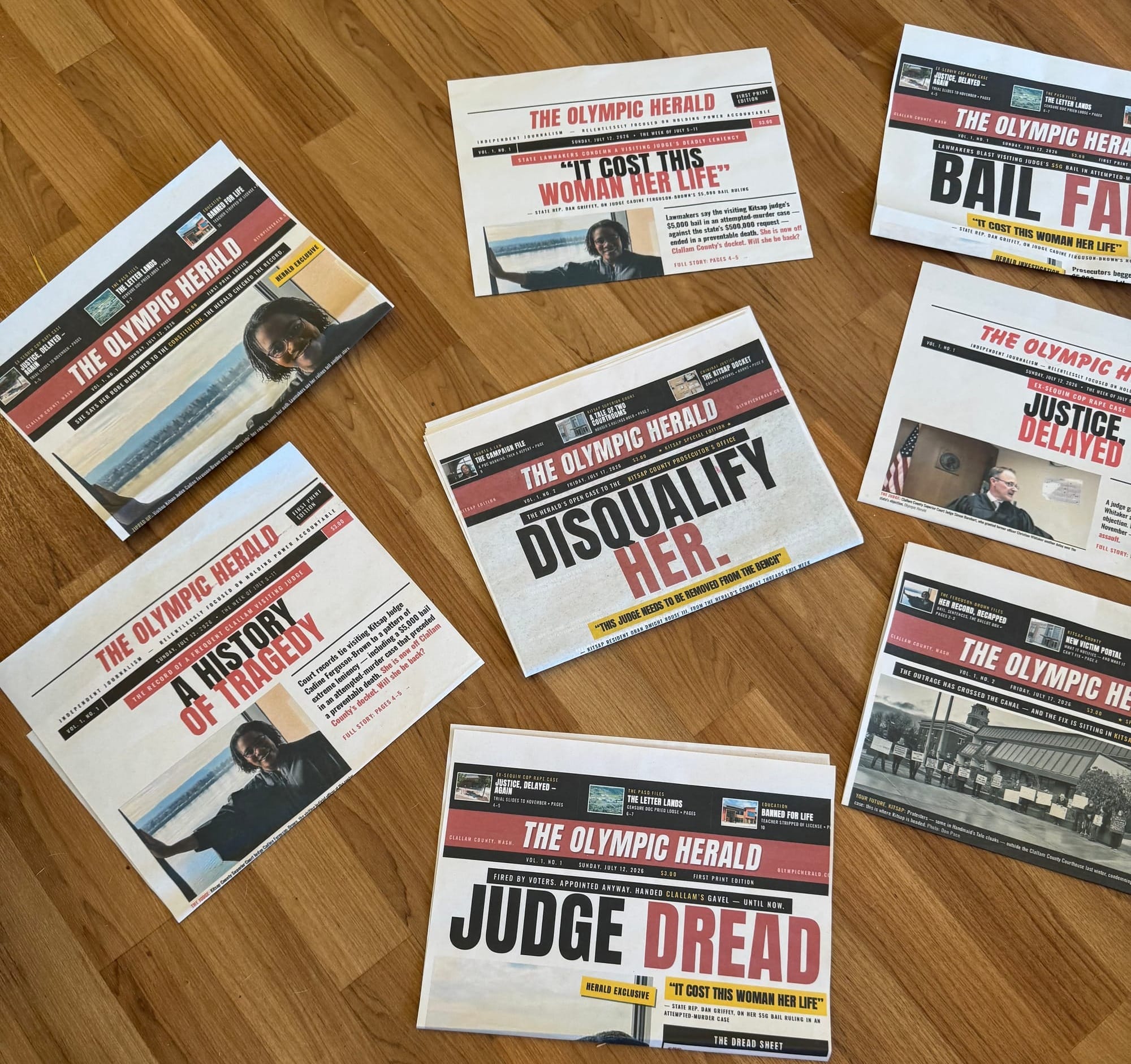
On a separate note: the Herald is testing designs for a print edition. We are experimenting with style, page size, and formatting, and we have left some sample copies around the courthouse for the public to pick up.
Suing a court is not free, and neither is the year of records requests that led to it. The Olympic Herald is 100% reader-supported, with zero corporate backing.
If you want this kind of accountability journalism to continue in Clallam County, upgrade to a paid subscription today or make a one-time contribution of any amount. Every dollar goes back into the reporting.
Republish this story
Our stories are free to republish, online or in print, under these rules:
- Credit The Olympic Herald and the author, and link back to this story.
- Don't edit the story except for style, length, or to update time references.
- If you republish online, use our canonical URL so search engines credit the original.
- Don't sell the story or use it primarily to sell advertising.
Questions? Contact us.