
A divided Washington Supreme Court ruled Thursday that breath test results are admissible in a vehicular homicide prosecution even though the arresting deputy saw tiny strands of chewing tobacco stuck between the driver's teeth before administering the test.
The 5-4 decision filed Thursday morning, affirms the Court of Appeals and allows the State to use the test results against John Henry Sliger, who is charged in Ferry County Superior Court following a 2020 collision with a dirt bike whose rider later died.
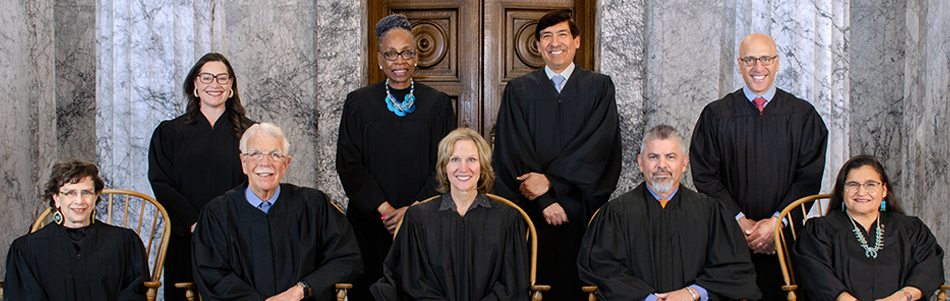
Justice Barbara Madsen, sitting as a justice pro tempore, wrote the lead opinion, joined by Chief Justice Debra Stephens and Justices Charles Johnson and G. Helen Whitener.
Justice Steven González concurred in the result only.
Justice Salvador Mungia dissented, joined by Justices Sheryl Gordon McCloud and Raquel Montoya-Lewis and Justice Pro Tempore Mary Yu.
Justices Colleen Melody and Theodore Angelis did not participate.
The case
According to the opinion, Sliger was involved in the April 2020 collision and admitted to Deputy Mitchell Kahns that he had been drinking a few hours before the crash.
At the scene, the deputy noticed chewing tobacco in Sliger's mouth and told him to spit it out before a portable breath test. Sliger was arrested for driving under the influence.
At the Stevens County Jail, Sliger agreed to take a Draeger breath test. Asked whether he had any foreign substances in his mouth, he said no.
But Deputy Kahns noted in his DUI arrest report that he saw "tiny tobacco strands stuck in teeth." The strands were not removed, and the test showed an alcohol level over the legal limit.
Sliger moved to suppress the results. State law in effect at the time required the prosecution to produce prima facie evidence that the person tested "did not have any foreign substances" in their mouth at the start of a 15-minute observation period.
Sliger argued that "any" means any quantity, so the visible tobacco made the test inadmissible.
The trial court denied the motion, relying on Sliger's denial, and the Court of Appeals affirmed.
The majority's reasoning
Madsen wrote that reading "any" to cover every speck of a foreign substance "would lead to absurd results," making tests inadmissible over microscopic debris that has no effect on accuracy.
The Legislature's purpose in setting the admissibility standards, she wrote, was to ensure swift consequences for impaired driving and to push most disputes about test reliability to the jury rather than the judge.
The court held that the State met its burden through expert testimony from Trooper John Axtman, a breath test technician, who testified that small tobacco flecks left in teeth would not affect the validity of the test, unlike a lump of chewing tobacco.
The lead opinion added a caveat: when the presence of a foreign substance is debatable, the State can make its prima facie case only by presenting an expert to attest that the substance does not affect the test's reliability. Sliger can still challenge the test's accuracy at trial.
González wrote separately, saying no expert testimony was required and that Sliger's denial alone supported a reasonable inference that no more than a de minimis quantity was present.
The dissent
Mungia wrote that the Legislature adopted a bright line rule, and, quoting the court's own precedent, that courts "must not add words where the legislature has chosen not to include them."
He wrote that the Washington State Patrol's own breath test training manual instructs officers to clear a subject's mouth of foreign substances such as chewing tobacco, having the person rinse if necessary, and that Deputy Kahns did not follow that procedure.
The dissent also pointed out that suppressing the test would not necessarily end the case, noting that Sliger admitted to drinking, performed field sobriety tests, and had blood drawn at a hospital before booking.
↺ Republish this story
Our stories are free to republish, online or in print, under these rules:
- Credit The Olympic Herald and the author, and link back to this story.
- Don't edit the story except for style, length, or to update time references.
- If you republish online, use our canonical URL so search engines credit the original.
- Don't sell the story or use it primarily to sell advertising.
Questions? Contact us.