
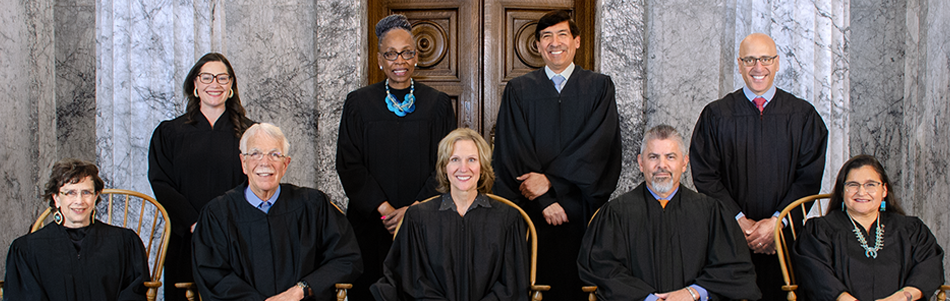
The Washington Supreme Court ruled Thursday that the state’s emergency medical immunity statute does not shield an ambulance company from liability for its EMT’s negligent driving, leaving intact a $2.3 million jury award to the estate of a patient who died after an ambulance crash.
The 6–3 decision in Lang v. Platinum Nine Holdings, LLC rejected the company’s argument that the statutory protections for emergency medical care also covered its driver’s conduct while rushing Frank Costa to a hospital. Platinum Nine Holdings does business as Northwest Ambulance.
Writing for the majority, Justice Salvador Mungia distinguished medical treatment provided inside an ambulance from driving the vehicle.
Three dissenting justices said that distinction ignored how ambulance crews work together to transport and treat patients.
The ruling did not decide whether the same immunity could cover the crew’s separate failure to use shoulder restraints. The majority concluded that negligent driving alone was enough to sustain the verdict.
Costa, 78, was living at an Everett care facility and had metastatic breast cancer when concerning bloodwork prompted an ambulance transfer in November 2020, according to the Court of Appeals’ account.
Two emergency medical technicians, Henry Shaw and Jack Wilson, and an EMT trainee responded. The crew placed Costa on a gurney with guardrails and belts across his waist and knees but did not use shoulder straps, despite a company policy requiring them.
During the trip, Wilson became concerned about Costa’s irregular heartbeat and called for emergency driving. Shaw activated the ambulance’s lights and sirens.
On Highway 526, Shaw accelerated as a garbage truck appeared to move right. Shaw testified that the truck then moved back into his lane and that he could not brake in time to avoid it. He swerved right to avoid the truck and struck a highway divider.
The Court of Appeals said the ambulance hit the divider at 53 mph. Costa was thrown from the gurney into the ambulance wall and died later that day from blunt force trauma.
Northwest Ambulance fired Shaw and Wilson after the crash. The Supreme Court majority cited a termination letter identifying failures involving patient restraints, excessive speed and defensive driving.
Michael Lang, representing Costa’s estate, sued Northwest Ambulance for wrongful death and survival claims.
The company admitted ordinary negligence and that its negligence caused Costa’s crash-related injuries and death, but denied gross negligence and continued to assert immunity.
That distinction mattered because RCW 18.71.210 protects qualifying emergency medical services performed in good faith from ordinary-negligence liability. It does not protect gross negligence or willful or wanton misconduct.
The estate argued that driving an ambulance and fastening restraints were outside the medical procedures covered by the law. Northwest Ambulance argued that its licensed crew was providing protected emergency services during transport.
The trial court rejected the immunity defense. With negligence admitted, the issue of noneconomic damages went to trial, and a jury awarded the estate $2.3 million.
King County Superior Court Judge Andrea A. Darvas entered the judgment in February 2024. Division I of the Court of Appeals upheld the result in July 2025.
The company paid the award before appealing, according to the Court of Appeals. The Supreme Court’s decision preserves that verdict rather than ordering a new payment.
The Supreme Court majority focused on language limiting immunity to emergency medical procedures within a provider’s medical expertise.
A related statute defines emergency medical service as treatment and care that may be delivered at an emergency scene or “while transporting” a patient.
The majority read that language as identifying when and where treatment may occur, rather than making transportation itself a medical procedure.
“[T]he act of driving is not itself medical treatment or care under the qualified immunity statute,” Mungia wrote.
The majority also pointed to state training requirements. Driving an ambulance is not part of the medical skills required for EMT certification, the court said, and the EMT behind the wheel is not simultaneously attending to the patient.
Mungia highlighted Shaw’s testimony that his initial driver training consisted of a PowerPoint presentation lasting perhaps one or two hours. Shaw took an emergency vehicle incident prevention course after the crash through another employer, the majority noted.
The company also relied on a provision covering transport to mental health facilities and chemical dependency programs.
The majority said that amendment extended protection for medical care provided during trips to those destinations; it did not create immunity for driving.
Other statutes reinforced the distinction, the court concluded. Washington’s Good Samaritan law expressly addresses both emergency care and transportation, showing that lawmakers know how to protect each activity when they choose.
State traffic law also gives emergency vehicle drivers certain privileges, including permission to exceed speed limits under specified conditions, while preserving their duty to drive with regard for everyone’s safety.
The majority said ambulance drivers remain subject to the ordinary standard of care for emergency vehicle drivers.
Justice Raquel Montoya-Lewis dissented, joined by Justice Sheryl Gordon McCloud and Justice Pro Tempore Barbara Madsen.
Montoya-Lewis argued that transportation and medical treatment are integral parts of ambulance service. The EMT caring for the patient assesses the medical emergency and directs changes in the driving response, while the driver acts on that medical judgment.
The dissent emphasized the specialized skills involved in emergency driving and cited Shaw’s testimony that he first drove with lights and sirens under a field training officer’s supervision and had done so at least 30 to 40 times before the crash.
She read the statute’s medical-expertise limitation as preventing providers from claiming immunity for procedures beyond their qualifications, rather than excluding ambulance operation from protected services.
The dissent also distinguished a duty of reasonable care from immunity for breaching that duty.
Under its interpretation, ambulance drivers would still have to exercise ordinary care, but good-faith mistakes would be protected unless they amounted to gross negligence or other excluded misconduct.
Montoya-Lewis would have extended immunity to both the driving and the use of patient restraints and ruled for Northwest Ambulance.
The majority left the restraint question unanswered because the jury returned a general verdict that did not distinguish between negligent driving and the failure to secure Costa. Northwest Ambulance had not requested a special verdict form separating those theories.
Because the driving claim supported the verdict, the majority held, the company could not obtain a new trial by challenging the other theory.
↺ Republish this story
Our stories are free to republish, online or in print, under these rules:
- Credit The Olympic Herald and the author, and link back to this story.
- Don't edit the story except for style, length, or to update time references.
- If you republish online, use our canonical URL so search engines credit the original.
- Don't sell the story or use it primarily to sell advertising.
Questions? Contact us.