
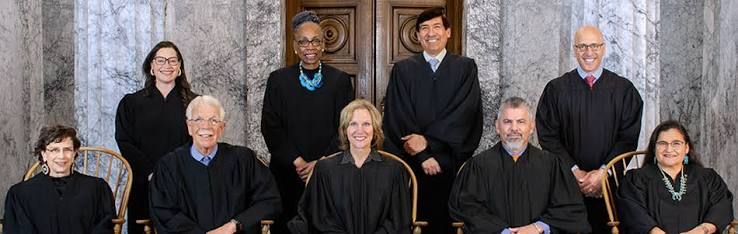
The Washington Supreme Court unanimously rejected efforts to recall Skagit County’s prosecuting attorney and three county commissioners, upholding a $5,348.22 sanction against six petitioners for filings the courts found were intentionally frivolous and intended to harass the officials.
The decision leaves in place the dismissal of seven recall petitions targeting Prosecuting Attorney Richard Weyrich and Commissioners Ron Wesen, Peter Browning and Lisa Janicki. The court also awarded the officials attorney fees for the appeals.
The petitions centered on alleged defects in the filing of oaths by other public servants: three judges, a district court commissioner and two deputy prosecutors.
The petitioners argued that those defects invalidated the public servants’ authority and that the four elected officials should have intervened.
The court rejected that premise. All six public servants had taken oaths, and alleged delays or errors in filing them did not establish grounds to recall the prosecutor or commissioners.
“And an elected official does not commit a recallable offense by declining to adopt a constituent’s mistaken legal theory,” Justice Steven González wrote.
Washington’s recall process requires courts to determine whether charges are legally and factually sufficient before they can proceed.
At that stage, courts assess whether the allegations, if true, would support recall rather than deciding whether the charges are true.
In this case, the justices found every properly filed charge insufficient.
The court explained that filing a superior court judge’s oath with the secretary of state is not a prerequisite to beginning judicial duties. It also found that no statute conditions a deputy prosecutor’s authority on a filed oath.
The petitioners had not established that the prosecutor or commissioners had a legal duty to enforce other public servants’ oath-filing obligations or authority to declare their offices vacant, the opinion said.
The court also rejected the argument that salaries paid to those public servants amounted to a loss of public funds that should have been reported to the state auditor.
They performed the work of their offices, and paying them for that work was not a loss, the justices concluded.
Other claims alleged that the prosecutor’s office directed the county auditor not to create records of judicial oath-filing dates. The court found the petitioners offered only their own inference from the records. Claims concerning election violations identified no relevant election law, the opinion said.
In upholding the sanctions, the justices pointed to earlier court decisions rejecting versions of the oath-related claims and evidence that the filings were coordinated.
According to the opinion, Cody Hart delivered all seven charging documents to the county auditor, one at a time, over approximately two weeks.
Months before the petitions were filed, Chief Civil Deputy Prosecuting Attorney Erik Pedersen had written to Hart and fellow petitioner Derrill Fussell explaining that a late-filed oath did not disqualify a judge and warning that the county might seek sanctions.
The justices said that record supported the lower court’s finding of coordinated harassment. They emphasized that a person cannot be required to pay an elected official’s legal fees merely for seeking recall, but intentionally frivolous petitions filed to harass can justify sanctions.
The $5,348.22 is one award for which six petitioners are jointly and severally liable. It is not a separate assessment of that amount against each person. A seventh petitioner, Timothy Garrison, was not sanctioned by the superior court.
Six petitioners who appealed jointly argued that the sanctions chilled their First Amendment and recall rights. The court rejected that challenge, finding they had not meaningfully explained how sanctions for purposeful, coordinated harassment violated those rights.
Larry Jensen, who appealed separately, argued that holding him responsible for the shared sanction was unfair because he signed only his own charges. The justices rejected that argument, finding he had joined the coordinated effort and could be held responsible for its costs.
Jensen also argued that county officials had improperly singled out his tulip farm for code enforcement in violation of a county policy requiring a citizen complaint.
The court ruled that allegation fell outside his filed recall charges, which concerned a deputy prosecutor’s oath, and noted that Jensen had not sought to amend them.
The justices expressly declined to decide whether Jensen’s selective-enforcement theory would be legally and factually sufficient as a recall charge.
↺ Republish this story
Our stories are free to republish, online or in print, under these rules:
- Credit The Olympic Herald and the author, and link back to this story.
- Don't edit the story except for style, length, or to update time references.
- If you republish online, use our canonical URL so search engines credit the original.
- Don't sell the story or use it primarily to sell advertising.
Questions? Contact us.