
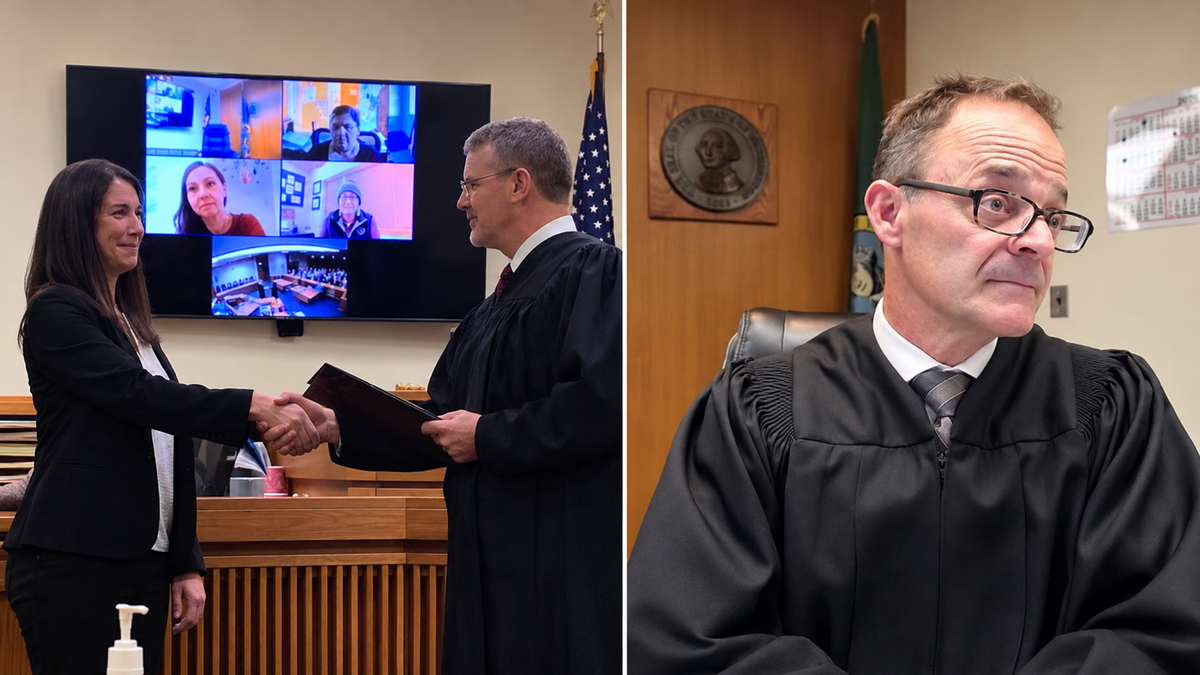
Clallam County Superior Court is putting Brent Basden back in charge, effective immediately. This is the judge who said from the bench last December: “Whenever law enforcement gets involved for any reason, it necessarily involves the children again, and that I think deepens the problem.”
He now leads the court where police bring their search-warrant applications, where prosecutors ask for bail and where people who assault officers are sentenced.
Judge Simon Barnhart will leave the bench February 1, 2027. The leadership change did not wait for him to go. Basden has already assumed the duties of presiding judge, with Elizabeth Stanley serving as assistant presiding judge, according to the Clallam County Bar’s November 19 announcement.
The court did not send that announcement to the Herald. It was a letter from Basden and Stanley. It reached the bar, and at least one other news organization quoted from the court’s email.
This has happened before. On February 11, the Herald formally asked to be added to the court’s media distribution list. Court Administrator Lacey Halberg answered that “[n]o other persons are, or will be, copied on our correspondence to the Bar.” On February 18, she sent a press release to four other news outlets.
On May 19, an announcement about a new court commissioner went out in a single message to the bar and four news organizations. I learned of it through a county records request.
On November 2, I wrote to the court demanding equal access to its announcements and warning of federal claims for First Amendment retaliation and viewpoint discrimination.
Seventeen days later, the court announced a judge’s resignation and a new presiding judge. The Herald was left off again. It was the first announcement of Basden’s new tenure, and it went out the way the old ones did.
Neither that letter, as the bar describes it, nor the governor’s November 18 vacancy notice gives a reason for Barnhart’s resignation. The available announcements do not connect his decision to the controversies described here. Nor do they say why the presiding role changed hands more than two months before he goes, or how the choice was made.
My involvement is part of this record. I have been a litigant before this court, submitted records requests for The Olympic Herald and brought litigation seeking access to court records. The criticism that follows rests on the reporting and records linked throughout this article.
What he said
Basden made the remark after being told that Child Protective Services wanted an interview. A doctor’s office had called 911 with a concern that children had “no food, no heat, no water.”
“CPS’s desire to do an interview doesn’t require you to do an interview,” he said. Of what an investigation might produce: “I don’t think that they’re going to generate anything that’s helpful.” The Herald published the courtroom video in March.
He did not say “in this case.” He said “for any reason.” Washington law takes the opposite view of a call like that one. It requires medical practitioners, teachers and others who have reasonable cause to believe a child has been abused or neglected to report it to law enforcement or the state.
On November 3, I asked in print what the police officers did wrong, what evidence supported his view and what conduct he was criticizing. Basden has not answered.
What he has done since
One remark could be set aside as a bad afternoon. His recent decisions make that harder.
On October 15, according to police reports, a Forks man fled officers at about 50 mph in a 25 mph zone with four children between the ages of 3 and 10 in the vehicle, then reversed into a Forks officer’s patrol car. The officer reported being told: “I’m going to get you when I get out because I ain’t going to be gone forever.” The reports say the man spat at officers and threatened to find them, referring to their homes.
The next day a deputy prosecutor asked for $50,000 bail. Basden approved release on personal recognizance. The man remained in jail on a separate allegation, which he denies, that he punched a corrections deputy during booking. Four days later, with nine charges filed and prosecutors now asking for $250,000, Basden set bail at $100,000.
In March, a Port Angeles man was arrested after an attack on his 71-year-old neighbor, during which state Sen. Mike Chapman used his own body to shield the victim. Officers reported that the man resisted arrest. Prosecutors asked for $50,000 bail. Basden set it at $15,000.
On October 12, prosecutors asked for $500,000 bail and GPS monitoring for a registered sex offender arrested in a rape investigation. Basden set bail at $250,000 and declined the GPS request.
On October 13, Basden sentenced a 22-year-old man who spat in a sheriff’s sergeant’s face to one year in jail, the sentence prosecutors and the defense had agreed on. The man’s record already included convictions for assault, threats to kill and theft of a firearm. Deputies reported that after the spitting he made a death threat and talked about pulling guns on deputies. The conviction covered only the spitting.
The pending charges are unproven, and bail is a judge’s call. That is the point. These were his calls. Read alongside his own words, they describe a judge who, in my view, regards law enforcement as the party to be managed.
What the court will not show
The plainest record of how Basden has handled police requests is one the court refuses to release.
A search-warrant log is the running record of what officers asked a judicial officer to approve and what he signed. Basden was a court commissioner before he was a judge. A 2011 motion filed in Jefferson County Superior Court alleged that 203 Clallam County search warrants, nearly 13 percent, were missing from court files during a four-year span of his time as commissioner, the Herald reported in February.
I requested his logs from 2007 through 2011, along with former Commissioner Brian Parker’s. The court refused, calling them chambers records, and Barnhart upheld the refusal in July.
After I sued, he sent the case to King County on October 16. “Unquestionably, this Court is conflicted,” he wrote. The order decided where the case will be heard. It did not decide whether the logs are public.
Parker’s log has its own history. The day after he was terminated, the county’s human resources director wrote to him that the court “was unable to locate the Search Warrant Log document in your office.” Parker replied within the half hour: “I have the search warrant log and will make arrangements to return it.”
Then there is Johnny Watts, the court’s former adult and juvenile drug court coordinator. He was arrested in March and has pleaded not guilty to federal drug and firearm charges. I requested Basden’s emails with him from 2018 through 2024. The court refused. On April 29, Barnhart sent the request back, writing that the chambers exemption is “a specific exception rather than a blanket shield.” As of November 2, I had received none of the emails.
When a second Herald journalist asked in September for any artificial-intelligence prompts and outputs used by Basden and Parker, Barnhart denied the request and warned that future requests “suggestive of an effort to deceive the Court” could be denied or met with “other appropriate action by the Court.” She had filed under her own name and copied me openly.
Under General Rule 31.1, a court’s refusal to release administrative records is reviewed by the presiding judge or a judge he designates. Each time, that was Barnhart. It is now Basden, including for requests about Basden.
The hiring he presided over
Parker was hired as family court commissioner while Basden was presiding judge. On November 1, 2024, Court Administrator Lacey Halberg wrote to human resources: “I did not include the one-year probationary period as directed by the judges.” Asked for interview notes, she answered: “I do not have any notes.”
On January 29 of this year, residents gathered in front of the courthouse. They asked for two things: Parker’s removal and Basden’s resignation. Eleven days later, Barnhart, by then the presiding judge, signed a letter ending Parker’s employment. It stated no reason.
One of the two January demands was met in eleven days. The court gave its answer to the other this week.
How he answers questions
In January, the Herald reported that Basden had appointed a friend and former business partner as defense counsel in a murder case. At a hearing the next morning, he described reporting on his potential conflicts as “cyberbullying.”
In 2020, County Commissioner Bill Peach said publicly that he did not appreciate “this wink-wink, nod-nod of superior court judges” leaving about a year before their terms ended, which let the governor rather than the voters choose the replacement.
Basden emailed him the next evening under the subject line “Judicial Independence.” He called the remarks “disheartening,” said they “can only have the effect of undermining the legitimacy of the judiciary,” and faulted Peach for speaking publicly without first consulting the judges to “test your theory.”
In the same email, Basden denied any coordination between branches of government and said he had encouraged judges to finish their terms or leave on a schedule that let voters choose.
Barnhart was re-elected in November 2024 with 27,121 votes and no opponent on the ballot. He is leaving with nearly two years of that four-year term unserved, and the governor will fill the seat. The judge who told an elected commissioner he should have checked with the judges first now speaks for the court.
In October, the Herald reported that Basden served on an LDS ward council that discussed a family whose custody case he was hearing. Our review of the court file found no disclosure of his council role. People appearing before a judge should be able to assess a potentially relevant relationship while their case is being decided.
What may come next
Complaints about Basden have gone to the state Commission on Judicial Conduct, as the Herald reported in March. I doubt the commission will be the last body to take an interest.
In April, the Herald raised the possibility of federal oversight. The Justice Department’s Civil Rights Division can investigate a local justice system for a pattern or practice of constitutional violations. It has done so with a court.
In 2012, a Justice Department investigation of the juvenile court in Shelby County, Tennessee, found systemic due process and equal protection violations, and that court was placed under a federal agreement.
Washington courts are not out of reach. The department opened a civil rights review of King County Superior Court in 2011 over interpreter services and did not close it until 2015.
No federal inquiry into Clallam County Superior Court has been announced, and what follows is my speculation. But federal authorities are already looking at this courthouse from more than one direction. Federal prosecutors are prosecuting its former drug court coordinator.
On November 2, I put the court on notice of possible federal claims for First Amendment retaliation and viewpoint discrimination. And this Justice Department has made a point of saying it stands with police.
The legal question in any federal review would be whether people who come before this court are treated equally.
The political question is simpler. The court’s presiding judge is on video saying that when law enforcement gets involved “for any reason,” it “deepens the problem,” and the court will not release the records of the warrants he signed. I would not be surprised if Justice Department oversight is next.
Residents stood in front of this courthouse in January. I expect they may be back.
Barnhart’s departure
Former Gov. Jay Inslee appointed Barnhart in May 2020 to replace retiring Judge Brian Coughenour. He had been general counsel for Clallam County Public Utility District No. 1 and previously practiced with the Platt Irwin Law Firm.
On October 5, he dismissed with prejudice the second-degree rape charge against former Sequim police officer Christian Whitaker, relying on the corpus delicti rule, which requires evidence independent of a defendant’s out-of-court statements.
Prosecutors filed a notice of appeal October 22. Charges of first-degree voyeurism and disclosing intimate images remain, and Whitaker has pleaded not guilty to all three charges.
Gov. Bob Ferguson is accepting applications for the seat through Sunday, December 20. Materials go to Chief Legal Counsel Kristin Beneski at Judicial@gov.wa.gov, and the forms are on the governor’s judicial appointments page.
Clallam County deserves a different standard
The court should explain how this leadership choice was made and why it could not wait until February. It should name a judge from outside the county to review records requests involving Basden. And it should release the warrant logs.
Basden should step aside as presiding judge. If he will not, he can begin by answering the question he raised himself: What, exactly, is the problem that law enforcement deepens?
↺ Republish this story
Our stories are free to republish, online or in print, under these rules:
- Credit The Olympic Herald and the author, and link back to this story.
- Don't edit the story except for style, length, or to update time references.
- If you republish online, use our canonical URL so search engines credit the original.
- Don't sell the story or use it primarily to sell advertising.
Questions? Contact us.